


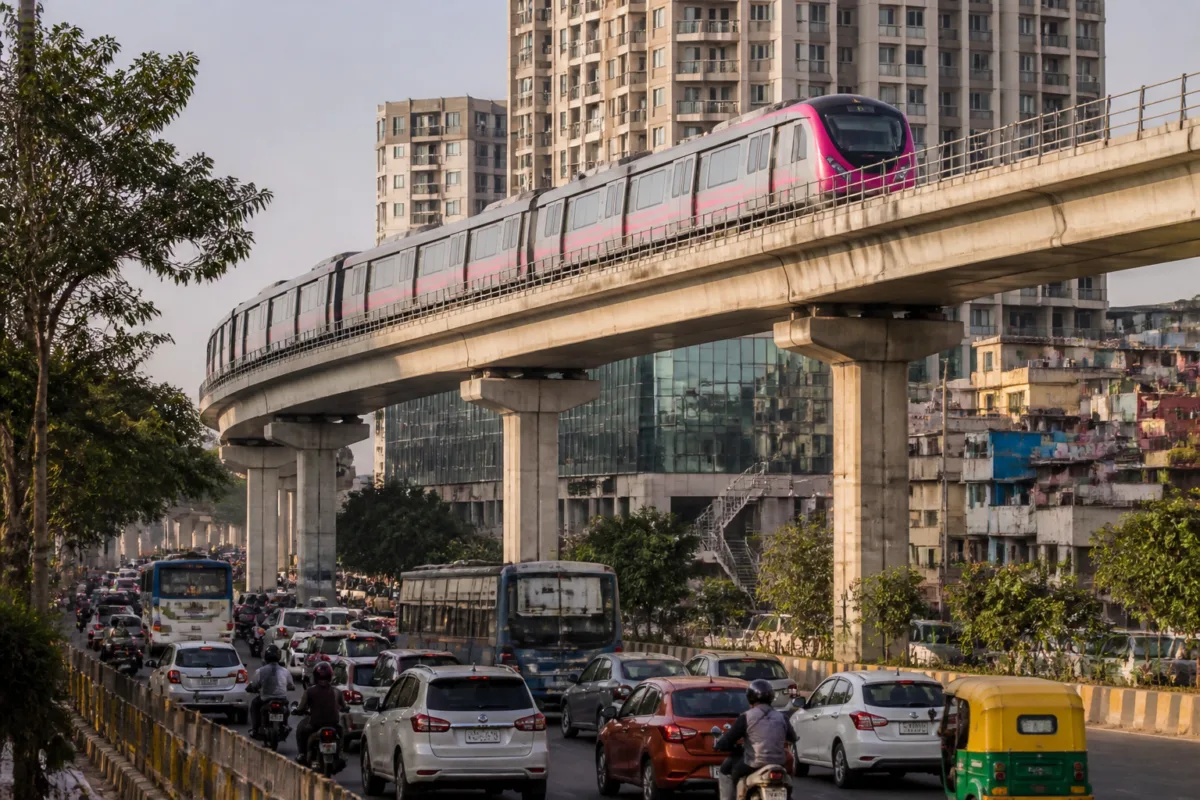
Bengaluru’s newly inaugurated elevated Pink Line stretch is offering commuters a nine-minute ride over Bannerghatta Road, replacing journeys marked by potholes, traffic congestion and difficult junctions, according to a Deccan Herald review of the route.
The metro journey began at SG Palya station, formerly known as Tavarekere, and passed over a corridor that has long struggled with uneven road widths, crater-like potholes and heavy traffic. The report described the air-conditioned train ride as a sharp contrast to travelling by scooter or BMTC bus along the same stretch.
The route passes through a rapidly changing urban landscape, with technology offices, high-rise apartment buildings, places of worship and low-income neighbourhoods located close to one another. The elevated alignment provides a continuous view of this mix as the train moves above Bannerghatta Road.
The report also highlighted passenger navigation challenges at Jayadeva Hospital, Bengaluru’s third interchange metro station. Passengers transferring between the Yellow Line and the Pink Line will have to move between different platform levels. Yellow Line users switching between platforms 1 and 2 will need to ascend to the Pink Line level, where platforms 3 and 4 are located.
Jayadeva Hospital station has 12 entrances, marked A to L. Entering through the wrong access point could require passengers to return to the concourse or climb to the Pink Line platforms before descending again, depending on their destination. A security officer cited in the report compared the possible confusion to the experience at Majestic station and advised passengers to use the correct entrance and platform.
The interchange design is significant because the Pink Line is not only a corridor serving Bannerghatta Road. It is also being integrated into Bengaluru’s wider metro network, making station-level wayfinding an important part of the commuter experience. A fast train journey can still become difficult if passengers lose time navigating entrances, concourses and platform changes.
The larger benefit of the corridor is expected when the 13.75-km underground section of the Pink Line opens. The report said the section is expected to open in March, although the supplied account did not provide a confirmed opening date. Once operational, the completed line is expected to connect the elevated section with the underground stretch and improve access towards central Bengaluru.
For commuters who currently travel by road, the time difference could be substantial. The report noted that a scooter journey to MG Road had taken more than half an hour, while the metro journey could take about 10 minutes. BMTC passengers on the corridor have also faced overcrowded buses and delays at congested junctions.
The Pink Line trains use automated acceleration and braking and are equipped with Alstom’s communications-based train control signalling system. The report said the trains will operate at Grade of Automation 2, indicating a system in which train operations are assisted by automation while staff remain involved in operating and supervising services.
The immediate test for the elevated stretch will therefore involve both speed and usability: whether it can provide a reliable alternative to Bannerghatta Road traffic, and whether passengers can move through Jayadeva Hospital station without the confusion created by its multiple entrances and platform levels. The next major milestone identified in the report is the opening of the 13.75-km underground section, expected in March.

