


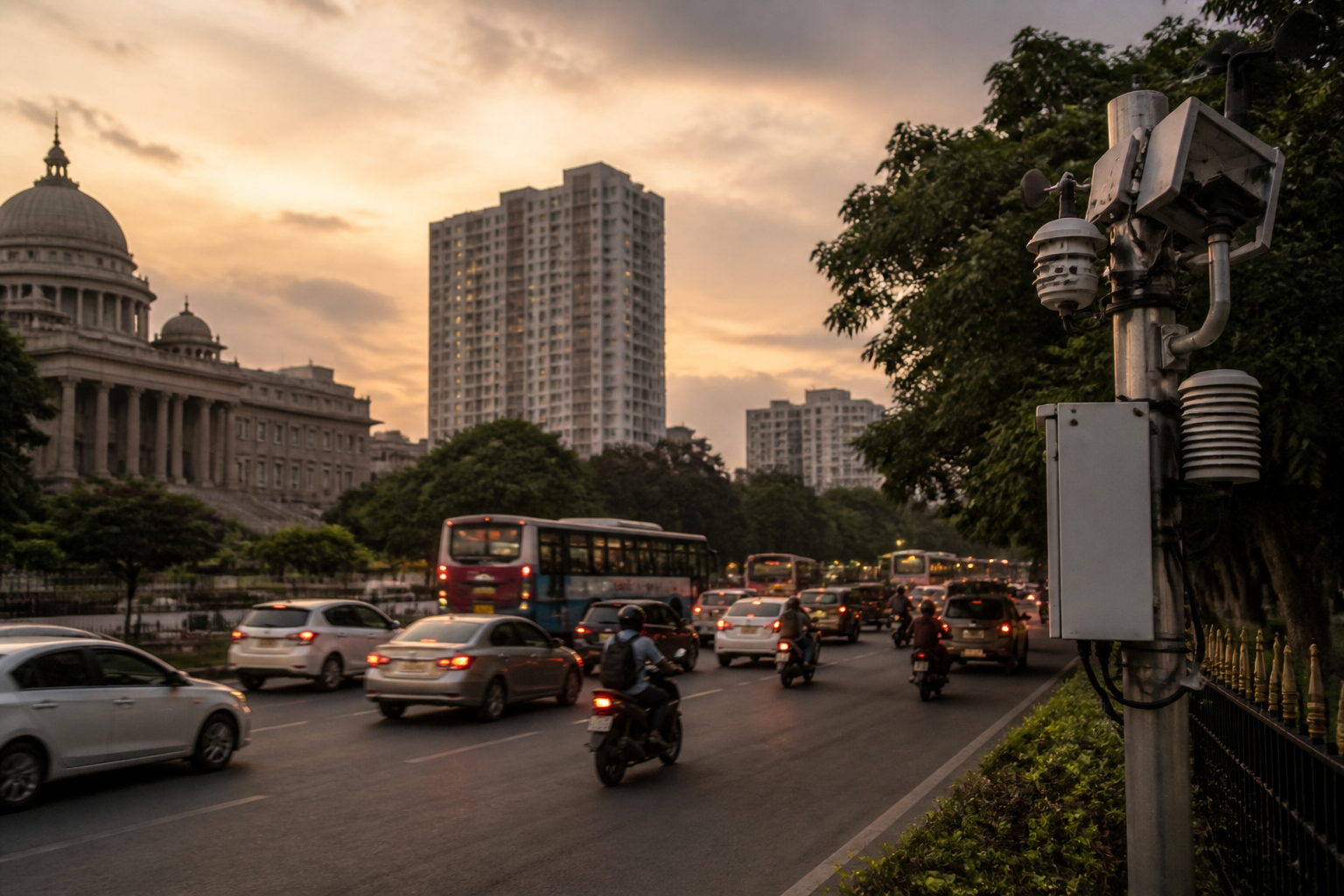
Bengaluru’s noise levels appear to have declined at several monitored locations since 2018, according to recent Karnataka State Pollution Control Board data. Yet the same readings show that noise remains above permissible limits in multiple parts of the city, particularly at night. The more important question is whether the data captures Bengaluru as it exists today—or only the parts of the city where monitoring stations were established years ago.
The figures present a mixed picture. Near NIMHANS, the average noise level was 14.2% above the permissible limit during the day and 45% above it at night. Around RVCE on Mysore Road, the exceedance was 24.4% during the day and 55.3% at night. Residential areas also remained above the prescribed levels: Domlur recorded readings 16.9% higher than the daytime limit and 30.7% higher at night, while BTM Layout exceeded the limits by 17.6% during the day and 34.9% at night.
Compared with the same period in 2018, the latest readings are lower at several of these locations. The monitoring station near NIMHANS had recorded noise levels more than 38% above the permissible daytime limit and nearly 62% above it at night. In Domlur, the levels were around 20% higher during the day and 36% higher at night. BTM Layout had exceeded the daytime limit by 23% and the nighttime limit by nearly 50%.
Taken together, the comparison suggests an improvement in the readings recorded at these stations. It does not, however, establish that Bengaluru as a whole has become significantly quieter. The distinction matters because a city’s noise profile depends heavily on where sound is measured, how traffic moves around the monitoring point and whether newer sources of urban activity are included in the measurement network.
Anti-noise pollution campaigners cited in the report argue that the decline may be too marginal to support a broad conclusion. They also question whether the number and locations of monitoring stations have kept pace with Bengaluru’s expansion. Traffic patterns have changed considerably, while the locations of the monitoring stations have reportedly remained unchanged. If the city has grown around a fixed network, the resulting data may describe a limited set of established points rather than the noisiest or fastest-changing areas.
That concern shifts the debate from the numbers alone to the design of the monitoring system. A reading is not simply a measurement of the city; it is a measurement of a particular place, at a particular time, through a particular monitoring arrangement. If the selected place no longer reflects surrounding activity, a lower reading can coexist with worsening conditions elsewhere.
Raja Kannan, a resident of Begur Kopa Road in Hulimavu and an anti-noise pollution campaigner, said newer areas should be monitored and the noisiest locations should be used as benchmarks. His argument points to a basic administrative challenge: a monitoring network designed for an earlier urban geography can become less representative as development spreads across the metropolitan region.
Prajna Dutt, founder of the citizen collective Noisewatchers and a resident of JP Nagar, questioned the continued use of locations that may no longer reflect their designated zones. She cited the monitoring station on Church Street, which is treated as being in a commercial area even though vehicular movement is banned there. She also questioned the location of the BTM Layout station, arguing that the city has expanded beyond what the current number and placement of stations can adequately represent.
The Church Street example illustrates how land-use labels and actual urban activity can diverge. A location may be classified as commercial, but restrictions on traffic or changes in street use can alter the sound environment that the station records. The reading may be accurate for that point while still being an incomplete indicator of noise in the wider commercial district.
The same problem can arise in residential areas. Domlur and BTM Layout both recorded noise above permissible limits, especially at night, but the available data does not show whether these locations are representative of other residential neighbourhoods. Nor does it establish how conditions compare across newer layouts, peripheral growth areas, major construction zones or roads where traffic volumes and vehicle types may differ.
The evidence supplied in the report therefore supports two conclusions at once. First, the monitored readings at several locations are lower than they were in 2018. Second, excess noise remains a persistent condition at those same locations, with nighttime exceedances particularly pronounced. A reduction from an earlier level does not necessarily mean that the present level is compliant or that the broader city has experienced a comparable decline.
The nighttime figures are especially significant because they show the greatest departures from the permissible limits at all four locations described. NIMHANS recorded a 45% excess at night, RVCE 55.3%, Domlur 30.7% and BTM Layout 34.9%. The pattern is consistent across institutional, road-side and residential settings: noise remains a problem after daytime activity declines, even though the material does not identify the exact contribution of each source at each location.
Experts quoted in the report identify vehicular noise, including the use of shrill horns, as the biggest contributor. Infrastructure projects are also described as contributors to higher noise pollution. This places transport regulation at the centre of the policy discussion. The issue is not limited to construction schedules or isolated events; it also concerns everyday movement through the city and the enforcement of rules governing vehicle noise and unnecessary honking.
Dutt said authorities should reduce and standardise decibel levels across vehicles and called for a stricter policy to penalise unnecessary honking. These proposals are presented in the context of the report’s broader concern that Bengaluru’s noise problem cannot be assessed only through a small, unchanged set of stations. Measurement and enforcement are connected: weak coverage can make it harder to identify problem areas, while unclear standards or limited enforcement can allow known sources to persist.
The institutional responsibility rests substantially with the KSPCB, whose data forms the basis for the comparison. But the report also raises questions involving transport authorities, traffic enforcement agencies, urban planners and local administrations. Noise is produced through multiple urban systems, so a single agency’s measurements may not be sufficient to explain or manage the pattern. The supplied material does not establish whether the authorities have approved new stations, revised the network or adopted the proposed vehicle-noise measures.
That absence is important. The current data can show what the existing stations recorded, but it cannot by itself resolve whether the citywide trend is downward. To establish that more firmly, Bengaluru would need monitoring that reflects its current urban form and changing traffic patterns. The report does not provide a new station count, a citywide map of coverage or readings from newer growth corridors, so the scale of any broader improvement remains uncertain.
Bengaluru’s noise data thus reveals less a simple success story than a measurement problem layered over a continuing compliance problem. Several monitored sites are quieter than they were in 2018, but they remain above permissible limits, most sharply at night. At the same time, campaigners argue that unchanged monitoring locations may understate conditions in a city that has expanded rapidly.
The next step for the authorities is not established in the supplied material. The issues requiring attention are clear: whether monitoring stations remain representative, whether newer and noisier areas are included, and how vehicle noise and unnecessary honking are regulated. Until those questions are addressed, the available evidence can confirm lower readings at selected locations—but not conclusively that Bengaluru itself has become quieter.
