


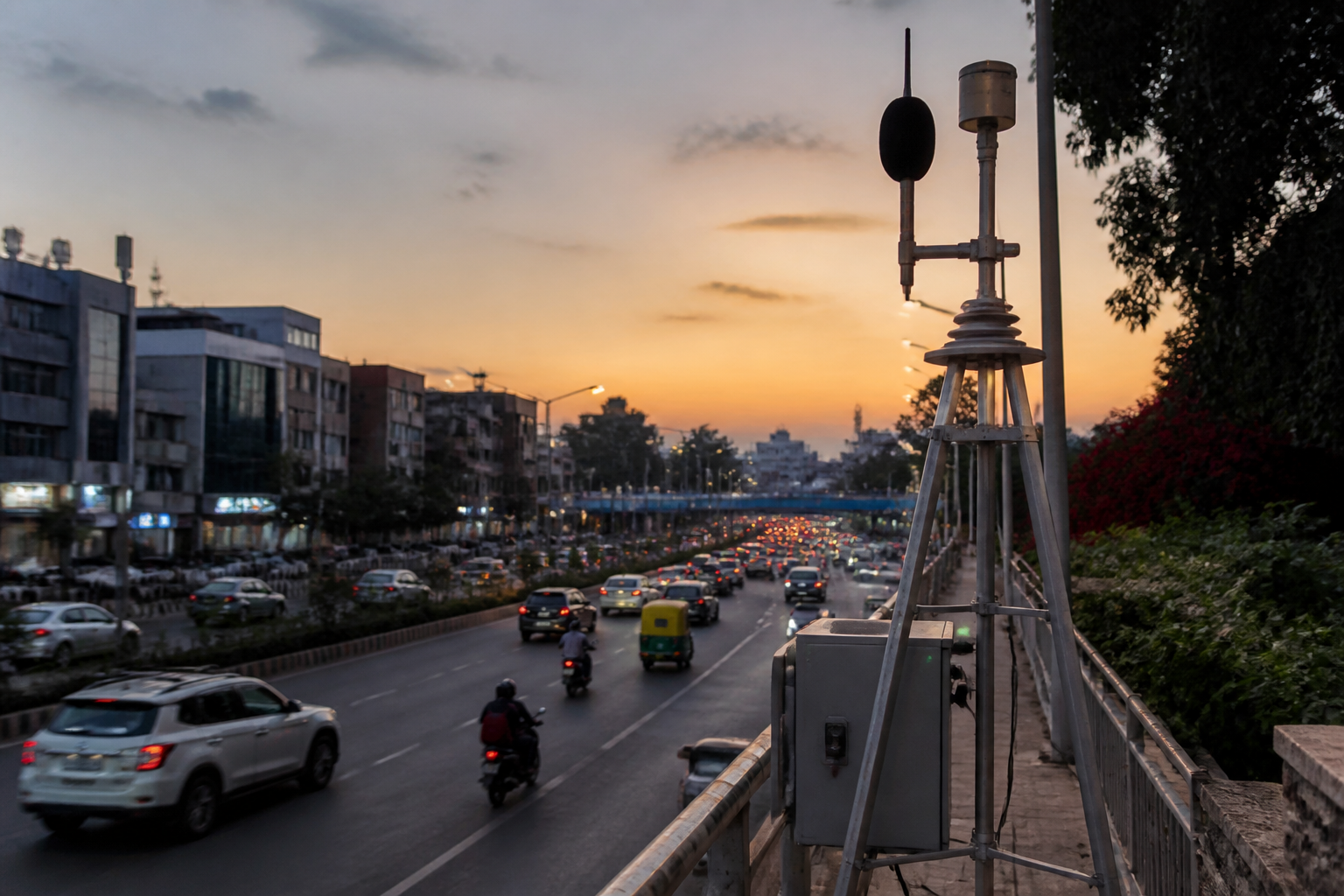
Subheadline: KSPCB readings are lower at several monitored locations than in 2018, yet persistent exceedances and unchanged monitoring sites complicate the claim that Bengaluru has become significantly quieter.
Standfirst: Bengaluru’s latest noise readings appear to offer a modest improvement over the city’s pre-COVID levels. Data from the Karnataka State Pollution Control Board shows lower average noise levels at several monitored locations, including NIMHANS, Domlur and BTM Layout. But the same readings remain above permissible limits, particularly at night. Campaigners also question whether the monitoring network still represents a city whose traffic patterns and built-up areas have changed considerably. The evidence therefore points to two conclusions at once: noise levels at selected stations have fallen compared with 2018, but the data does not establish that Bengaluru’s broader noise problem has been solved. This analysis examines what the available figures show, where their limits lie and why the location of monitoring stations matters to the way an expanding city understands environmental stress.
The first fact in Bengaluru’s latest noise debate is relatively straightforward. Recent monthly data cited from the Karnataka State Pollution Control Board shows lower noise readings at several locations than those recorded in 2018. At the monitoring station near NIMHANS, the average level was reported to be 14.2% above the permissible daytime limit and 45% above the nighttime limit. Near RVCE on Mysore Road, the excess was 24.4% during the day and 55.3% at night. In Domlur, the readings were 16.9% above the daytime limit and 30.7% above the nighttime limit. BTM Layout recorded an excess of 17.6% during the day and 34.9% at night.
Compared with the figures cited for 2018, the direction of change is downward at some of these stations. Near NIMHANS, the monthly average was more than 38% above the permissible limit during the day and nearly 62% above it at night in 2018. Domlur was around 20% above the daytime limit and 36% above the nighttime limit, while BTM Layout was 23% above the daytime limit and nearly 50% above the nighttime limit. On the face of it, the comparison suggests an improvement. The scale of that improvement, however, differs by location and does not remove the underlying exceedance.
That distinction is important. A fall in the amount by which a reading exceeds the permissible limit is not the same as compliance with the limit. At every location for which the recent figures are cited, the reported readings remain above the permitted level. The gap is particularly pronounced during the night: 45% near NIMHANS, 55.3% near RVCE, 30.7% in Domlur and 34.9% in BTM Layout. The available material does not establish that Bengaluru has become quiet in an absolute sense. It shows that some monitored locations are less noisy than they were in the comparison year, while still recording excessive noise.
The nighttime pattern is also central to understanding the issue. Across all four locations, the excess over the permissible limit is greater at night than during the day. That pattern is visible in both the recent data and the 2018 comparison. The figures do not identify a single cause for this difference, and the supplied material does not provide hourly readings, traffic counts or a location-by-location breakdown of activity. But they do show that the city’s noise burden cannot be assessed only through daytime averages. A monitoring approach that reports overall reductions without foregrounding nighttime exceedances would leave out the period in which the reported gap is widest.
The more difficult question is whether the selected monitoring stations still describe Bengaluru’s urban reality. Anti-noise-pollution campaigners cited in the report argue that the number and locations of stations have remained unchanged even as traffic patterns have shifted and the city has expanded. Their objection is not that the KSPCB figures do not exist, but that a fixed network may produce a partial picture. If activity moves, new growth areas emerge or formerly busy places change function, readings from older locations may no longer represent the noisiest or fastest-changing parts of the city.
The examples offered by campaigners illustrate the problem. Raja Kannan, a resident of Begur Kopa Road in Hulimavu and an anti-noise-pollution campaigner, said newer areas should be monitored and the noisiest locations used as benchmarks. Prajna Dutt, founder of the citizen collective Noisewatchers, questioned the location of existing stations. She pointed to Church Street, which is treated as a commercial-zone station even though vehicular movement is banned there, and to the BTM Layout station, which she said could also produce misleading readings. Her broader argument was that the city had grown substantially and that the existing number and location of stations required reconsideration.
These criticisms create a measurement problem rather than automatically disproving the KSPCB trend. The reported data can support a comparison between readings at the same stations in different periods. It cannot, by itself, show whether the monitored network captures all major noise sources across the wider city. Nor does the supplied material establish how many stations operate in total, how frequently they are relocated, whether the stations measure the same kinds of urban activity or whether newer neighbourhoods have been added to the network. Those unanswered questions limit the conclusions that can safely be drawn from the comparison.
The distinction between station-level change and citywide change is especially relevant in a growing metropolitan area. A citywide claim requires confidence that the sample of locations reflects the geography and activity of the city. When monitoring sites remain unchanged while traffic patterns and development change, the meaning of an average can become less certain. A lower reading at a particular station may reflect quieter conditions around that station, a change in nearby activity or a broader reduction. The available report does not provide enough evidence to separate those possibilities. It therefore supports a cautious finding: selected locations are recording lower excesses than in 2018, but the network’s representativeness remains contested.
The reported sources also identify transport and construction as important parts of the noise picture. Experts cited in the report say that infrastructure development projects contribute to higher noise pollution, while vehicular noise, including the use of shrill horns, remains the biggest contributor. Prajna Dutt called for a stricter policy against unnecessary honking and said authorities should reduce and standardise decibel levels across vehicles. These statements identify areas of concern and proposed policy attention, but the supplied material does not quantify the contribution of traffic, construction or honking separately. It would therefore be premature to assign the observed changes to any one intervention or source.
This is where the policy landscape becomes inseparable from the data. Noise monitoring is not only a technical exercise; it determines which parts of a city become visible to regulators. The KSPCB figures provide a basis for comparing conditions at specific stations. The campaigners’ concerns raise the administrative question of whether those stations remain appropriate for enforcement and planning. If the objective is to understand exposure across an expanding city, the locations selected for measurement need to reflect current land use, traffic movement and areas where residents experience persistent noise. The supplied material does not say that the KSPCB has announced a change in its network, nor does it record a formal response to the campaigners’ requests.
The figures also show why a single headline about Bengaluru becoming quieter would be incomplete. At NIMHANS, the reported nighttime excess fell from nearly 62% above the permissible limit in 2018 to 45% in the recent data. At BTM Layout, it fell from nearly 50% to 34.9%. In Domlur, the nighttime excess moved from around 36% to 30.7%. These are reductions in the reported margin above the limit, but they leave conditions outside the permitted level. The RVCE reading, meanwhile, records a nighttime excess of 55.3% in the recent data, the highest among the four locations cited.
There is also no evidence in the supplied material to determine whether the change has been consistent month after month, whether it applies across the entire city or whether it is linked to a specific period. The comparison is between recent monthly readings and figures from around the same period in 2018, but the exact recent months are not stated. Nor are raw decibel values provided. Percentages above the permissible limit make the relative position clear, but they do not allow readers to assess the absolute sound levels or compare the readings with locations not included in the report.
The larger urban question is therefore not simply whether Bengaluru is louder or quieter than before. It is how a city measures an environmental condition that changes with roads, land use, construction, traffic and public behaviour. The KSPCB data indicates that readings at several established stations have improved relative to 2018. The continuing exceedances show that improvement is incomplete, while the campaigners’ objections suggest that the monitoring frame may not have kept pace with the city’s expansion.
What the evidence confirms is limited but significant: noise remains above permissible levels at the reported locations, especially at night, even though the excess has declined from 2018 at several stations. What remains uncertain is whether the same pattern holds across newer and noisier parts of Bengaluru. The developments to monitor are whether the monitoring network is expanded or relocated, whether authorities respond to concerns about station placement and whether measures targeting unnecessary honking and vehicle noise produce verifiable changes in future readings.
