


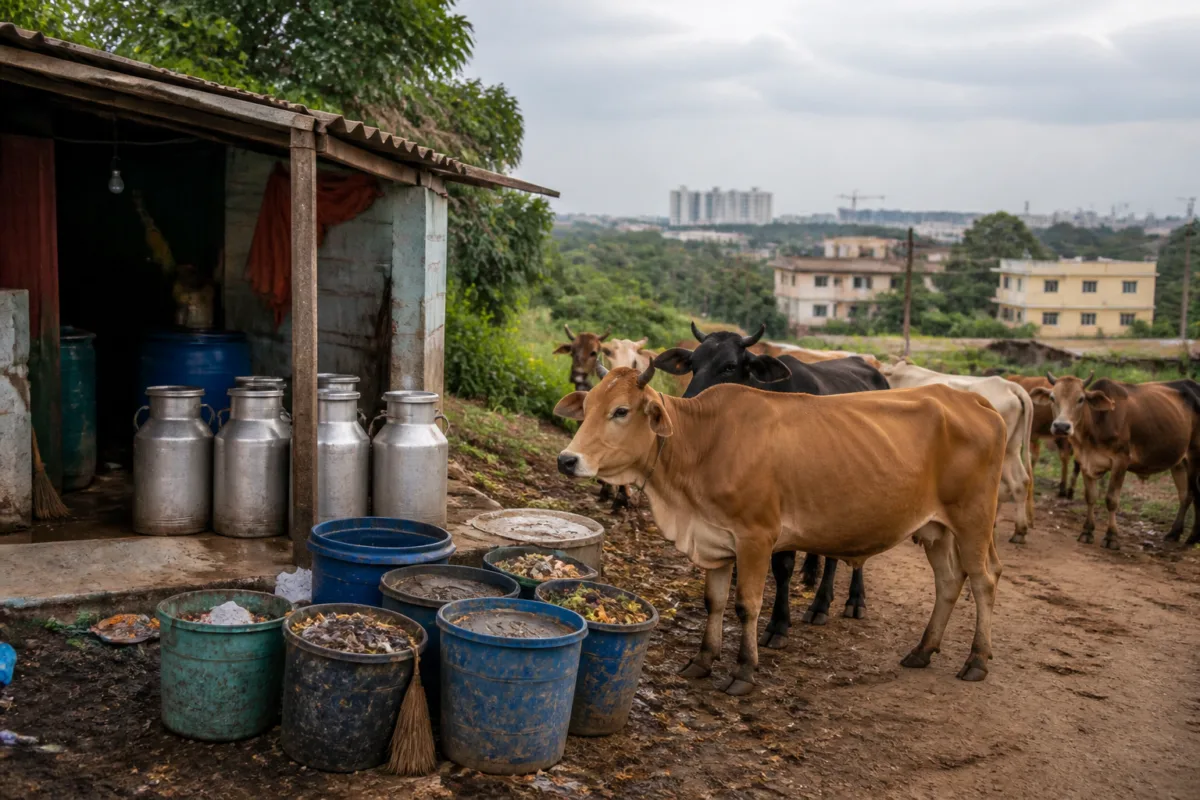
Bengaluru milk safety concerns have emerged in villages around Yelahanka after residents and dairy representatives alleged that some cattle owners are feeding cows rotten hotel food, meat waste and bones collected from restaurants in exchange for lower-cost feed.
The reported practice has been identified in Linganahalli, Kolurayanahalli, Shettikempanahalli, Kakolu and surrounding villages in the Hesaraghatta hobli, where hotel waste is allegedly being supplied to cattle across more than 20 villages. Residents have raised concerns that milk produced by cows receiving such waste is being sent to local primary milk producers’ cooperative societies.
The claims were reported by Vijay Karnataka. The report said leftover rice, sambar, meat waste and bones are transported from hotels in Bengaluru and sold to villagers at between Rs 100 and Rs 200 per drum. Some cattle owners are reportedly using the material instead of, or alongside, fresh grass, which the report said can cost between Rs 300 and Rs 400 per bundle.
The practice is allegedly driven by the effort to reduce cattle-feed expenses while maintaining milk production. However, the report did not cite laboratory findings establishing that the milk is contaminated or unsafe. Bengaluru Cooperative Milk Union Deputy Manager Prasanna V. P. said the union had already issued a notice to a milk producers’ society that was collecting such milk, but added that no milk had yet been sent for testing.
“Whenever a complaint is made, we will take immediate action. We have already issued a notice to the society collecting such milk. We have not subjected any milk to testing,” Prasanna was quoted as saying.
Manjunath, president of the Kolurayanahalli Milk Producers’ Cooperative Society, said the issue had continued for about a year. He said complaints had been made seeking inspection and strict action, but that if one society stopped accepting the milk, producers could divert it to a neighbouring society.
The report said cooperative officials had warned milk producers not to feed cattle with waste food and had instructed societies not to accept milk linked to the practice. It also reported that some producers continued to supply milk elsewhere after facing restrictions from one collection point.
The issue has also been linked to changing waste patterns around Rajanukunte, where the growth of meat shops and paying-guest accommodation has increased the amount of food and meat waste generated, according to the report. The waste is allegedly being moved from urban establishments to nearby rural settlements rather than being handled through formal waste-management channels.
Farmer Narayanappa called for field officers to inspect all dairies in the area, collect milk samples and send them to laboratories for testing. He also sought action by the Food Safety Department and the police against those allegedly feeding hotel waste to cattle.
The immediate institutional question is whether the affected milk collection societies will conduct systematic testing and traceability checks. The Bengaluru Cooperative Milk Union’s stated next step is action on complaints and the monitoring of the society that received the notice. Until laboratory results are available, the safety of the milk remains an allegation requiring formal verification rather than an established finding.

