


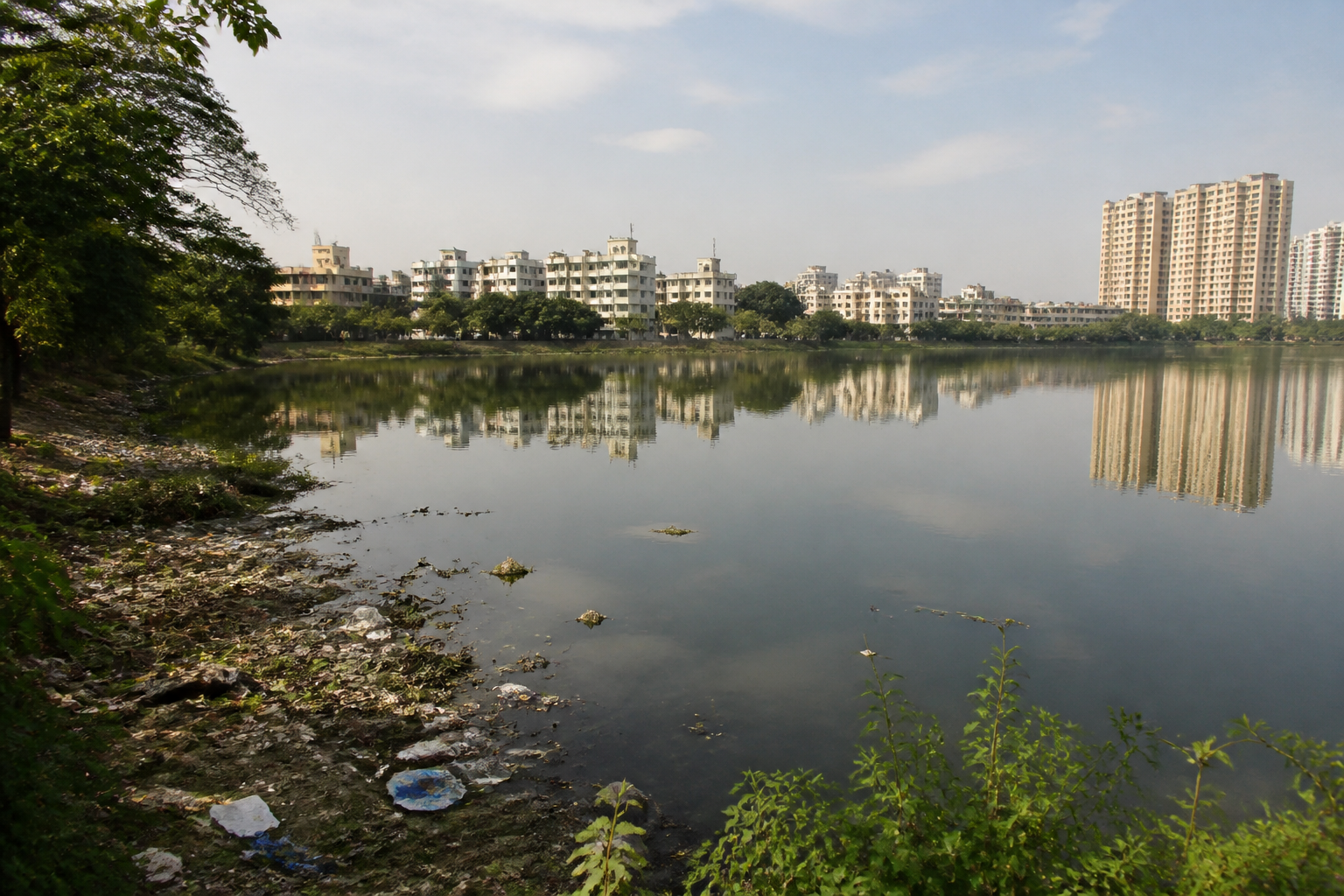
A study of three lakes in north Bengaluru has brought into focus a problem that extends beyond the condition of individual water bodies: the city’s expanding urban edge is generating wastewater and solid waste faster than local systems can contain them. Researchers from Bangalore University found signs of pollution and ecological stress in Dasarahalli, Madavara and Chikkabanavara lakes, with the severity and character of contamination differing across the three sites.
The study examined the lakes during April and May 2026 and assessed pH, turbidity, electrical conductivity, total dissolved solids, hardness, nutrients, dissolved oxygen, biochemical oxygen demand and chemical oxygen demand. The findings did not show that every tested parameter had crossed permissible limits. pH, electrical conductivity, chloride, fluoride and nitrate were reported to be within permissible limits. But elevated total dissolved solids, turbidity, hardness, phosphate, biochemical oxygen demand and chemical oxygen demand at some locations indicated deteriorating water quality.
That distinction is important. Urban lake pollution is not a single condition that can be captured by one measure. Different indicators point to different pressures. Nutrient enrichment can encourage ecological imbalance, while high biochemical and chemical oxygen demand indicates a greater load of organic material requiring oxygen-consuming decomposition. Turbidity and elevated dissolved solids can reflect suspended material, waste inflow and changes in the composition of water. The study’s results suggest that the three lakes are not experiencing an identical crisis, but are being affected by a shared urban system.
Madavara Lake recorded the highest nutrient overload among the three, including phosphate, sulphate and nitrate, as well as the highest chemical oxygen demand. Researchers associated those findings with severe organic pollution. Dasarahalli Lake recorded the highest electrical conductivity, total dissolved solids, hardness, turbidity, chloride, fluoride, sodium and biochemical oxygen demand. The researchers said this pattern indicated a high inflow of domestic sewage.
Chikkabanavara Lake showed relatively better water quality than the other two lakes. That, however, did not place it outside the zone of concern. The study identified encroachment and waste accumulation as continuing problems there. A lake with comparatively better water quality can still be vulnerable if the land around it is being occupied or if waste is allowed to collect within and around the water body.
The larger issue is therefore not simply whether one lake currently performs better than another. It is whether the catchments feeding these lakes are being managed as parts of an interconnected urban drainage and ecological system. The researchers described much of north Bengaluru as peri-urban, with some areas undergoing rapid urbanisation. They also pointed to a lack of underground drainage in these areas, allowing a large share of generated waste to enter nearby water bodies.
Dr Raghavendra M of Bangalore University’s Department of Environmental Science said the three lakes were selected because outlet water from them joins the Arkavathi River, which eventually reaches Tippagondanahalli Reservoir. The reservoir is a source of drinking water for some parts of Bengaluru. This connection changes the meaning of the findings. Pollution entering an urban lake is not necessarily contained within that lake. It can move downstream through the river system, linking neighbourhood-level waste management to a wider drinking-water and watershed question.
The study does not establish the precise quantity of pollutants entering each lake or assign responsibility to a particular agency, settlement or facility. It also does not provide a complete time series showing how each parameter has changed over several years. What it does provide is a location-specific snapshot of multiple pollution indicators and an explanation of the urban pressures researchers believe are driving them. The absence of a fully documented long-term dataset in the supplied material means the scale and rate of deterioration cannot be quantified here. The evidence does, however, identify the nature of the risk.
The contrast between Madavara and Dasarahalli illustrates why lake restoration cannot rely on a standard intervention applied uniformly across a city. Madavara’s reported problem is associated particularly with nutrient overload and high chemical oxygen demand. Dasarahalli’s results point more strongly towards domestic sewage inflow, reflected in its elevated biochemical oxygen demand and other indicators. Chikkabanavara’s relative advantage is offset by encroachment and accumulated waste. Each lake requires monitoring that can identify the dominant source of stress rather than merely measuring whether the water appears cleaner after a one-time removal operation.
This is where the study’s emphasis on source-level control becomes significant. Treating pollution after it has reached a lake addresses the visible endpoint of the problem. It does not prevent wastewater, nutrients or solid waste from entering drains and channels in the first place. Researchers warned that measures taken only after pollution reaches the lakes would be temporary. Their proposed responses include strengthening sewage treatment, preventing direct discharge of wastewater, controlling encroachment, removing solid waste and invasive weeds, conducting regular water-quality monitoring and involving local communities.
These measures also reveal the institutional complexity of urban lake protection. A lake is visible, but its pollution may originate across a broader catchment. Sewage management depends on drainage networks and treatment capacity. Solid-waste control depends on collection, transport and enforcement against dumping. Encroachment control depends on land records, planning authority and sustained action. Water-quality monitoring requires regular sampling and the ability to respond when results show deterioration. Community participation can support surveillance and maintenance, but it cannot substitute for missing public infrastructure.
The north Bengaluru case illustrates the difficulty of managing peri-urban growth. Areas at the city’s edge can urbanise before underground drainage, sewage treatment and waste-management systems are extended. As houses, institutions, roads and other built uses expand, natural drainage routes and lake catchments come under pressure. Wastewater may then enter water bodies through informal or inadequately managed channels. The researchers’ account links that infrastructure gap directly to lake pollution rather than treating ecological decline as an isolated environmental event.
The downstream connection to the Arkavathi River and Tippagondanahalli Reservoir adds another layer to the policy question. Protecting a drinking-water source cannot depend only on action at the reservoir or at the final point of abstraction. It also requires attention to upstream lakes, tributaries and drainage channels. The supplied study does not quantify how much pollution from these three lakes reaches the reservoir, nor does it measure the resulting effect on drinking-water treatment or public health. Those unanswered questions require further investigation. The connection nevertheless demonstrates why urban water management cannot be divided neatly between lake restoration and river protection.
The findings also complicate the idea that water-quality compliance is binary. Several parameters were within permissible limits, while others were elevated at some locations. A lake can therefore remain below a threshold for certain measures and still show substantial ecological stress through a combination of turbidity, nutrient enrichment, organic pollution and waste accumulation. Monitoring systems that report only isolated readings may miss the cumulative effect of these pressures. Regular assessment across locations and seasons is necessary to identify whether interventions are reducing pollution or merely shifting it.
The study period—April and May 2026—offers a defined assessment window, but the material does not provide comparable readings from other seasons. That matters because urban lake conditions can vary with rainfall, runoff and changing inflows. The researchers also referred to climate change as one of the pressures affecting Bengaluru’s urban and semi-urban lakes, but the supplied findings do not separate climate-related effects from sewage, solid waste, nutrient enrichment or encroachment. A stronger long-term assessment would need repeated monitoring that distinguishes among these drivers.
What the evidence confirms is that the three lakes are receiving different forms of stress within a common landscape of rapid urbanisation and inadequate waste-management infrastructure. Madavara shows the strongest reported nutrient and chemical oxygen demand concerns. Dasarahalli shows indicators associated with domestic sewage inflow. Chikkabanavara, although relatively better in water quality, remains exposed to encroachment and waste accumulation. Together, the findings show that comparative improvement at one lake does not remove the need for catchment-wide protection.
The larger urban question is whether Bengaluru’s infrastructure is being extended in step with its growth. If drainage and sewage systems lag behind development, lakes become receiving points for the consequences. If monitoring occurs only periodically or after visible deterioration, authorities may respond to symptoms rather than sources. And if encroachment and waste accumulation are treated as maintenance problems alone, the land-use and governance conditions producing them remain unaddressed.
The next stage of scrutiny should focus on the actions that follow the study: whether source-level sewage controls are established, whether direct wastewater discharge is prevented, whether lake boundaries and encroachments are enforced against, and whether regular water-quality data are made available. The supplied material does not establish that these measures have been implemented. It establishes why they are necessary. For Bengaluru’s lakes, the difference between restoration and repeated decline will depend less on one clean-up exercise than on whether the urban systems feeding them are finally brought under sustained control.
