


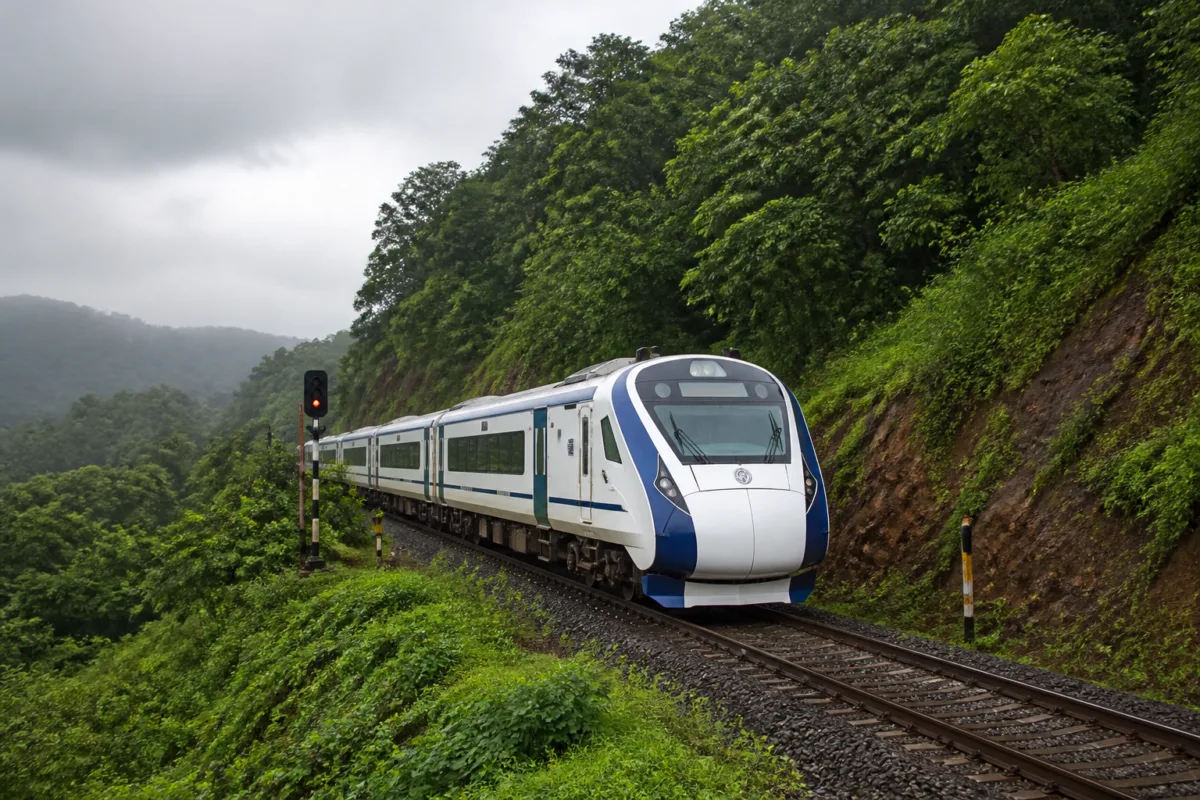
The upcoming Bengaluru–Goa Vande Bharat service is expected to become India’s slowest Vande Bharat chair-car train, with an average speed of about 53–54 kmph because much of the railway route between Mangaluru Junction and Madgaon remains single-track, Vijay Karnataka reported.
The service will run between Yeshwantpur in Bengaluru and Madgaon in Goa. The journey from Yeshwantpur to Madgaon is expected to take around 12 hours and 20 minutes, while the return trip is scheduled to take approximately 12 hours and 55 minutes.
The travel time will make the premium train substantially slower than several other Vande Bharat services operating in the country. The Varanasi–Delhi Vande Bharat, currently reported as the fastest, covers 759 km at an average speed of about 95 kmph and completes the journey in roughly eight hours.
Other services cited in the report include the Chennai Egmore–Nagercoil route, which operates at an average speed of about 82 kmph, the Secunderabad–Visakhapatnam service at around 79 kmph and the Chennai Central–Narsapur service at approximately 76 kmph.
The main constraint on the Bengaluru–Goa route is the condition and configuration of the railway infrastructure. A significant portion of the line between Mangaluru Junction and Madgaon is single-track. On such sections, trains travelling in opposite directions must wait at designated locations before continuing, creating operational delays and reducing average speeds.
The report also states that railway authorities permit trains to operate at a maximum speed of only about 30 kmph on parts of these tracks. Although Vande Bharat trains are designed to reduce long-distance travel time, their performance depends on the infrastructure over which they operate, including track capacity, permitted speeds and the ability to avoid opposing traffic.
As a result, the Bengaluru–Madgaon service is expected to operate at a speed comparable to, or only marginally higher than, conventional mail and express trains. The report notes that ordinary mail and express services generally average between 50 kmph and 54 kmph on the network, while trains averaging more than 55 kmph are classified as superfast services.
The route’s operating profile highlights the difference between introducing a faster train and upgrading the railway corridor itself. The service is scheduled to begin soon, but the report does not provide a separate timeline for doubling or substantially upgrading the single-track sections between Mangaluru Junction and Madgaon.

