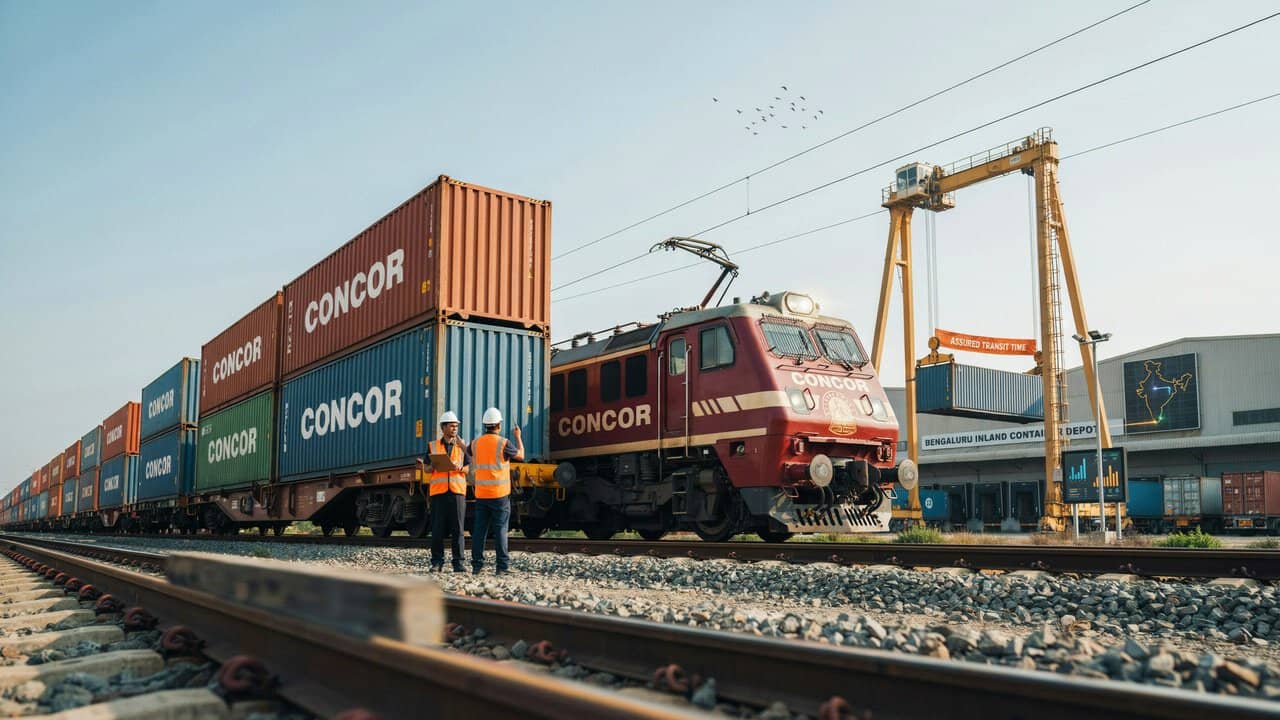
Bengaluru has gained a more predictable rail freight link with North India after a new weekly container train service connecting Whitefield with Tughlakabad in Delhi was launched. The service offers an assured 166-hour transit window for the roughly 2,500-km journey, giving manufacturers and logistics operators greater certainty over deliveries and supply-chain planning.
The service, operated by the Container Corporation of India in collaboration with Indian Railways, originates from the Inland Container Depot at Whitefield every Saturday. Containers travel through CONCOR’s terminal at Tondiarpet in Chennai before continuing towards Tughlakabad, creating a scheduled rail connection between southern production centres and the Delhi-NCR market. The importance of the Bengaluru Delhi container train lies in its emphasis on predictability rather than simply speed. For manufacturers, uncertain transit times can force companies to hold additional inventory, complicate production schedules and make delivery commitments harder to manage. A fixed service window allows businesses to plan shipments and warehouse requirements with greater confidence. The corridor could serve a wide industrial catchment around Bengaluru. Manufacturing and logistics clusters across Whitefield, Hoskote, Malur, Tumakuru, Bommasandra, Electronic City, Jigani, Anekal, Devanahalli, Peenya and other industrial areas can potentially use the rail network to reach markets in North India. The service also strengthens the case for shifting suitable long-distance freight from road to rail.
Rail can move large volumes over long distances with fewer individual vehicle movements, potentially reducing pressure on highways and lowering the logistics burden associated with long-haul trucking. However, the competitiveness of rail will depend on dependable schedules, terminal efficiency and effective first- and last-mile connections. The initiative comes as Bengaluru’s logistics economy continues to expand. The city’s airport has recently overtaken Mumbai as India’s second-largest domestic air-cargo hub, underlining the scale and diversity of its freight ecosystem. A stronger rail option gives businesses another mode for moving goods, allowing companies to select transport based on urgency, cost and cargo characteristics.The Bengaluru Delhi container train could become more significant as industrial activity spreads beyond the metropolitan core. Better rail freight connectivity can strengthen the relationship between Bengaluru and surrounding manufacturing clusters while improving access to large consumption markets in northern India. The next opportunity is to expand this model beyond Whitefield. A direct container terminal planned at Thimmarajanahalli in Tumakuru could eventually enable services between Tumakuru and Tughlakabad, creating a more direct rail-freight connection for one of Karnataka’s major industrial regions.
For Bengaluru, the new service represents more than another freight train. If reliability is maintained and terminal connectivity improves, predictable rail logistics could help diversify the city’s transport network, reduce dependence on long-distance road freight and strengthen its position as a major manufacturing and distribution hub.