


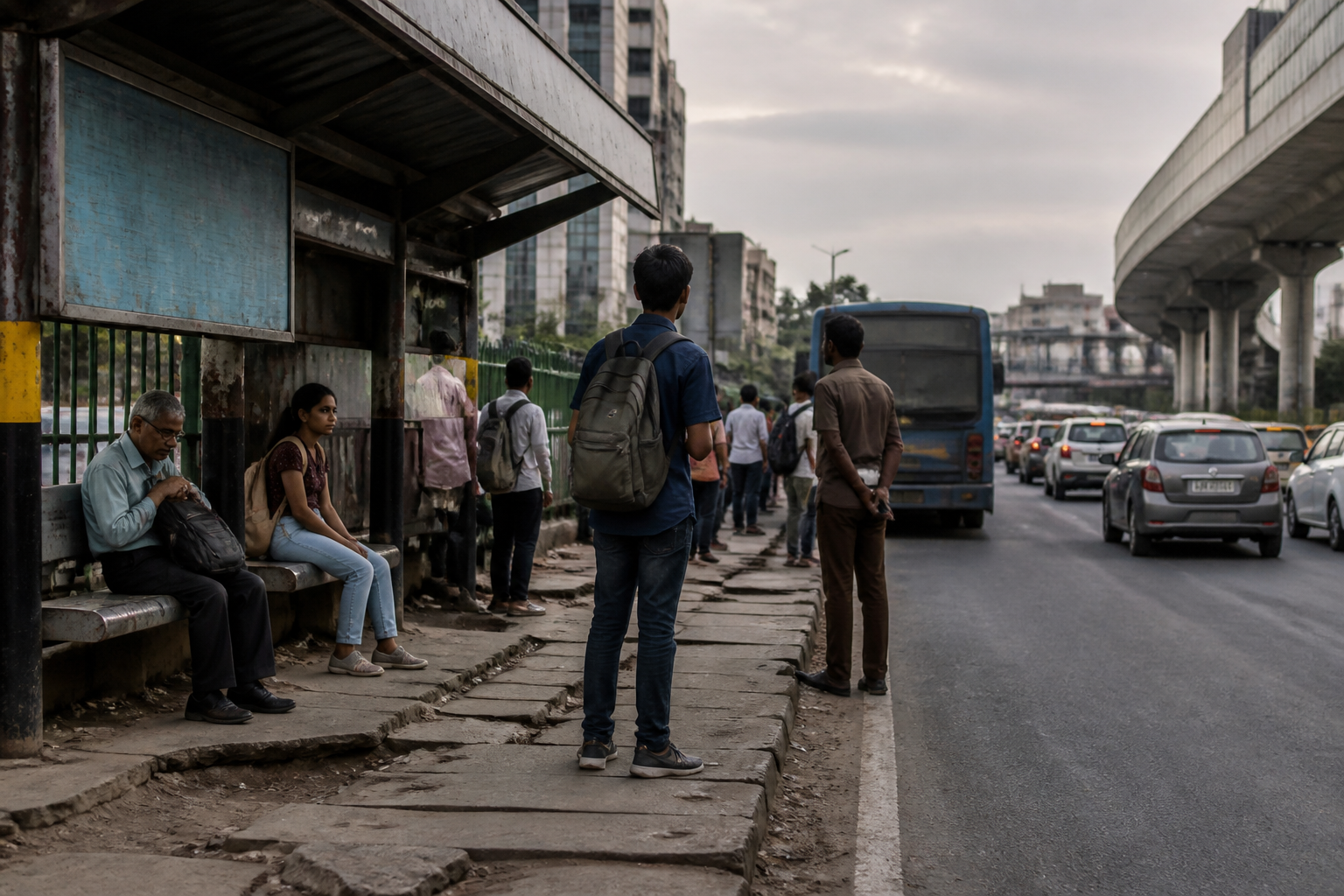
A bus journey on Bengaluru’s Hosur Road corridor is failing before commuters board the bus. An audit of 16 bus stops along the six-kilometre stretch from Shoolay Circle to Silk Board found damaged or poor-quality pavements at 88% of locations, inadequate signage at 94%, and major gaps in seating, passenger information, lighting, cleanliness and security. The findings show that the city’s public transport experience is shaped not only by buses and routes, but by the often-neglected space between the footpath and the vehicle.
The audit, conducted by the Bangalore Political Action Committee (B.PAC), examined accessibility, passenger comfort, passenger information, safety and security, and maintenance. Fourteen of the 16 locations had shelters, while two had none. But the presence of a shelter did not necessarily mean that commuters had a usable or safe waiting environment. Several stops had inadequate seating and waiting areas, poor pedestrian approaches, unclear boarding arrangements and deteriorating facilities.
The most significant pattern is the break between walking, waiting and boarding. Broken footpaths, high kerbs and uneven level transitions made it difficult to reach boarding points. Some stops appeared to function as informal stopping areas or serve private buses without clearly defined waiting spaces. This means that the bus stop cannot be treated as an isolated piece of street furniture. Its usefulness depends on whether a commuter can reach it safely, identify it, wait comfortably and board without negotiating obstacles.
Revathy Ashok, managing trustee and CEO of B.PAC, said the audit indicated that bus-stop infrastructure on one of Bengaluru’s busiest corridors remained fragmented and inconsistent, particularly at the pedestrian-bus interface. She said the audit found missing shelters, inadequate seating and waiting areas, poor pedestrian approaches and level transitions, limited route information and stop identification, little or no real-time estimated time of arrival information, inadequate lighting and CCTV, and gaps in cleanliness and maintenance.
The information deficit is especially visible. Only 31% of the audited stops provided route and timing information, while 44% had real-time ETA displays. A passenger may therefore reach a stop but still lack basic information about which services operate there or how long the wait may be. For a regular commuter, this creates friction in an already uncertain journey. For a new user, an older passenger or someone travelling at night, the absence of information can make the system harder to use altogether.
The audit also recorded weak maintenance outcomes. Only 13% of stops were found to be clean, and only 13% had waste bins. Information boards were reported to be deteriorating, while shelters and surrounding areas showed signs of poor upkeep. These are not merely cosmetic shortcomings. A dirty, poorly maintained or badly identified stop signals that waiting passengers are not being treated as part of the transport system’s design and operations.
Safety gaps add another layer to the problem. The audit identified inadequate lighting and CCTV at several locations. Ashok said that at B.MOBILE, the organisation saw first-mile pickups fall by around 30% after 7 pm at stops without lighting and information because people felt unsafe waiting. This figure is attributed to B.MOBILE’s experience and is not presented as a citywide measure, but it illustrates how conditions at a stop can influence whether people use public transport connections beyond the main bus ride.
The findings are consistent with a wider accessibility problem identified through B.MOBILE’s separate audit. According to the report, all 12 audited segments had footpath continuity issues, with more than 200 deficiencies recorded. Read together, the two audits describe a connected failure rather than two separate infrastructure defects. A person may encounter a broken or discontinuous footpath while approaching a stop, find a high kerb or uneven transition at the boarding point, and then wait in a shelter without reliable route information, lighting or cleanliness.
This sequence matters because public transport is experienced as a chain. A bus service can be frequent, but its practical value is reduced when passengers cannot reach the stop safely or do not know when the bus will arrive. The audit’s evidence places the bus stop within this larger chain of access. It also challenges the idea that providing a shelter alone amounts to providing public transport infrastructure.
The institutional issue emerging from the audit is fragmentation. Ashok said maintenance is divided among multiple agencies, leaving problems such as poor lighting, damaged footpaths, faded boards and non-functional CCTV unresolved. The supplied audit does not identify the responsibility for each individual defect or specify an enforcement mechanism, but the reported pattern indicates that a commuter encounters one public transport facility even when its components may be managed separately.
That division can make accountability difficult. A shelter, footpath, kerb ramp, signboard, lighting system, CCTV camera and waste bin may each be treated as a separate asset. The commuter, however, experiences them as one journey. If one element is missing, the entire interchange can become less accessible or less safe. A fragmented maintenance structure therefore risks producing fragmented outcomes, particularly at locations where transport, street design and public-realm upkeep meet.
B.PAC has urged authorities to consolidate small shelters at the same location into larger shelters offering continuous weather protection and more comfortable seating. It has also recommended leaning rails, improved lighting, route maps, BMTC stop identification and real-time arrival information. These proposals focus on making the stop legible and usable rather than simply adding a physical roof.
The recommendations also include obstruction-free footpath connections, tactile paving, accessible kerb ramps and marked boarding zones. These measures address the transition between the pedestrian network and the bus. Without them, a stop may remain technically present but functionally inaccessible to people with mobility difficulties, senior citizens, passengers carrying bags and others who cannot easily negotiate uneven surfaces or high kerbs.
The audit further proposed solar panels to power lighting and information systems. The report does not establish whether such systems have been approved, funded or scheduled for installation. Their relevance in the recommendations is that lighting and passenger information need reliable operational support, especially at stops where safety concerns become more pronounced after dark.
The Hosur Road findings also reveal the limits of measuring transport infrastructure through network expansion alone. The audit covers a six-kilometre corridor rather than the entire city, and it does not provide a systemwide sample from which citywide performance can be calculated. Yet the concentration of deficiencies across 16 locations is enough to raise a specific planning question: how are bus stops evaluated after they are installed, and who is responsible for ensuring that the pedestrian approach, waiting area and boarding point continue to work together?
The percentages make the issue difficult to dismiss as an isolated defect. Fourteen of the 16 locations had shelters, but 88% had poor or damaged pavements and 94% had inadequate signage. Only 31% supplied route and timing information, and fewer than half had real-time ETA displays. The contrast suggests that the visible presence of a shelter is a weak indicator of the overall quality of a bus stop.
The same data also shows why maintenance cannot be separated from access. A stop may have infrastructure at the time of construction, but faded boards, damaged pavements, blocked approaches or missing waste bins can progressively reduce its usefulness. If inspections focus only on whether an asset exists, they may miss whether a passenger can actually use it safely and with adequate information.
For Bengaluru, the larger urban question is whether public transport planning begins and ends with the vehicle. The B.PAC audit indicates that the commuter’s experience is determined at the street edge, where bus operations meet footpaths, lighting, signage, security and public-space maintenance. This is where the city’s transport ambitions are tested by everyday conditions.
The evidence confirms serious deficiencies along the audited Hosur Road stretch, but it does not establish how quickly the recommended changes will be implemented or which agency will lead them. The next meaningful test will be whether authorities respond with coordinated action covering footpath continuity, stop identification, passenger information, safety systems and routine maintenance, rather than treating each defect as a separate repair.
