


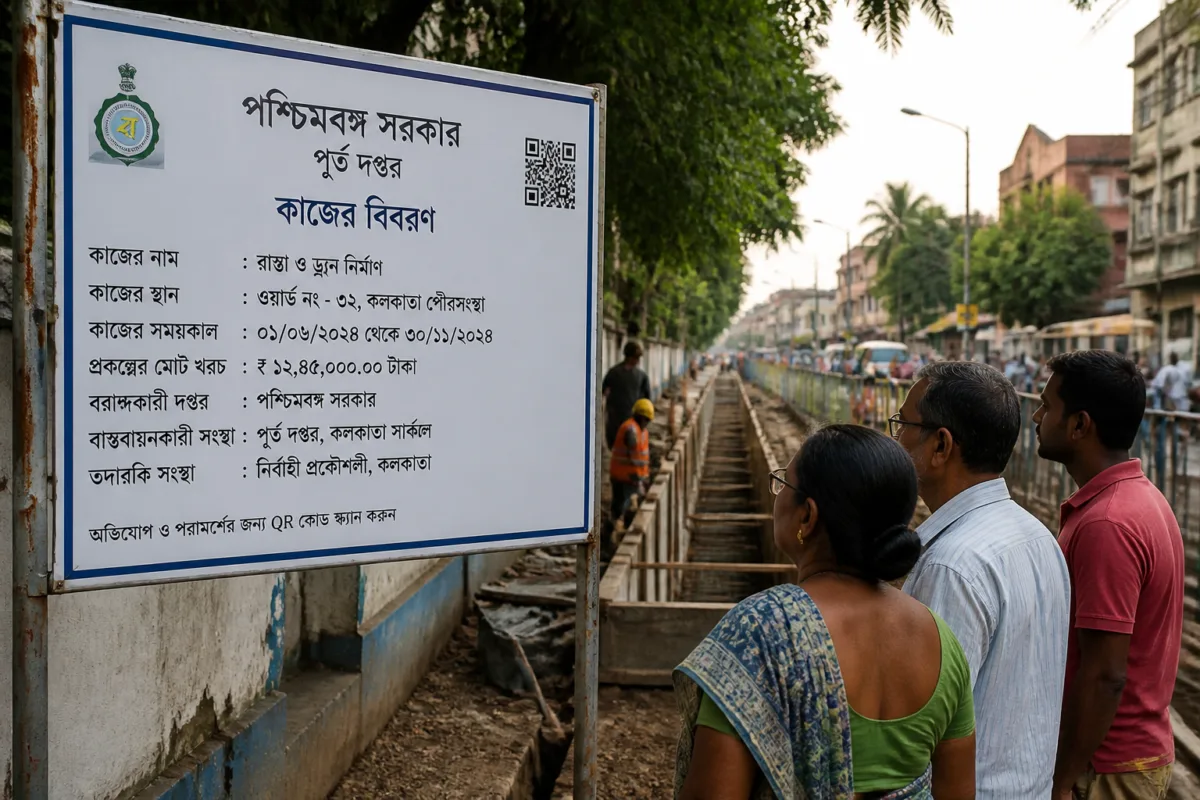
West Bengal has made Bengali mandatory on information boards, signages, plaques and public notices at government project and scheme sites, with Nepali required in the hill areas of Darjeeling and Kalimpong by November 30. The order also sets out a standard list of project details that must be displayed for public access.
Chief secretary Manoj Agarwal issued the direction on Friday to all state government departments, directorates, public-sector entities, development authorities, local bodies and district administrations. The decision follows the government’s observation that information boards at several project sites were being installed only in English.
Under the order, boards and notices must provide details of the relevant government work or scheme, including the scheme name, estimated cost, source of funds, commencement date, expected completion date and implementing agency. Contact details must also be displayed. These details are to be provided in Bengali across the state and in Nepali in Darjeeling and Kalimpong.
The measure is intended to make information about public works accessible to local residents in the language understood by them. It applies to project and scheme sites overseen by a wide range of government and government-linked institutions, including local administrations and development authorities.
The order does not prohibit the use of English or Hindi where those languages are required under the guidelines of a centrally funded scheme. However, such language requirements cannot replace the Bengali or Nepali version. The state has specified that the regional-language information must remain available even when central scheme rules require additional text in English or Hindi.
The direction also proposes linking each project board to a centralised online repository through a QR code. The proposed system would create a state-wide, geo-tagged database of government works and schemes. By scanning the code, citizens would be able to access information on the sanctioned cost, funding sources, implementing agency, project timelines and location.
The repository is also intended to show the physical and financial progress of works. If implemented as described, the system would connect information displayed at a project site with a digital record that can be accessed remotely, giving residents another way to examine the status and financial structure of public projects.
The order places responsibility for compliance across departments, directorates, parastatals, development authorities, local bodies and district administrations rather than limiting the requirement to a single category of public work. The November 30 deadline will require these agencies to update existing boards and ensure that new project signage follows the prescribed format.
The state’s directive therefore combines a language-access requirement with a proposed public works tracking mechanism. Its immediate implementation will depend on agencies placing the required information on project sites in Bengali or Nepali, as applicable, and on the proposed QR-linked repository being populated with accurate project records.

