


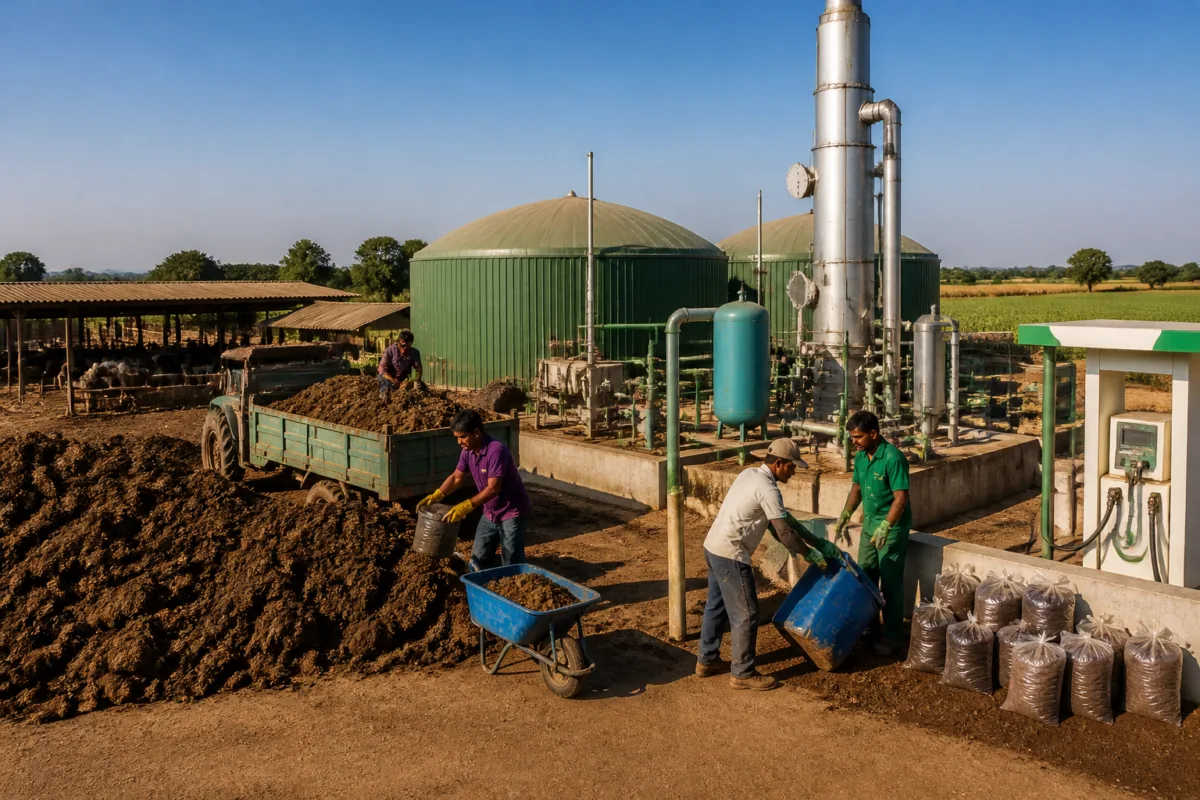
Banas Dairy will raise its cattle dung processing capacity by 51 per cent to 515 tonnes a day with two new bio-CNG plants in Tharad and Radhanpur in Gujarat’s Banaskantha district, expanding a cooperative model that links livestock waste management with farmer payments and lower-cost vehicle fuel.
The dairy cooperative currently processes about 340 tonnes of dung daily through four plants. Once the new facilities become operational, the network’s capacity is expected to increase by 175 tonnes a day. Banas Dairy purchases dung from farmers at around ₹1 per kg, weighs it at the farm and deposits payments directly into their bank accounts every fortnight along with their milk bills.
The dung is converted into compressed biogas for vehicles and organic fertiliser for farms. The residual slurry produces solid and liquid fertilisers, which are supplied to farmers through local milk societies under the Bhoomi Amrut brand. Bio-CNG from the existing plants is sold to motorists at ₹75-80 per kg, compared with around ₹92 per kg for conventional CNG in Gujarat, according to the report.
The initiative began in February 2020, when Banas Dairy started procuring dung from Dama village in Deesa. In August that year, it launched what the Gujarat government describes as the country’s first commercial-standard compressed biogas outlet. Plants later became operational at Agathala, Khula and Vinchhiwada under a tripartite arrangement involving Suzuki Motor Corporation and the National Dairy Development Board.
Banaskantha has an estimated 28 lakh livestock, including around 24 lakh animals belonging to cattle breeders associated with Banas Dairy. These animals generate approximately 24,000 tonnes of dung every day, indicating that the cooperative’s current processing network handles only a portion of the district’s available livestock waste.
Banas Dairy plans to eventually establish around 200 plants across the district. The Gujarat government’s Energy and Petrochemicals Department has projected that the proposed network could produce 1,168 lakh kg of compressed biogas annually and generate direct annual returns of ₹875 crore for livestock farmers. The figures are projections for the expanded network and do not represent current output.
The model integrates dung procurement into the cooperative’s established milk-payment system, creating an additional income stream for cattle breeders while supplying fuel and farm inputs locally. The expansion is also linked to a wider India-Japan cooperative effort to establish 1,000 biogas plants across India. The new facilities at Tharad and Radhanpur are expected to expand the district’s processing network ahead of Prime Minister Narendra Modi’s scheduled visit to Banaskantha on October 30.

