


Ayodhya land prices have risen far faster than gold in some locations around the Ram Mandir, according to property consultancy Liases Foras as cited by NDTV Business, but the gains are concentrated in selected growth pockets rather than across the entire city.
The comparison is based on reported price movements through November 2026. The average price of 24-carat gold was around Rs 48,720 per 10 grams in 2021. The IBJA closing price for 24-carat gold stood at Rs 1,29,531 per 10 grams on November 19, 2026, representing an increase of nearly 166 per cent, excluding taxes and other costs.
A Rs 5 lakh investment made at the 2021 average gold price would therefore be worth approximately Rs 13.3 lakh at the November 19 rate. Gold had touched around Rs 1.78 lakh per 10 grams in late January 2026 before correcting. NDTV attributed the recent decline to factors including a stronger US dollar, higher Treasury yields and expectations of further interest-rate increases by the US Federal Reserve.
Ayodhya’s property market has recorded a more uneven but sharper increase in some areas. Liases Foras said land prices across Ayodhya had risen by 25-40 per cent since 2019, while prices in areas surrounding the Ram Mandir had reportedly increased five to ten times.
A fivefold rise represents a 400 per cent gain, while a tenfold increase represents a 900 per cent gain. On that basis, a Rs 5 lakh investment in land that appreciated fivefold would be worth Rs 25 lakh, while one that appreciated tenfold would be worth Rs 50 lakh. These figures are illustrations based on the reported appreciation and do not establish that every plot, locality or investor achieved those returns.
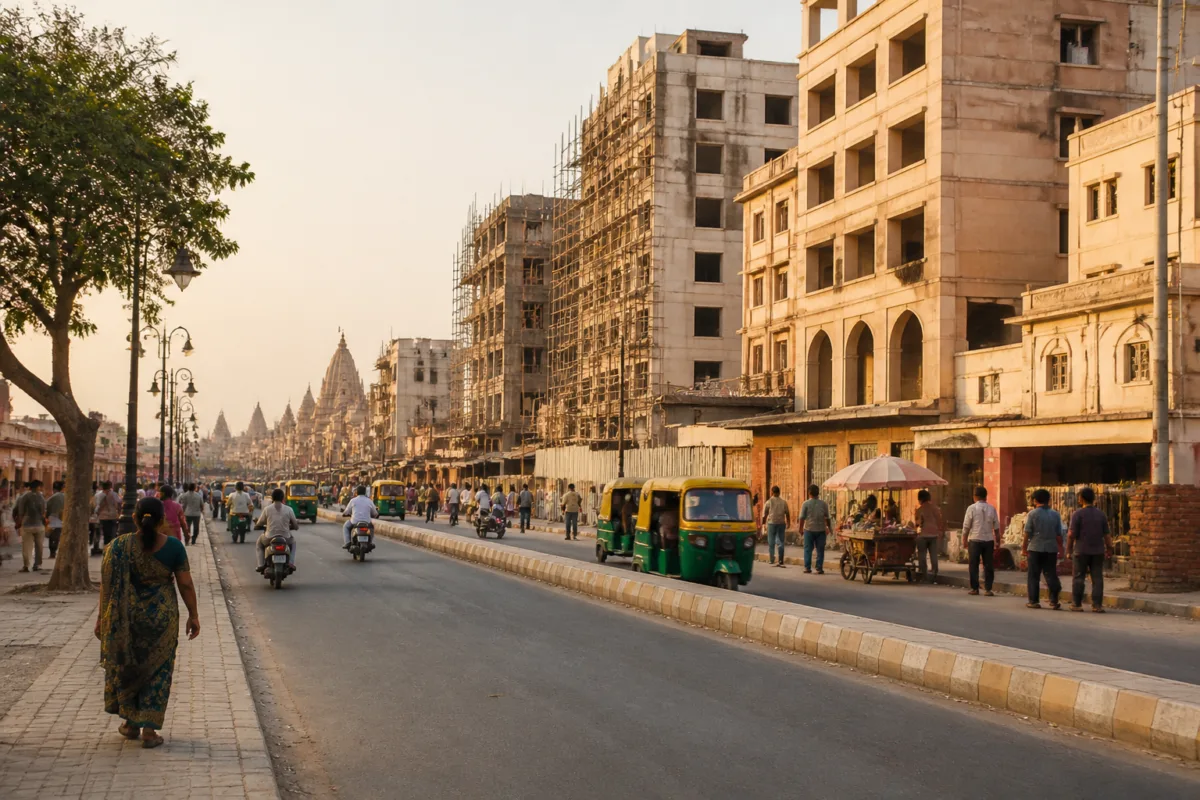
The reported property-price increase has taken place alongside a wider transformation of Ayodhya. The city recorded 5.8 crore visitors in 2023, rising to 29.9 crore in 2025, according to the figures cited by NDTV. The Ram Mandir has remained a major attraction, while a new airport, redevelopment of the railway junction and investments in urban infrastructure have improved connectivity and the city’s capacity to receive visitors.
That visitor growth has expanded attention beyond religious tourism. Hotels, restaurants, retail businesses, transport operators and housing projects could benefit from higher economic activity, potentially supporting demand for commercially located land and property close to major access routes and attractions. The supplied report, however, does not provide data on actual hotel occupancy, employment growth, housing absorption or commercial revenues.
Ayodhya’s circle rates were also revised in June 2025 after an eight-year gap. The revision involved increases of up to 200 per cent in certain areas. Circle rates are government-prescribed minimum values used for property transactions, and the reported increase should not be treated as a direct measure of actual market prices. Market prices can be higher or lower depending on location, access, land quality, title and demand.
This distinction is important for anyone comparing land with gold. Gold has a daily quoted price and can generally be sold through established channels. Land is less liquid: finding a buyer can take months or years, and a quoted price may not be the amount at which a transaction is completed.
Land purchases also involve risks that do not arise in the same way with gold, including title disputes, land-use restrictions, access problems and the possibility of buying at an inflated price. The sharpest appreciation reported in Ayodhya is concentrated in selected areas around the Ram Mandir, so it cannot be used to assume equivalent returns for every plot in the city.
Samujjwal Ghosh, chief executive officer of The House of Abhinandan Lodha, told NDTV that investors should assess a destination’s future growth drivers rather than focus only on current property prices. He cited tourism, emerging industries and improved connectivity, while also stressing the importance of clear ownership and a defined development plan.
The comparison ultimately shows two different forms of investment performance. Gold’s return can be tracked through a relatively transparent market price, while Ayodhya land’s reported gains depend heavily on location, timing and the ability to convert a paper valuation into a completed sale. Whether the city’s property appreciation is sustained will depend, among other factors identified in the report, on whether rising visitor numbers translate into durable commercial activity, employment and housing demand.

