


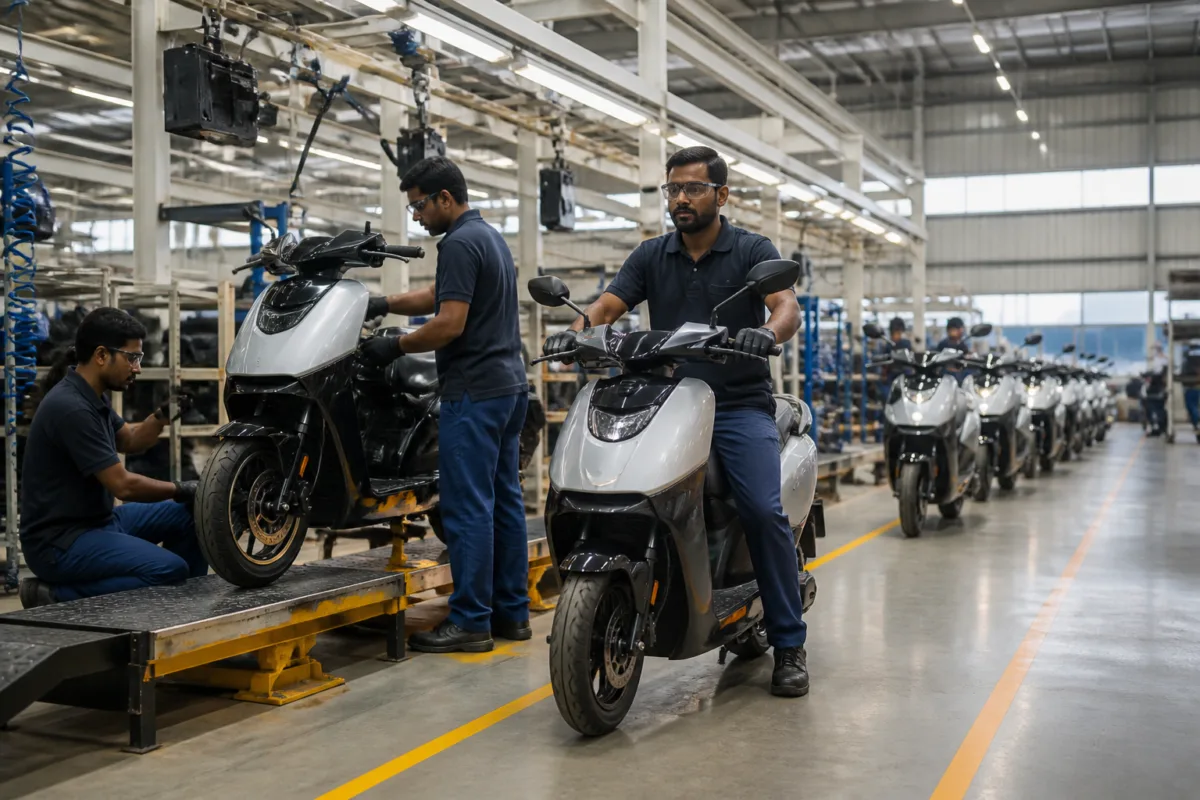
Ather Energy’s return to quarterly profit is being accompanied by a much larger bet on manufacturing capacity. The electric two-wheeler maker plans to add 2.25 lakh units of annual production capacity across Tamil Nadu and Maharashtra, a move that shows how quickly demand is beginning to test the physical limits of India’s electric mobility supply chain.
The company reported a consolidated profit after tax of ₹1.26 crore for the September quarter, compared with a loss of ₹154 crore in the year-ago period. Its consolidated total income rose 62 per cent year-on-year to ₹1,527 crore, while volumes increased 42 per cent to 93,211 units. Shares of Ather Energy rose nearly 14 per cent to ₹1,575 on Monday after the results and capacity announcement.
The figures matter because they show a company moving from a growth model built around product adoption towards one that must now manage scale, factory utilisation and operating efficiency. Ather reported EBITDA of ₹74.2 crore, its second consecutive EBITDA-positive quarter. EBITDA margin improved to 4.9 per cent from minus 9.6 per cent in Q2 FY26, while adjusted gross margin rose 160 basis points year-on-year to 24 per cent despite elevated commodity costs.
That combination is significant for an electric vehicle manufacturer. Higher volumes can spread fixed manufacturing and operating costs across more vehicles, but only if the company can maintain pricing, control input costs and prevent bottlenecks from limiting deliveries. Ather’s reported improvement suggests that the company is beginning to capture some of those benefits, although its profit after tax remains modest relative to revenue.
The immediate operational constraint is capacity. Ather plans to invest around ₹122 crore to expand production at its Hosur facility in Tamil Nadu and its upcoming AURIC plant in Chhatrapati Sambhajinagar, Maharashtra. Hosur’s annual capacity is expected to rise by 75,000 units to 4.95 lakh units by December. The AURIC facility, which has an initial annual capacity of 5 lakh units, is planned to receive a further expansion of 1.5 lakh units, expected to come on stream by Q2 FY28.
Together, these additions would take Ather’s installed annual capacity to around 11.4 lakh units by Q2 FY28. The capacity plan therefore extends beyond a short-term production adjustment. It creates a manufacturing footprint across two states and gives the company room to support a wider product range as demand moves beyond its earlier performance-focused positioning.
The pressure behind the expansion is visible in the company’s demand indicators. Customer enquiries rose 109 per cent year-on-year to about 10 lakh during the quarter, while pre-orders more than doubled to 1.8 lakh units. The Hosur facility operated at 98 per cent capacity utilisation during peak production. In manufacturing terms, that leaves limited spare capacity to absorb a sudden increase in orders or to manage production interruptions without affecting delivery schedules.
Tarun Mehta, co-founder and chief executive officer of Ather Energy, said demand had more than doubled year-on-year during the quarter and that the company was augmenting capacity at Hosur and AURIC to meet it. The statement links the investment directly to demand rather than presenting it as a standalone expansion programme.
The distinction is important. Capacity announcements in the automotive sector can represent either a response to sustained market demand or a forward-looking bet on future sales. In Ather’s case, the reported utilisation rate, enquiries and pre-orders provide evidence of an immediate supply-demand imbalance. The supplied results, however, do not establish how quickly all pre-orders will convert into delivered vehicles or how the company’s margins will behave as the new capacity comes on stream.
The wider market data points in the same direction. India’s electric two-wheeler registrations rose 82 per cent year-on-year to a record 5.98 lakh units in Q2, according to Vahan data cited in the report. Electric two-wheelers accounted for 11.2 per cent penetration during the quarter. These figures place Ather’s production expansion within a market that is growing rapidly, but they also show that electric vehicles remain a minority of total two-wheeler registrations.
That creates a dual challenge for manufacturers. They must increase supply to serve customers who are already choosing electric vehicles, while also competing for the much larger conventional two-wheeler market. Production scale alone cannot resolve that challenge. Manufacturers must also offer products across different price and usage segments, maintain service networks and build enough charging access and software support to make ownership practical beyond early adopters.
Ather’s product strategy indicates an attempt to broaden its addressable market. The company launched Konarc, its first scooter on the new EL platform, adding to the performance-focused 450 series and the family-oriented Rizta. The new platform and expanded portfolio can help the company reach customers with different expectations, but the supplied material does not provide pricing, delivery volumes or segment-level performance for the new model.
The company is also seeking to increase revenue beyond the sale of vehicles. Non-vehicle revenue, including software subscriptions, charging, accessories and services, accounted for 15 per cent of revenue from operations, up from 12 per cent a year earlier. That rise indicates that the economics of electric two-wheelers are not limited to the initial transaction. Connected software, charging services and after-sales activity are becoming part of the revenue architecture around the vehicle.
For cities, this shift has consequences beyond factory output. Electric two-wheelers are used largely for daily urban travel, and their growth affects the systems that support mobility: charging infrastructure, power distribution, parking, service facilities and road-space demand. A manufacturer’s capacity expansion does not automatically create those systems, but it increases the number of vehicles that urban infrastructure may need to accommodate.
The geography of Ather’s expansion also highlights the industrial dimension of the electric mobility transition. Hosur, in Tamil Nadu, is already the company’s operating production base, while AURIC in Chhatrapati Sambhajinagar is being developed as a second major facility. The investment distributes manufacturing activity across two locations and links electric vehicle demand with state-level industrial infrastructure, land, labour and logistics capabilities. The report does not provide details of incentives, employment numbers or local infrastructure commitments, so those effects cannot yet be quantified.
The company’s financial results suggest that operating discipline is becoming as important as sales growth. Ather attributed the improvement in EBITDA margin to higher volumes, an improved product mix and cost discipline. Adjusted gross margin rose despite elevated commodity costs. The result is a more sustainable financial profile than a business that depends only on increasing volumes, although the ₹1.26 crore quarterly profit shows that the transition to durable profitability is still at an early stage.
The next phase will test whether the reported demand can be converted into profitable, reliable scale. Ather must add capacity without creating underused assets, maintain quality while production rises and ensure that the new product portfolio does not dilute margins. It will also need to turn enquiries and pre-orders into completed sales while supporting customers after delivery through charging, software and service networks.
The evidence currently confirms three linked developments: electric two-wheeler demand is expanding quickly, Ather’s existing production system is operating close to its practical limit, and the company has moved into quarterly profitability while investing for larger scale. What remains uncertain is whether the new capacity will translate into sustained profits and how much of the broader electric two-wheeler market Ather can capture. The company’s Hosur expansion by December and the planned AURIC addition by Q2 FY28 will provide the next measurable tests of that strategy.

