


Asia’s AI data-centre expansion is becoming an important source of economic activity, but the concentration of growth around advanced chips and computing infrastructure is also exposing the region to a potential investment reversal, according to a report carried by Hindustan Times from The Wall Street Journal.
The report said export data from Asian economies showed little evidence that demand for artificial-intelligence-related products was slowing. Shipments of semiconductors and other data-centre components have increased, while prices have also risen sharply as demand intensified.
Taiwanese semiconductor manufacturers, South Korean memory-chip producers and high-tech equipment suppliers in China, Japan and Singapore are among the main beneficiaries of the boom. Samsung Electronics, SK Hynix and Taiwan Semiconductor Manufacturing Co. were cited as examples of companies whose profits demonstrate the importance of Asian manufacturing to the global AI industry.
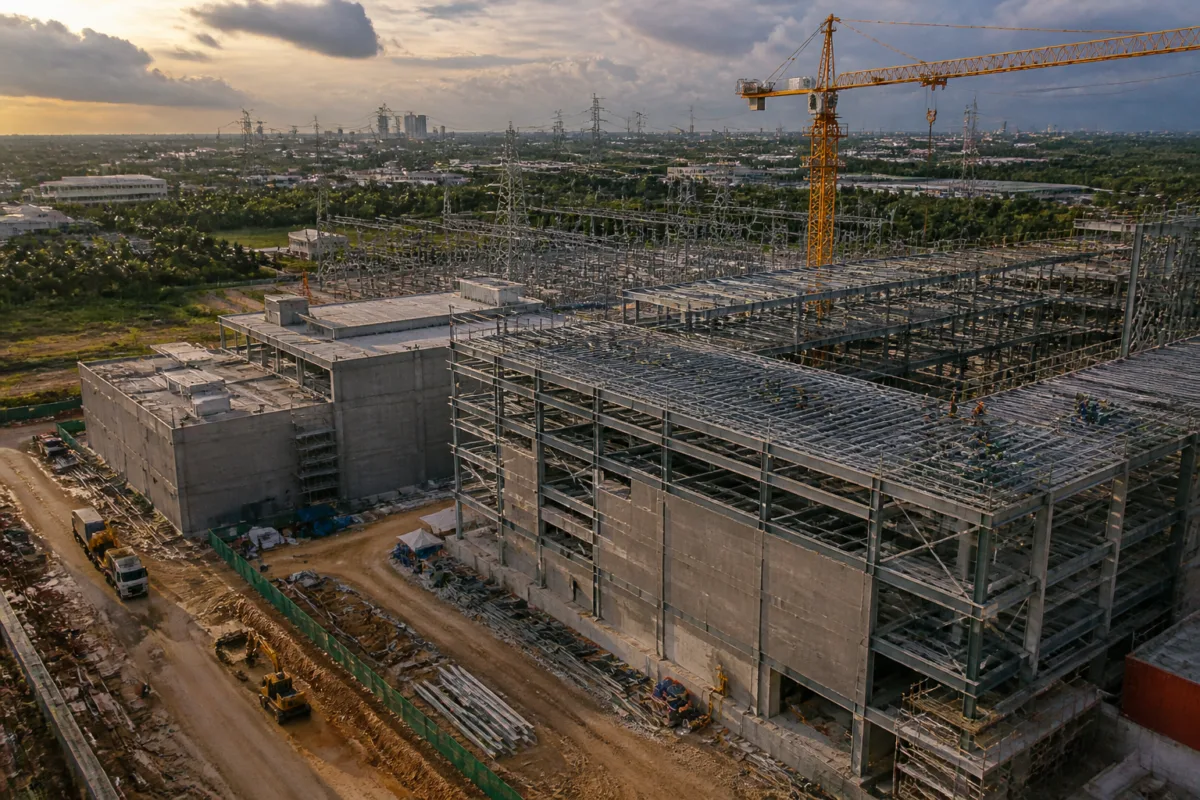
This industrial demand is translating into physical infrastructure. The report said Asian economies are increasingly becoming data-centre hubs themselves, particularly in Southeast Asia, where facilities are being developed in countries including Malaysia and Thailand. The expansion links the region’s export performance to construction activity, power-intensive computing facilities and the equipment needed to operate them.
The trend is also visible in the United States. Revised figures cited in the report showed that the US economy grew at an inflation-adjusted annual rate of 4.3% in the third quarter, compared with an earlier estimate of 3.4%. Investment in non-residential buildings, a category that includes data centres, grew at a 16% rate.
For cities and infrastructure planners, the figures underline how technology investment can create demand for large, specialised buildings. Data centres require substantial capital expenditure and depend on reliable supplies of advanced chips and high-tech equipment. However, the report does not provide project-level information on land use, electricity demand, water consumption, construction schedules or local employment in the Southeast Asian markets it identifies.
That absence of local detail is significant because a regional investment cycle does not affect all cities or infrastructure systems in the same way. The report establishes that data-centre construction is contributing to growth, but it does not quantify the facilities being built, their locations or their demands on municipal utilities. It therefore offers a macroeconomic view rather than a city-by-city assessment.
The durability of the expansion is also uncertain. Some economists cited in the report said that the recent levelling off in chip prices could be an early indication that the AI boom is approaching a crest. Institutions such as the International Monetary Fund have raised a broader concern: economies in Asia and elsewhere may be becoming too dependent on AI-related activity to sustain growth.
That dependence creates a risk for the built environment. If investment in computing infrastructure slows, data-centre construction could lose one of its current growth drivers. The report described a pullback in such construction as a potential blow to regional economic expansion, although it did not forecast when or whether such a reversal would occur.
Geopolitical controls are adding another layer of uncertainty. The United States has tightened export rules intended to limit China’s access to the most advanced chips. The report said Nvidia had ordered partners to pause shipments to Malaysia, Thailand, Singapore and Indonesia as the company responded to the changing restrictions.
Those measures could affect both the supply of equipment and the pace at which data-centre projects are developed in Southeast Asia. The report does not establish that any named project has been cancelled or delayed, so the immediate local impact remains unconfirmed.
The market response has been volatile. According to the report, enthusiasm around AI has attracted new investors and supported stock-market gains, helping offset subdued domestic spending in some Asian economies. A sustained decline in AI-linked shares could instead reinforce consumer restraint, economists said.
The evidence points to a construction cycle with two opposing features. AI is creating demand for specialised facilities and the components that support them, strengthening Asian exports and investment. At the same time, that growth is increasingly tied to chip pricing, international technology controls and investor confidence. For urban economies seeking to attract data-centre investment, the central issue is not only how quickly facilities can be built, but how resilient the underlying demand will be if the AI investment cycle loses momentum.

