


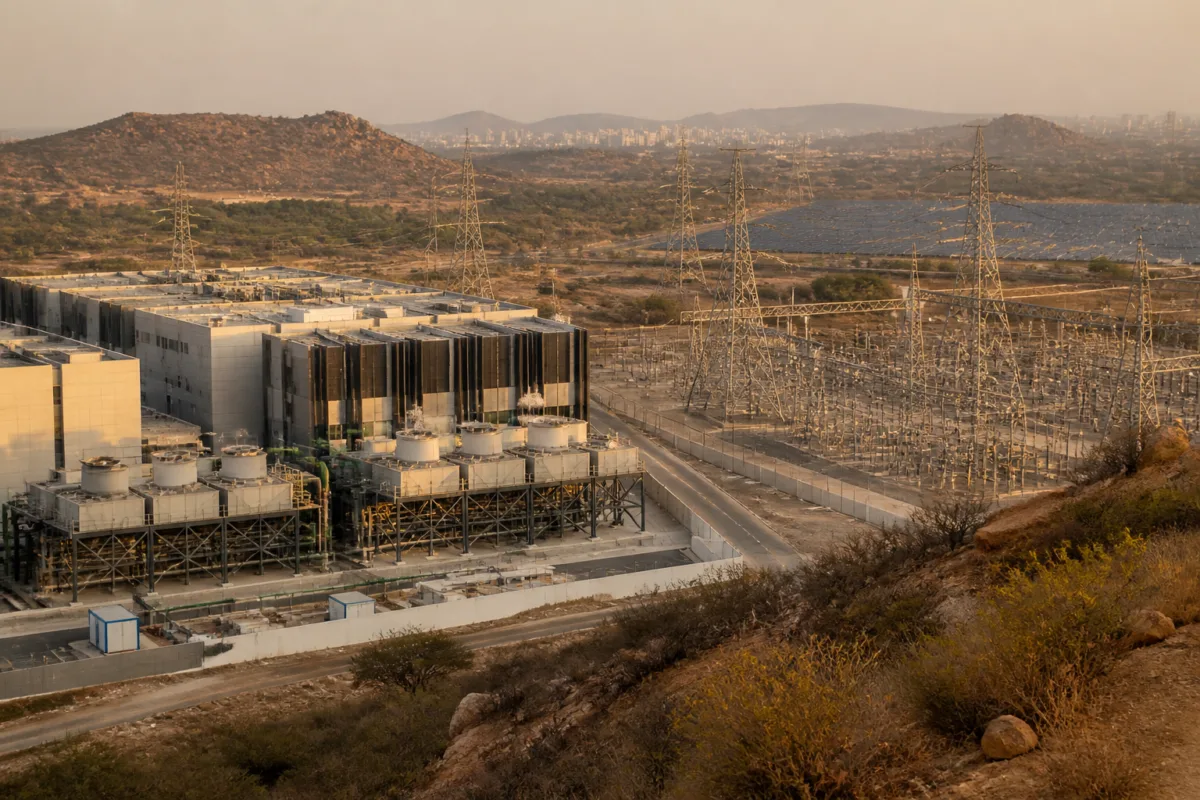
Hyderabad’s ambition to expand as an artificial intelligence and data-centre hub is bringing a basic infrastructure question into sharper focus: whether the city and Telangana can provide the electricity, grid capacity and water required to operate increasingly power-intensive computing facilities.
The issue is significant because data centres do not depend only on buildings and servers. They require continuous electricity, substations, transmission capacity and cooling systems. As facilities become larger and more heavily used for AI, their resource requirements are expected to rise.
The International Energy Agency estimates that global electricity consumption by data centres could more than double, from about 460 terawatt-hours in 2024 to more than 1,000 TWh by 2030. In India, the Boston Consulting Group estimates that data-centre capacity could increase from around 1.5 gigawatts in 2025 to 6–8 GW by 2030.
These figures indicate the scale of infrastructure that may be needed alongside new computing capacity. According to the Telangana Today analysis by Kalyan Sivalenka, data centres can be built within two to three years, while energy infrastructure often takes longer to plan and deliver. That difference could create pressure on grid connections and power supply if computing projects move ahead faster than supporting infrastructure.
The challenge is not limited to Hyderabad. The analysis points to Virginia in the United States, an established data-centre market where growing demand has contributed to lengthy waits for grid connections. The example illustrates the difficulty of expanding electricity infrastructure at the same pace as large computing facilities, even in mature markets.
For Telangana, the investment pipeline already indicates substantial interest. Amazon Web Services has announced plans to invest Rs 60,000 crore in expanding its data-centre operations in the State. Telangana has also signed a memorandum of understanding with CtrlS Datacenters for a proposed Rs 10,000 crore, 400 MW AI data-centre cluster.
The figures describe announced or proposed capacity rather than completed infrastructure. The State government’s data-centre investment portal lists around 200 MW of operational IT capacity, along with 4.7 GW of committed or early-stage capacity. Much of that pipeline remains at different stages of development, making the timing and final scale of actual resource demand uncertain.
The proposed expansion also raises questions about where new facilities will be located and how they will be connected. Telangana has identified Chandanvelly and Bharat Future City as areas for data-centre development. Moving beyond established technology districts could provide land for larger facilities, but those locations would also need dependable power connections, transmission infrastructure, water systems and other supporting services.
Cooling is another important part of the infrastructure equation. Servers generate heat, and cooling systems can consume substantial amounts of electricity and water. The resource impact will vary according to the design of each facility and the technology used. Treated wastewater and other non-potable sources could reduce dependence on freshwater where suitable treatment and supply infrastructure are available.
The energy transition adds another layer of complexity. Telangana’s Clean and Green Energy Policy reports approximately 11.4 GW of existing renewable-energy capacity and targets an additional 20 GW of renewable energy and storage capacity by 2030. However, installed capacity does not mean that electricity will be generated or available at every hour.
Data centres operate continuously, while solar and wind generation varies by time and weather conditions. Renewable power for such facilities therefore needs to be combined with storage, reliable grid connections and other systems that can support uninterrupted operations. The IEA expects renewables to meet nearly half of the additional global electricity demand from data centres between 2024 and 2030, but the extent to which this can be achieved will depend on the pace of generation, storage and grid development.
The State has set an ambition for data centres to run entirely on renewable power by 2047, supported by energy storage, advanced cooling, water recycling and efficiency standards. The pathway to that objective will depend on how such requirements are applied to individual projects and coordinated across the wider development pipeline.
The analysis argues that Telangana could require developers to disclose projected electricity and water consumption, coordinate approvals with power and water utilities, and examine the combined impact of multiple facilities planned in the same region. Such measures would shift planning from project-by-project approvals towards a more cumulative assessment of infrastructure demand.
Hyderabad’s technology ecosystem could also contribute to the supply-side challenge. The article identifies potential roles for deep-tech start-ups, research institutions and universities including IIT Hyderabad and IIIT Hyderabad in areas such as energy storage, advanced materials, energy systems and the integration of renewable power into the grid. These possibilities are presented as opportunities rather than established outcomes.
For Hyderabad, the central planning issue is therefore not simply how much investment the AI sector can attract. It is whether the city and the State can align computing growth with the electricity networks, renewable capacity, storage, cooling systems and water resources needed to sustain it. The scale of the announced pipeline gives Telangana time to prepare, but also makes early coordination important before proposed capacity becomes operational demand.

