


A Visakhapatnam-based researcher has returned from an Indian Arctic expedition with water samples that could help scientists understand how pollutants trapped in snow and ice behave as glaciers melt. The findings may eventually inform research on marine pollution along India’s coastline and in the Bay of Bengal, although the samples are yet to be analysed.
Dr Manoj Rayaroth, assistant professor in the Department of Chemistry at GITAM Deemed to be University, was selected by the National Centre for Polar and Ocean Research (NCPOR), under the Union Ministry of Earth Sciences, for the 2026-27 Indian Arctic Expedition. He travelled to Ny-Ålesund in Norway during August and September as part of the expedition’s fourth batch.
Rayaroth’s project, with Dr NVS Venugopal, professor and head of the Department of Chemistry at GITAM School of Science, as co-investigator, focuses on how organic contaminants reach the Arctic, how they change under shifting environmental conditions and what happens when pollutants deposited in snow and ice are released into water.
Pollutants can reach the Arctic through long-range atmospheric transport and ocean currents. Chemicals associated with industrial, agricultural and urban activities may travel thousands of kilometres before reaching polar waters. Rising temperatures, changing water chemistry and melting glaciers can then influence their chemical behaviour, persistence and potential toxicity.
Rayaroth said the research goes beyond identifying pollutants in the Arctic. It will examine what happens after contaminants enter Arctic waters or come into contact with ice. Pollutants released through glacial meltwater may flow into fjords and marine waters along with minerals and other material from glaciers and surrounding terrain.
The researcher was one of seven scientists in his expedition batch, which included researchers from NCPOR, the National Institute of Oceanography, the Centre for Marine Living Resources & Ecology, Cochin University and Presidency University, among others. The team was based at Ny-Ålesund, an international research settlement where several countries operate scientific stations. India has maintained its Himadri research station there since 2008.
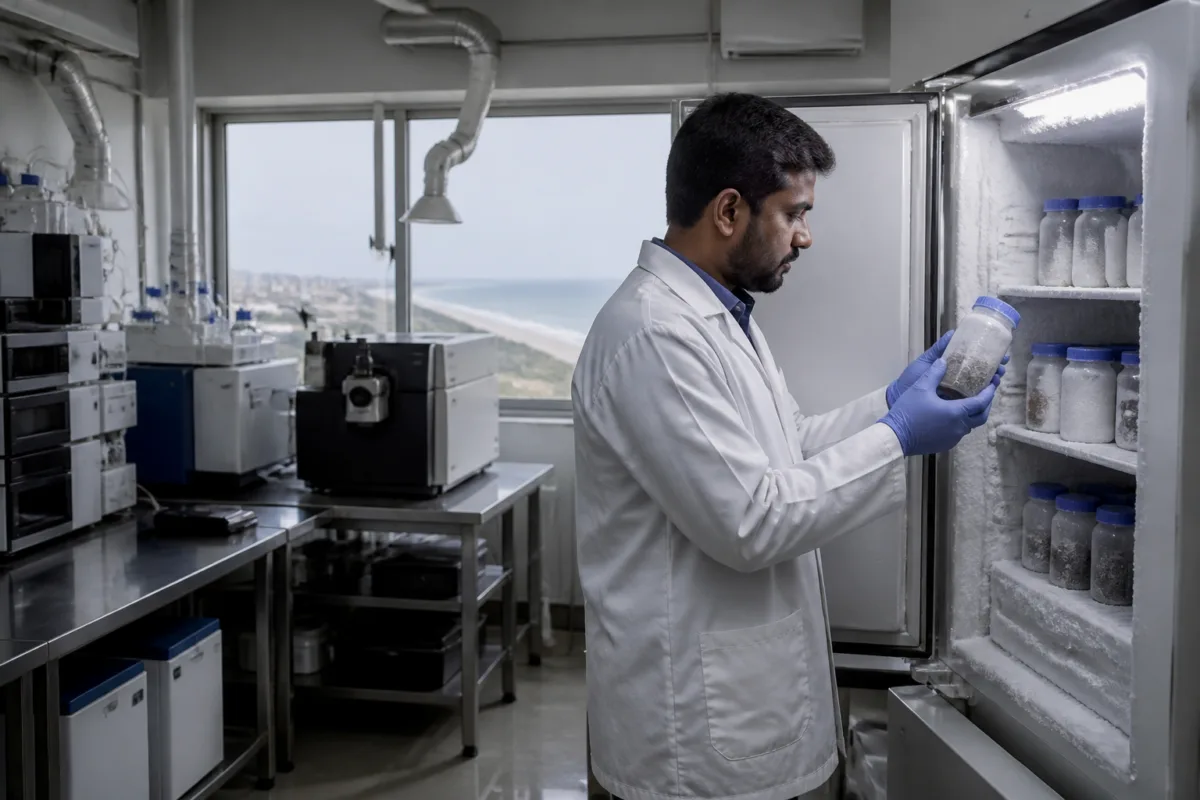
Rayaroth collected only water samples because the project was designed to study water pollution. The samples came from Arctic waters, including areas influenced by glacial meltwater. They are being preserved under controlled conditions and are expected to be transported to India in a refrigerated shipment maintained at about -20°C. The samples are expected to reach Visakhapatnam in two to three months, with collections from different expedition batches being consolidated to reduce shipping costs.
Once the samples arrive, the researchers plan to extract and analyse contaminants using chromatography and mass spectrometry. Rayaroth’s earlier research during his PhD in Kerala examined pollutants in water resources including backwater systems and the Periyar river, using mass spectrometry to identify organic contaminants in environmental samples.
The Arctic project extends that work into a less-studied environment. Rayaroth’s research group is also studying marine pollution along the Visakhapatnam coast and in the Bay of Bengal. The research team said ocean currents connect different marine systems and that pollutants in water can enter marine organisms and move through the food web.
The same samples could support future work by researchers in microbiology, marine biology and environmental science. Rayaroth said the Arctic project could develop into a broader interdisciplinary programme, but its immediate task is to analyse the samples and determine which organic pollutants are present, how they behave under polar conditions and whether changing ice and water conditions affect their movement and persistence.
The expedition lasted a month, while the research project will continue through 2026-27. Its eventual findings, along with further studies, will determine how far the results can contribute to understanding pollution pathways affecting Arctic and Indian coastal environments.

