


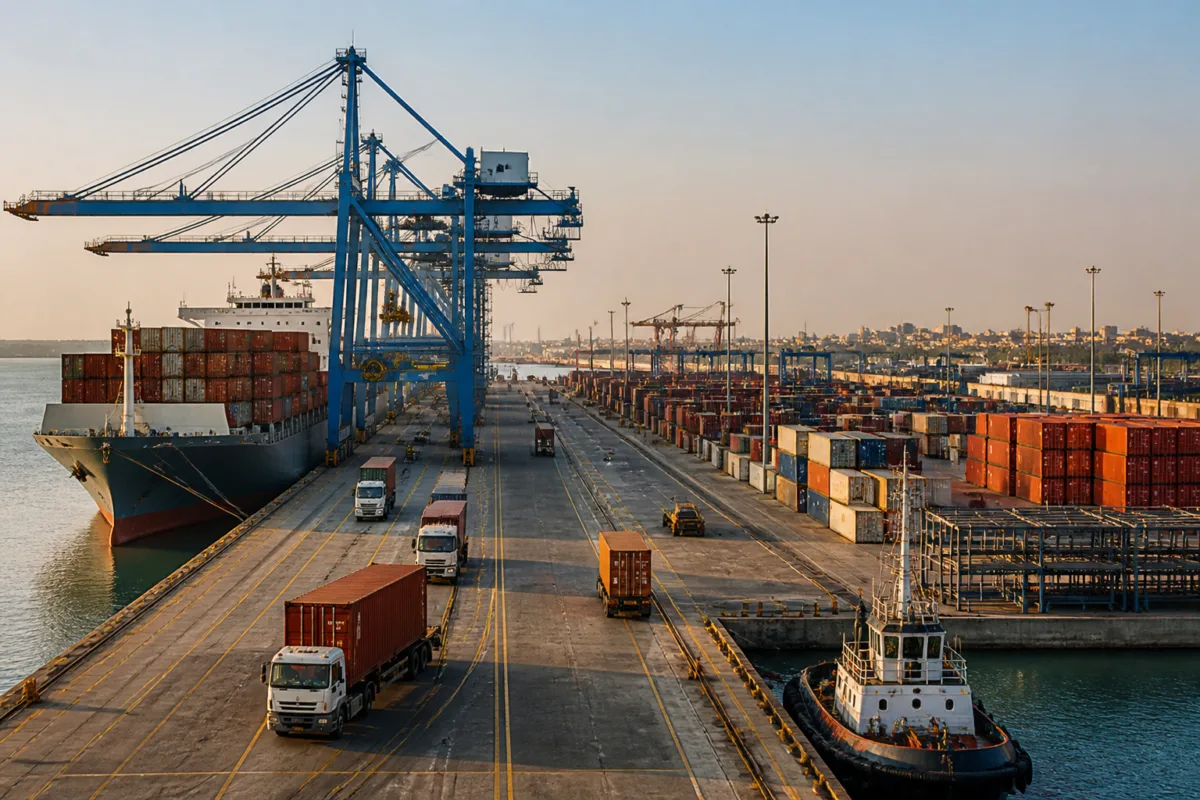
APSEZ’s decision to raise its FY27 revenue, operating-profit and capital-expenditure guidance is more than a quarterly earnings development. It signals an accelerating attempt to build a broader transport and logistics network in which ports remain the financial anchor, but international terminals, logistics and marine services provide the next layer of growth. For India’s cities and industrial corridors, that shift matters because the performance of ports increasingly depends on what happens beyond the berth: cargo movement, storage, marine support and connections across national and international networks.
The company reported consolidated profit after tax of Rs 3,682 crore for the September quarter, an 18% year-on-year increase. Revenue rose 24% to Rs 11,340 crore, while EBITDA grew 23% to Rs 6,807 crore. Following what the company described as a strong first-half performance, it raised its FY27 revenue guidance by Rs 1,000 crore to Rs 44,000-46,000 crore and its EBITDA guidance by the same amount to Rs 26,000-27,000 crore.
Those numbers establish the immediate financial story. The more consequential development is the composition of the growth. APSEZ’s domestic ports continue to contribute the largest share of earnings, with revenue rising 13% on cargo growth and higher realisations. But the report shows the company expanding its growth engine across geographies and service categories, creating a business that is less dependent on port operations alone.
That model reflects the changing role of ports in the urban and regional economy. A port is not an isolated coastal asset. Its performance is connected to the movement of goods through roads, logistics facilities and marine services, as well as to terminals and operating assets in other countries. When a port company adds these activities under one network, the business is attempting to capture more stages of the cargo journey. The supplied results do not establish how this will alter specific city-level traffic or land-use patterns, but they do show the scale at which transport infrastructure is being integrated commercially.
International ports recorded the sharpest growth in the quarter. Revenue increased 71%, while EBITDA more than tripled. The performance was attributed to the ramp-up of operations in Colombo and Tanzania, along with a contribution from Australia’s NQXT terminal. This is important because international expansion changes the risk and operating profile of a port company. Growth is no longer determined only by domestic cargo volumes and realisations; it also depends on the ability to scale newly ramped-up terminals across different operating environments.
The report provides no independent breakdown of the individual contributions from Colombo, Tanzania and NQXT. It therefore cannot establish which asset is driving the largest share of international growth or whether the reported pace can be sustained. What it does establish is that these assets are already central to the company’s explanation of its stronger first-half performance and revised guidance.
Domestic ports remain the stabilising base. Their 72.5% EBITDA margin gives APSEZ a substantial earnings platform while the company develops newer businesses. The contrast between the domestic port business and the faster growth of international operations is central to understanding the strategy: the established business supplies scale and stability, while newer segments are expected to expand the overall network.
That balance also explains why the higher capital-expenditure guidance deserves attention. APSEZ raised its FY27 capex guidance by Rs 3,000 crore to Rs 15,000-17,000 crore as it accelerates spending towards its Ambition 2031 targets. Capital expenditure at this level is not simply a maintenance decision. It indicates that the company is committing more resources to expanding capacity or capabilities across the wider portfolio, although the supplied report does not specify the allocation between domestic ports, international terminals, logistics and marine operations.
The company’s longer-term targets make the scale of the commitment clearer. APSEZ aims to generate Rs 91,500 crore in revenue and Rs 52,000 crore in EBITDA by FY31. Reaching those figures would require sustained expansion across its transport and logistics network, rather than a one-quarter improvement in profit. The distance between the current FY27 guidance and the FY31 ambition also means that the company will need growth across several businesses and geographies over multiple years.
The logistics and marine figures show how that diversification is being built. Logistics revenue grew 21% after recovering from disruption caused by the West Asia crisis in the first quarter. Marine revenue increased 57%, supported by fleet expansion, offshore services and entry into subsea services. These businesses extend the company’s role beyond cargo handling at ports. They also introduce a wider range of operational requirements, from fleet deployment to specialised marine capabilities.
The quarterly result therefore presents two different kinds of growth. The first is volume and realisation-led growth in domestic ports, the company’s established base. The second is portfolio expansion, visible in international terminals, logistics and marine services. Treating both as the same kind of growth would miss the institutional change underway inside the business. One depends largely on the performance of existing port operations; the other depends on integrating newer assets and services into a larger network.
For cities, the distinction is relevant because transport infrastructure creates effects across multiple jurisdictions. Port expansion can influence the demand for logistics capacity, marine services and connecting transport systems, but the report does not provide project-level details about new roads, rail links, warehouses or urban traffic. It would therefore be premature to translate the earnings announcement into a specific forecast for any one city. The evidence supports a narrower conclusion: APSEZ is positioning its infrastructure business around a broader logistics chain, and the company’s investment decisions will be important to the regions where those assets operate.
The governance and financing structure is also visible, even within a short earnings report. APSEZ’s management sets forward guidance, allocates capital across business lines and links current spending to the Ambition 2031 framework. The increased capex guidance is consequently both a financial commitment and an administrative signal about priorities. It indicates where the company intends to place resources, while leaving open questions about the timing, location and execution of individual investments.
The company’s stated strategy also places greater responsibility on execution. Ashwani Gupta, APSEZ’s whole-time director and chief executive officer, said that domestic ports continue to anchor earnings while international ports, logistics and marine are emerging as growth engines. That statement captures the portfolio transition, but it does not by itself resolve whether the newer businesses can deliver stable returns at the scale required by the long-term targets.
The available data shows why that question matters. International-port revenue grew 71% and EBITDA more than tripled, but the report describes these results in the context of ramping up operations. Logistics growth followed a first-quarter disruption, while marine expansion was linked to fleet and service additions. These are strong reported growth rates, but they arise from different operating conditions. The next stage of assessment will require tracking whether the businesses maintain growth after the initial ramp-up and recovery effects fade.
The broader infrastructure question is whether port-led growth can become a genuinely integrated logistics system rather than a collection of adjacent businesses. APSEZ’s results show the commercial logic of combining ports, logistics and marine services. They do not yet establish the full public or urban outcome of that integration. The supplied material contains no data on cargo volumes by corridor, congestion, employment, land requirements or investment in connecting municipal infrastructure.
That limitation is important. Financial performance can indicate the direction of an infrastructure strategy, but it cannot alone measure whether the resulting network is efficient for shippers, less disruptive for cities or better connected to other modes of transport. Those questions will depend on information about individual projects, capacity, cargo flows and implementation milestones that is not provided in the report.
For now, the evidence confirms a clear shift in APSEZ’s growth emphasis. Domestic ports remain the earnings foundation, while international ports, logistics and marine services are taking a larger strategic role. The company has responded to strong first-half performance by raising FY27 guidance and increasing planned capex to Rs 15,000-17,000 crore. The developments to monitor are whether the newer businesses sustain their reported momentum, how the additional capital is allocated and whether the expanded network translates into measurable improvements across the wider transport system.

