


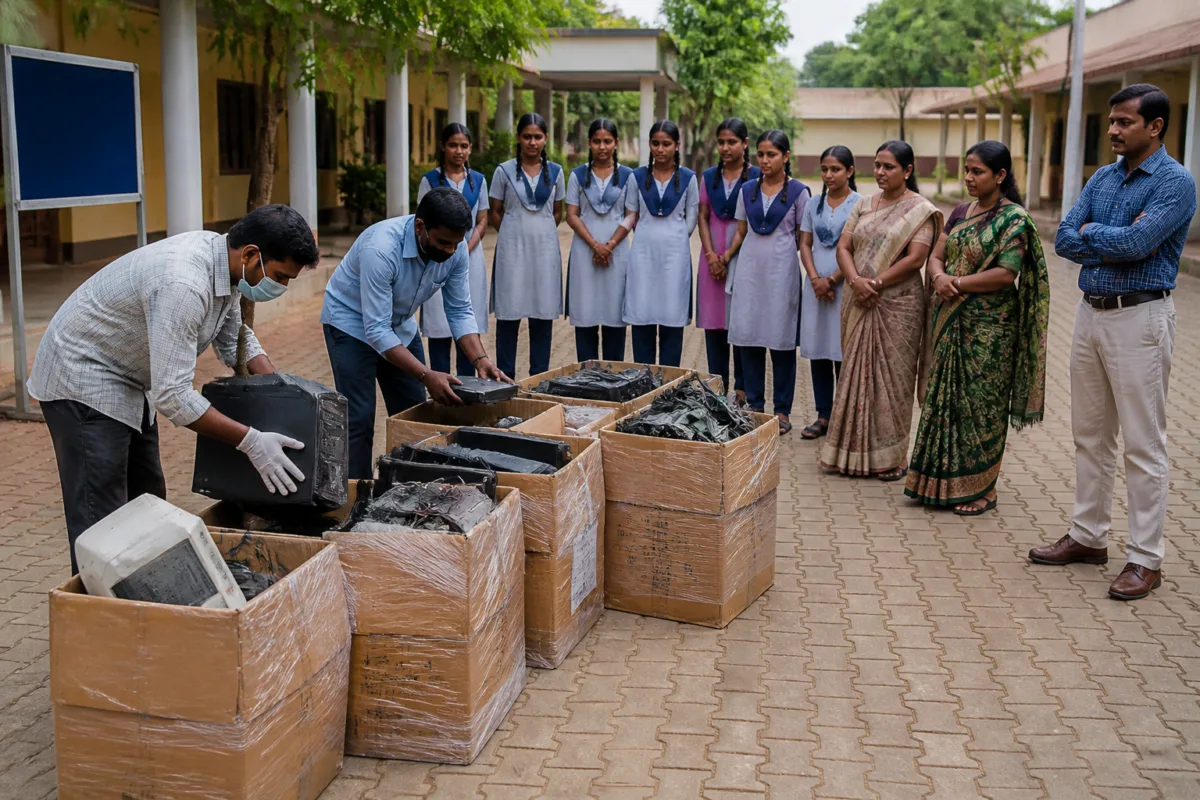
Andhra Pradesh’s e-waste collection drive has placed schools at the centre of a waste-management exercise, prompting concerns about child safety, teacher workload and the limits of what educational institutions should be expected to do. The reported instructions require teachers to collect discarded electronic goods from students, submit the material to Mandal Resource Committee offices and upload collection details, including student groups and photographs. The controversy is therefore not only about an awareness campaign. It is about whether the state is treating schools as environmental learning spaces or as an extension of the waste-collection system.
According to the report by Deccan Chronicle, schools have been asked to collect e-waste from students by October 26 and deposit it at the concerned Mandal Resource Committee office the following day. Schools must also record the exercise online. Students are to be divided into three age categories: three to eight years, nine to 11 years, and older children. The stated purpose is to promote the collection of discarded electronic goods and address environmental pollution.
The arrangement creates a direct operational link between classrooms and a waste stream that can contain hazardous substances if handled improperly. The report does not identify the specific types or quantities of electronic goods expected to be collected, nor does it set out the handling procedures, protective equipment or transport arrangements available to schools. That absence is important because the safety of a collection drive depends not merely on what is collected, but also on who handles it, how it is stored, how it moves and who ultimately processes it.
The central institutional question is one of responsibility. Schools can play a valuable role in environmental education because they reach children and families and can make otherwise technical issues visible in everyday life. But awareness and collection are different functions. A classroom discussion, demonstration or debate asks students to understand a problem. Asking children to bring discarded electronic items from home turns them into participants in the physical movement of waste. The report’s critics argue that this distinction has not been adequately recognised.
That distinction also matters for teachers. The instructions described in the report require teachers to collect material, maintain records, organise students into age groups and upload information online. These duties would be added to teaching, assessment and existing administrative work. A private school correspondent quoted by Deccan Chronicle said such assignments could divert time from classroom activities and that schools should focus on awareness rather than turning students into collection agents.
The concern is not that schools should remain disconnected from environmental responsibility. It is that the administrative design of a campaign can change the role of an institution without addressing its capacity. When a school is asked to collect waste, it needs clear protocols, trained personnel, safe temporary storage, documented handover arrangements and a verified destination for the material. Without those safeguards, the campaign can transfer responsibilities from the authorities and waste producers to institutions that were not established to manage hazardous or potentially hazardous materials.
The age categories mentioned in the instructions make the issue more sensitive. The youngest group includes children between three and eight years, while the other groups cover children aged nine to 11 and older students. The report says students are to be asked to collect e-waste from their homes, but it does not specify whether participation is voluntary, what types of devices are permitted, how parents are to be informed or whether collection is restricted to intact items. Those details determine whether the exercise functions as a controlled educational activity or an informal household-to-school transfer of discarded electronics.
The report also raises a question about where responsibility for e-waste begins. A teacher from Sri Sathya Sai district, quoted anonymously, argued that the government should not place the responsibility on students and teachers and should instead encourage residents of villages and towns to participate. This points to a wider weakness in collection systems: campaigns may find it easier to mobilise institutions with an existing administrative network than to establish convenient, accountable channels for households and waste producers.
That approach can make schools appear efficient collection points because they already have registers, communication systems and regular contact with families. Yet administrative convenience does not necessarily make an institution suitable for the task. Schools are designed around education and child welfare. A waste-management system requires a different chain of accountability, involving collection, segregation, safe storage, transport, processing and final disposal. The source report does not establish whether that full chain has been publicly specified for this campaign.
The proposed handover to Mandal Resource Committee offices indicates that the exercise has been connected to an administrative structure below the district level. However, the report does not identify whether these offices are authorised or equipped to receive e-waste, whether they will transfer it to registered recyclers or how the material will be processed. This is a crucial gap in understanding the campaign. Collection is only the first stage of waste management. If the downstream system is unclear, the campaign’s environmental purpose remains difficult to evaluate.
The requirement to upload photographs and details of student groups adds another layer to the exercise. Digital reporting can help authorities monitor participation, but it can also turn a public-awareness campaign into a compliance exercise. Schools may end up prioritising evidence that a collection event took place rather than the quality and safety of what happens to the collected material. The report does not say how the uploaded information will be used, whether it will be independently checked or whether schools will be assessed on the quantity collected.
This distinction between participation and outcomes is important for public programmes. A high number of participating schools or photographs may show administrative reach, but it does not establish that e-waste has been safely channelled for processing. Conversely, a school that conducts awareness sessions without collecting material may contribute to safer long-term behaviour even if it produces fewer immediately visible results. The supplied report presents this tension through the suggestion that schools should conduct practical demonstrations and debates rather than perform the work of collection agencies.
The role proposed for authorised agencies and recyclers is consequently central. The private school correspondent quoted in the report said such entities should collect and process e-waste according to safety requirements, while schools should promote environmental responsibility. This would separate education from material handling and place technical tasks with organisations expected to have the relevant expertise. The report does not say whether such agencies have been appointed for the drive, leaving the implementation model unresolved.
The issue also exposes the unequal capacity of schools. Government and private schools may differ in staffing, storage space, administrative support and access to transport. A uniform collection instruction can therefore produce different levels of risk and workload across institutions. The source material does not provide comparative evidence on how schools are expected to manage the exercise, but the concern raised by school representatives suggests that the administrative burden is already visible at the institution level.
At the citizen level, the campaign presents a complicated message. It seeks to make families aware that electronic goods should not be treated as ordinary household waste. That objective is relevant to towns and villages alike. But if the collection process is perceived as unsafe or burdensome, families may view e-waste as a school responsibility rather than a household and municipal concern. The campaign could then unintentionally reinforce the very responsibility gap it is meant to address.
The reported concerns do not establish that the drive has caused injury or that unsafe processing has occurred. They do establish that the implementation instructions, as described, have raised questions about safety, workload and institutional roles. Those questions require answers from the authorities: what materials may be collected, who will handle them, how children and teachers will be protected, which agency will receive the waste, and how the final processing route will be documented.
The larger urban lesson is that environmental programmes depend on institutional design. Schools can extend public awareness into households, but they should not become substitute collection agencies without clearly defined safeguards and responsibilities. In Andhra Pradesh’s reported drive, the immediate task is to clarify the boundary between environmental education and waste operations. Until that boundary, along with the downstream processing arrangement, is made clear, the campaign remains a test of whether public participation is being supported by a functioning e-waste system or used to compensate for its absence.

