


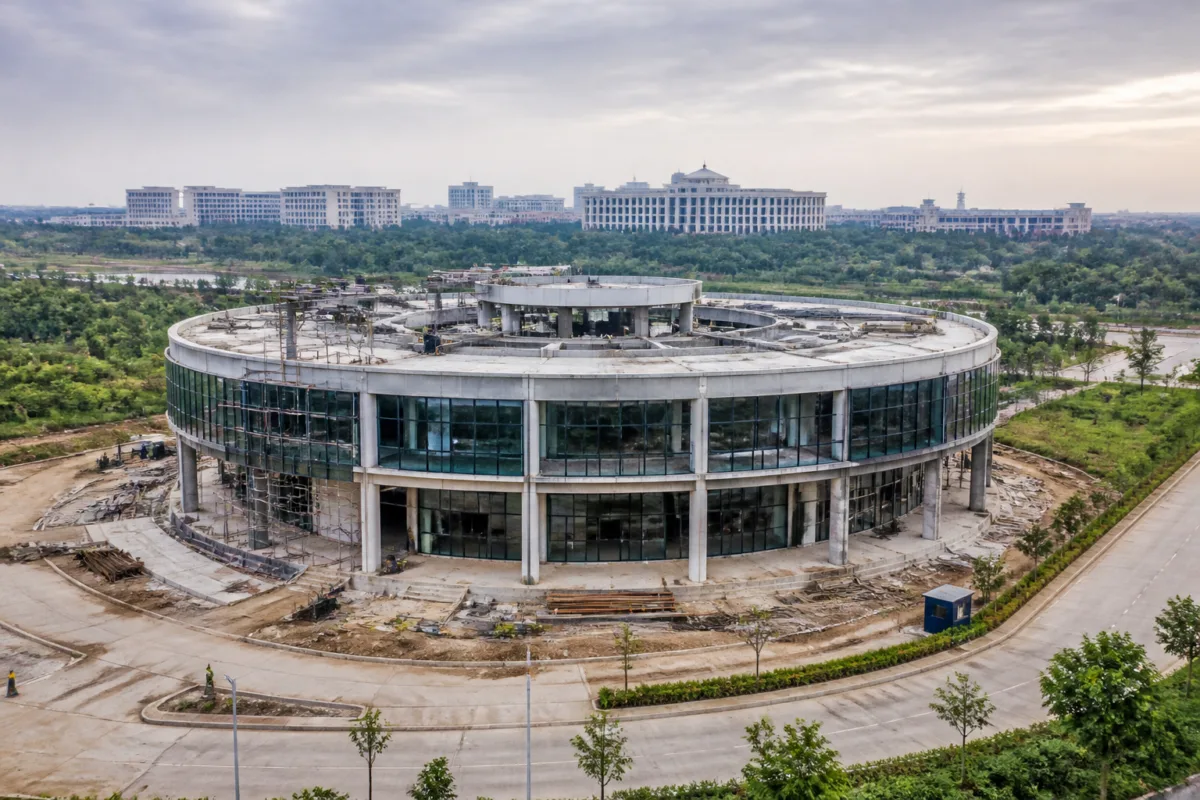
Amaravati’s quantum computing centre is being built as more than a specialised technology facility. Its planned IBM Quantum System Two installation will test whether a new capital city can convert a high-end research asset into a working public-private ecosystem involving government departments, universities, startups and industry.
The Andhra Pradesh government is expected to hand over the centre’s building to IBM by the end of October, allowing the company to begin moving its quantum computing system into the facility. Parts of the machine have already reached India from the United States, and commissioning is targeted for December 2026 or January 2027. The centre is expected to be inaugurated in the first week of February 2027.
That timeline matters because the project is not being presented simply as a building or equipment purchase. The Quantum Computer Centre is intended to anchor the Amaravati Quantum Valley project, which brings together IBM, Tata Consultancy Services, Larsen & Toubro, IIT Madras and IIT Tirupati. The arrangement places a government-backed urban development project alongside one of the most experimental areas of computing research.
The facility’s physical form reflects its specialised purpose. It is a circular, two-storeyed building on a two-acre site near the upcoming Andhra Pradesh legislature complex. Its location places a research and computing institution within the emerging administrative core of Amaravati rather than in an established technology cluster. That creates an important institutional question: whether the city can build the wider research, education and enterprise connections needed to make the centre useful beyond its formal inauguration.
According to C V Sridhar, mission director of the Andhra Pradesh State Quantum Mission, the shipment process began in September after approvals were secured. The systems are being sent in parts, with some components already at IBM’s warehouse in Bengaluru. Sridhar said testing had largely been completed in the United States and that basic testing and commissioning would take place in India once the remaining systems arrived.
The stated commissioning window is limited to a maximum of three months, with a buffer built into the schedule. That sequence illustrates the difference between constructing a technology facility and making it operational. The building must be completed and handed over, hardware must reach the site, components must be assembled, and testing must be completed before researchers and other users can access the system.
Quantum computers process information using qubits, which can exploit quantum properties in ways that differ from conventional computers based on bits representing either zero or one. The technology is expected to support work in areas such as drug discovery, materials research and complex optimisation. However, current quantum machines remain largely research tools. The Amaravati centre should therefore be understood as research infrastructure rather than a ready-made replacement for conventional supercomputers.
The project’s significance for India lies partly in access. Indian researchers, universities, startups, enterprises and government agencies would be able to work with advanced quantum hardware located within the country instead of relying solely on access to machines overseas. Physical availability does not by itself create a research ecosystem, but it removes one practical barrier for institutions seeking to develop quantum algorithms and applications.
IBM Research India director and IBM India and South Asia chief technology officer Amith Singhee said the company intended to install its most advanced available quantum processor. The precise configuration had not been finalised in the supplied report. Current IBM systems operate with approximately 120 to 150 or more qubits per chip, but the final machine at Amaravati will determine the centre’s actual technical capacity.
The ownership and operating structure is equally important. The computer will remain owned and operated by IBM, while users in India will access it through a service model. This means the public value of the facility will depend not only on the presence of the machine but also on how access is organised, which institutions can use it, what projects are selected and whether researchers and startups can sustain work on the platform.
Andhra Pradesh has already begun developing a pipeline of potential applications. The state has launched a programme to identify 100 quantum computing use cases based on problems proposed by government departments, industry and startups. This approach connects an emerging technology to operational questions rather than treating it only as an academic showcase.
One proposed application concerns the deployment and routing of the state’s 731 ambulances under the 108 emergency service. Four startups are participating in that work. Other proposed areas include electricity distribution, factory scheduling, drug discovery and materials research. These examples span public services, utilities, industrial operations and scientific research, giving the project a broader urban systems dimension.
The ambulance example is particularly significant because it places quantum computing against an existing public service network. The reported objective is to examine whether quantum-based optimisation can improve deployment and routing. The available information does not establish whether the approach will produce operational gains, but it shows how the state is attempting to define use cases around real administrative and service-delivery problems.
The electricity distribution proposal similarly links quantum research to a core urban utility. Power networks involve complex planning and allocation tasks, but the report does not provide details on the specific problem being studied, the current system’s performance or the expected improvement. Those details will be necessary to assess whether the technology is solving a practical constraint or simply being tested in a high-profile domain.
The governance model places the Andhra Pradesh government in the role of ecosystem builder rather than sole technology owner. It is providing the setting for the centre, supporting the state quantum mission and convening government, industry and academic partners. IBM controls the computer’s ownership and operation, while TCS, L&T and academic institutions are part of the wider Quantum Valley project.
That division of responsibility creates both clarity and dependence. IBM brings hardware and operational expertise, while the state brings institutional coordination and access to public-sector use cases. Universities and startups are expected to contribute research and applications. The project’s performance will therefore be distributed across several organisations rather than determined by a single department or company.
Amaravati’s status as an emerging capital city adds another layer. Unlike a facility being inserted into a mature research district, this centre is being developed near a future legislature complex in a city whose wider urban structure is still taking shape. The project consequently carries a place-making ambition: it is intended to help establish Amaravati as a location for advanced research and technology activity.
The available evidence confirms the planned facility, the equipment shipment, the commissioning schedule, the partners and the proposed use-case programme. It does not yet establish the final processor configuration, the access criteria for users, the cost structure of the service model, the number of researchers expected to use the system or the measurable targets for the 100 use cases. Those gaps will matter when the project moves from construction and commissioning to regular operation.
The next stage will reveal whether the centre functions as shared national research infrastructure or primarily as a corporate facility located in Amaravati. The service model suggests that access will be possible for several categories of users, but the supplied information does not specify how applications will be evaluated or how public agencies, universities and startups will be prioritised.
The project also raises a broader question about technology-led urban development. A high-value research asset can attract institutions and expertise, but only if the surrounding city supports collaboration, talent development and sustained use. In Amaravati, the centre is being built alongside the city’s administrative expansion, making its institutional connections as important as its physical design.
For now, the immediate milestones are concrete: completion of the circular two-storeyed building by the end of October, handover to IBM, arrival and installation of the remaining system components, commissioning in December 2026 or January 2027, and a planned inauguration in February 2027. The longer-term test will be whether the quantum computing centre can turn those milestones into durable research capacity and demonstrable applications across India’s public and private sectors.

