


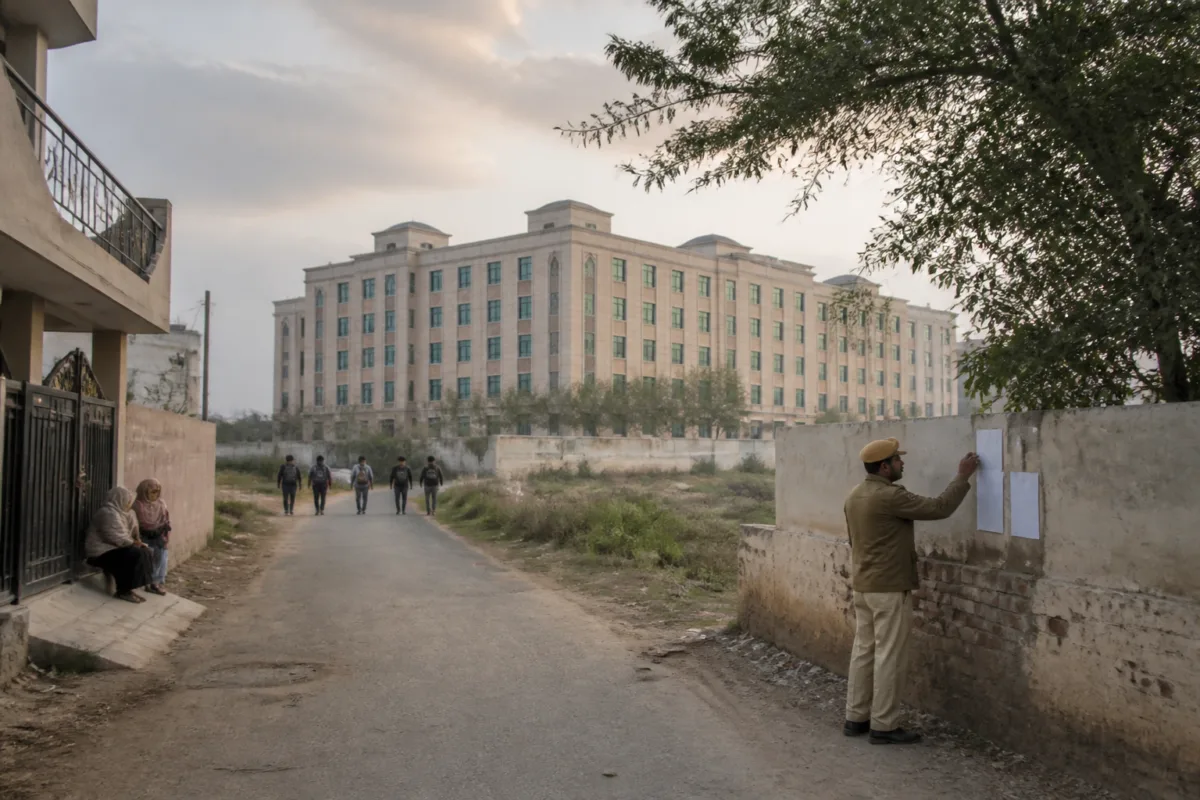
Al-Falah University is facing a prolonged test of institutional trust after a reported terror investigation connected some doctors associated with the Faridabad campus, leaving nearby villages dealing with heightened scrutiny, rental restrictions and reputational damage. A year after the incident came to light, the university’s challenge is no longer limited to the investigation itself; it also involves restoring confidence among students, residents and the authorities responsible for its oversight.
The account of the aftermath published by Jagran – New Delhi shows how a security investigation can extend beyond a campus boundary. Dhauj village, located near the university, experienced sustained police, Special Task Force and National Investigation Agency activity for about a month after explosives were found in Dhauj and Fatehpur Taga villages. Residents subsequently changed how they assessed tenants and visitors, while the university became the focus of questions about the continuity of education, the value of degrees and the institution’s ability to maintain public confidence.
The reported sequence also illustrates the difference between an incident and its urban aftermath. The original investigation was linked in the report to a so-called white-collar terror module in Faridabad. The report further said that names of some doctors associated with the university emerged during the investigation into the November 10, 2025, car blast near Delhi’s Red Fort and the earlier Faridabad case. These are reported investigative links, not findings independently established in the supplied material. Their effect, however, was visible in the surrounding settlement, where the university’s association with the investigation became a source of anxiety and social discomfort.
For Dhauj, the consequences were experienced at the neighbourhood level. Residents told the publication that the village’s public image suffered after the university came under scrutiny. The village was no longer seen only through its ordinary social and economic life; outsiders began asking questions about the incident and the people connected with the area. This kind of reputational spillover is significant because villages located around large institutions often share a practical ecosystem with them. Residents may rent rooms, provide services or interact with students and staff, even when they have no role in the institution’s administration.
The response described by village sarpanch Sajid was to focus on awareness, particularly among young people. Residents were told that maintaining social reputation and security was a shared responsibility. The most concrete change was in the rental market: according to the report, villagers would no longer rent homes to unknown people without detailed information and police verification.
That shift reflects a wider change in how ordinary housing transactions are being used as a security tool. Earlier, renting a room or house could be handled largely through personal references and local familiarity. After the incident, the village’s reported response placed formal verification at the centre of the decision. This may improve residents’ sense of control, but it also shows how a national-security investigation can alter everyday access to housing and reshape relations between landlords, tenants and local authorities.
The supplied report does not establish how many tenants were verified, how many rentals were refused or whether the police created a new verification mechanism for the villages. It does establish that residents now view tenant verification as necessary. That distinction matters. The change is documented as a local practice and community response, not as evidence of a formally measured security programme.
The university’s own institutional problem is more complex. Students were reported to have experienced mental stress and uncertainty over whether their education and degrees would remain secure. Their concerns centred on three connected issues: the continuity of classes, the recognition of degrees and future employment prospects. These concerns are common when an educational institution is drawn into a major investigation because students’ personal investment continues even when the controversy is outside their control.
At the same time, the report said the controversy had not visibly affected admissions. A university official stated that the institution had 1,700 seats across its faculties, including 200 MBBS seats, and that all MBBS seats had been filled. This figure provides one limited indicator of continuing demand, but it does not by itself demonstrate that confidence has been fully restored. Admissions can remain strong while students and families continue to seek reassurance about accreditation, academic continuity and employment outcomes.
The distinction between enrolment and trust is therefore important. A filled seat indicates that students are still joining the programme. It does not answer whether they feel secure about their degrees, whether employers view the institution normally or whether current students believe the university’s reputation has recovered. The report records students’ expectation that the university should rebuild its identity through education, results and academic achievement, but it does not provide independent measures of results, accreditation status, placement outcomes or student retention.
The governance response adds another layer to the story. After continuing controversy and questions about the institution’s functioning, the Haryana government took administrative and financial control of the university in March 2026, according to the report. Senior IAS officer Amit Aggarwal was appointed administrator. This move changes the institutional context in which the university must rebuild its reputation. The issue is no longer only about public communication by the university; it also involves administrative supervision, financial control and the responsibilities of the appointed authority.
The report does not specify the legal instrument used for the takeover, the precise powers granted to the administrator, the duration of the arrangement or the governance benchmarks against which the university will be assessed. Those details would be necessary to evaluate whether the intervention is primarily an accountability measure, a stabilisation arrangement or a longer-term restructuring process. What is clear from the supplied account is that the state’s involvement represents a significant escalation from reputational management to formal administrative oversight.
This matters because universities are not isolated buildings. They are operating institutions that depend on a chain of public and private systems: regulatory permissions, financial management, faculty continuity, student admissions, housing around the campus and local security coordination. When one part of that chain is disrupted, the effects can spread to residents and students who may have no connection with the conduct under investigation.
The Dhauj experience also highlights the limits of treating security as only a campus matter. Police, the Special Task Force and the NIA were reported to have visited the village repeatedly for about a month. Afterward, residents changed their rental practices and worked to educate young people. The immediate investigation may have been conducted by national and state agencies, but its social consequences were managed locally, through the decisions of landlords, village leaders and families.
There is also a question of proportionality and evidence. Community vigilance and police verification can respond to legitimate security concerns, but the supplied material does not show whether the new practice has been applied consistently or whether it has produced discrimination against particular groups. It would be premature to draw conclusions beyond the reported fact that residents have become more cautious. A fuller assessment would require information from the police, local administration, residents and tenants about how verification is conducted and what safeguards exist.
For the university, the next phase will depend on whether formal oversight can translate into visible academic stability. The immediate concerns identified by students—degree recognition, uninterrupted study and employment prospects—are institutional questions that require more than assurances. The supplied report does not state whether the administrator has announced a timetable, academic reforms, student grievance measures or a public report on the university’s condition. Those omissions leave the practical content of the takeover unclear.
The evidence currently supports a narrower but important conclusion. The reported incident affected three connected urban systems: the village housing market, the university’s social reputation and the state’s approach to institutional control. Dhauj residents responded by tightening access to rental housing and conducting awareness efforts. Students continued to seek assurance about their academic future. The Haryana government responded by assuming administrative and financial control. None of these developments, on their own, proves that the university has recovered or that the surrounding security concerns have ended.
Al-Falah University’s recovery will therefore be measured less by the passage of time than by whether students receive clarity, whether administrative oversight becomes transparent and whether nearby communities can regain a normal relationship with the institution. For now, the reported aftermath shows that the impact of a security investigation can persist through housing decisions, educational uncertainty and changes in public administration long after the initial headlines have faded.

