


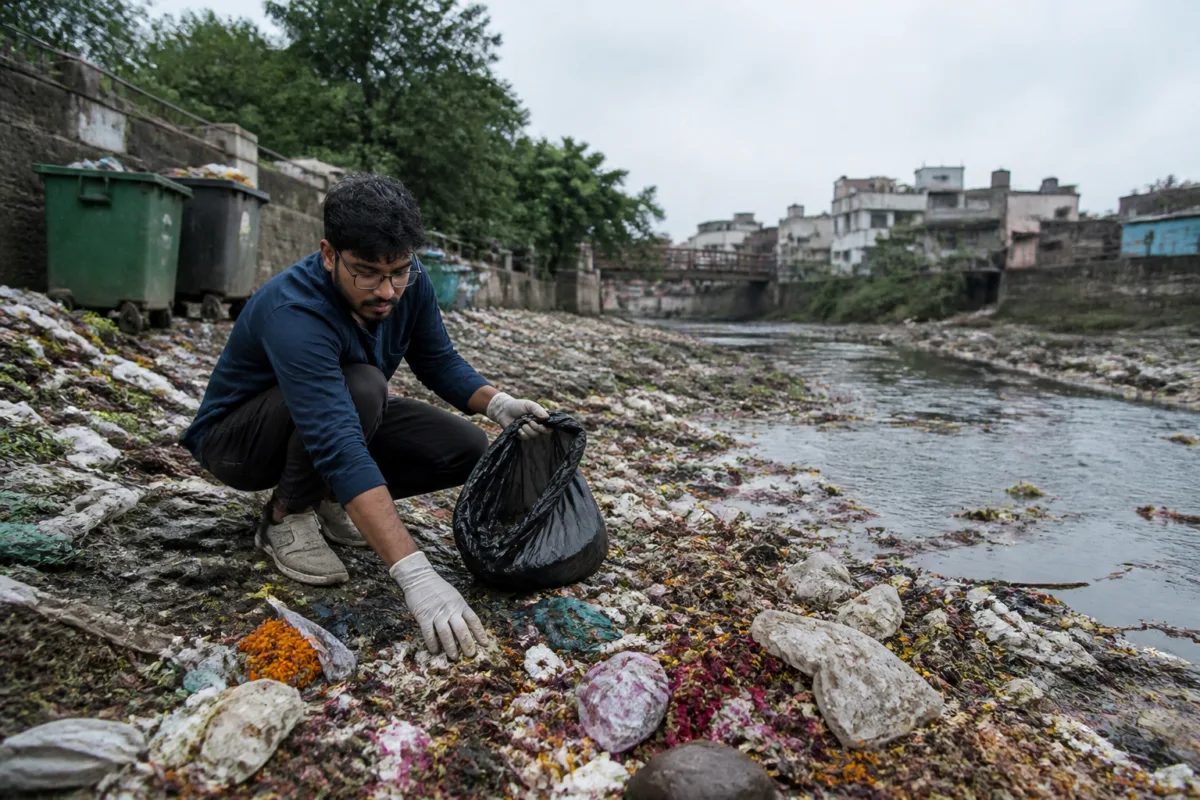
When a 20-year-old student says he may stop cleaning the Ajnar river because people dirty it faster than he can restore it, the immediate story is one of exhaustion. The larger story is about the limits of clean-up campaigns that remove waste without changing how a town collects, controls and disposes of it.
Surendra Singh Choudhary, known as Bittu Tabahi, has spent the past year cleaning a stretch of the Ajnar in Biaora, in Madhya Pradesh’s Rajgarh district. He began on January 26 with a few friends and later continued largely alone, using his own money, basic tools and manual labour. His effort drew attention across India and abroad after videos of the clean-up showed a visibly clearer stretch of river.
But the improvement did not last. According to Bittu, residents and visitors repeatedly dumped garbage back along the riverbank, sometimes soon after he had cleaned it. Fresh waste accumulated after Dussehra, worsening his frustration. “I have been working to clean this river for the past year. Every time I have cleaned it, people have dirtied it again,” he told the Times of India. He also said he was beginning to lose heart and was considering focusing on his studies instead.
That reaction is important because it identifies a basic distinction often lost in public clean-up drives: removing existing waste is not the same as preventing new waste from entering the system. The first is a visible operation that can be completed by a determined individual. The second requires routine civic infrastructure, local administration, enforcement and changes in public behaviour.
The Ajnar’s condition, as described in the report, suggests that the river had long been treated as an open dumping ground. Passers-by reportedly covered their mouths because of the stench. Bittu’s intervention changed one stretch temporarily, but it did not alter the conditions that allowed waste to accumulate there in the first place. The recurrence of pollution therefore became a test of whether the town’s waste practices had changed, rather than simply whether one stretch had been cleaned.
Bittu’s campaign also shows how easily responsibility for a public environmental asset can shift from institutions to individuals. There was no government order, formal campaign or dedicated funding behind his initial effort. He bought supplies himself, entered foul water despite not knowing how to swim and continued working despite health risks and encounters with snakes. His actions filled an obvious gap, but they could not substitute for a permanent service.
The limits of that arrangement became visible when Bittu installed two dustbins along the riverbank and one later went missing. The bins were intended for public use, not personal convenience, he clarified. Their disappearance illustrates the weakness of isolated infrastructure when it is not supported by maintenance, monitoring and a reliable system for collecting the waste placed inside it. A bin can provide a disposal point; it cannot by itself ensure that waste is deposited correctly, collected on time or kept away from the river.
The episode also raises a question about the institutional role of the local Nagar Palika. The report says Bittu carried out another clean-up with the Nagar Palika team, indicating that the municipality has participated in at least some operations. Yet the repeated return of waste shows that occasional joint drives have not resolved the underlying problem. The available account does not establish the town’s collection coverage, the frequency of waste removal, the location of disposal facilities or whether penalties are imposed for dumping. Those gaps matter because a clean riverbank depends on these routine functions more than on one-off campaigns.
A national flag found among the waste during one clean-up became, for Bittu, a symbol of the disconnect between public reverence and public responsibility. “When will we understand our responsibility?” he asked. The question is not only about individual behaviour. It also concerns how responsibility is divided between residents, visitors, municipal authorities and local institutions. Public participation is necessary, but participation cannot be treated as a replacement for public administration.
The Ajnar case provides no evidence that every resident is dumping waste or that the municipality has failed in every aspect of its work. It does show, however, that the existing response has not prevented the river from being polluted again. That distinction is essential. A clean-up video may demonstrate effort and produce short-term visibility, but repeated re-pollution is evidence that the intervention has not yet become a functioning civic system.
There is also a sustainability question. Manual removal can make pollution visible and mobilise public attention, but it exposes volunteers to contaminated water and other physical risks. Bittu reportedly worked without machinery and faced health hazards while cleaning the river. A model that depends on an individual repeatedly entering foul water is not a durable environmental management strategy. It may be valuable as a catalyst, but it is not a substitute for safer and institutionalised operations.
The story’s most revealing feature is the gap between recognition and support. Bittu’s videos earned attention in India and abroad, yet that recognition did not stop new waste from reaching the river. Public visibility can amplify a civic problem, but it does not automatically produce funding, enforcement or operational continuity. In this case, the campaign became a symbol of individual environmental action while the river remained exposed to the same disposal practices.
The supplied report does not provide historical pollution measurements, waste volumes, water-quality tests or a timeline of municipal spending. It is therefore not possible to quantify how much the river improved or how quickly it deteriorated. What can be established is the repeated pattern described by the volunteer: cleaning, renewed dumping and another clean-up. That pattern is enough to identify a governance problem, even if it does not measure the full scale of the environmental damage.
For Biaora, the immediate question is whether the riverbank will continue to depend on Bittu’s personal commitment. If he stops, the clean-up may lose its most visible organiser. The longer-term question is whether the local civic system can prevent waste from reaching the Ajnar regardless of whether a volunteer is present. That would require the responsibilities that the current account leaves unresolved to be made visible: who provides disposal points, who empties them, who monitors dumping, who responds to repeat violations and how residents are expected to use the riverbank.
Bittu’s possible withdrawal should therefore not be read simply as the end of a volunteer campaign. It is a warning about what happens when civic responsibility is personalised. An individual can draw attention to a neglected river, mobilise people and remove accumulated waste. But keeping the river clean requires a system that continues after the volunteer goes home, after public attention moves elsewhere and after the next festival generates another wave of waste. The Ajnar’s future will depend less on how much one student can remove than on whether the town can stop treating the river as a disposal ground.

