


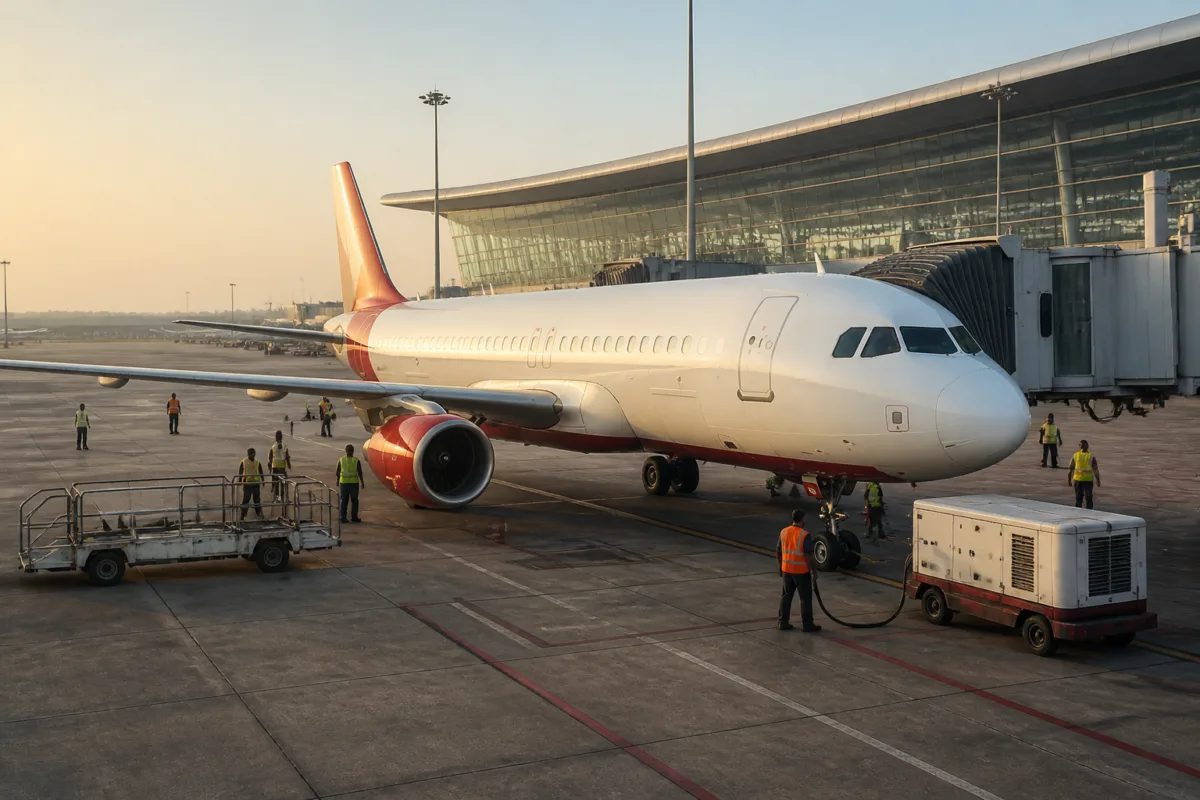
Air India has asked pilots operating its A320 aircraft to improve fuel efficiency through changes to ground operations, fuel planning and flying practices, as the airline pursues a wider cost-reduction programme.
The guidance, contained in an internal communication reviewed by The Hindu BusinessLine, covers the use of ground power and pre-conditioned air, delayed use of the auxiliary power unit, single-engine taxiing where permitted, and more efficient climb, cruise, descent and landing practices.
The communication was sent by Captain Abhinav Aggarwal, Chief Pilot–A320, Flight Operations. It highlights both the operational and environmental benefits of reducing fuel consumption. Airline sources told BusinessLine that some of the measures were already in place but were being reiterated amid high aviation turbine fuel prices and the airline’s financial position.
Air India’s guidance does not override approved company manuals, fuel policies or the commander’s authority, according to the communication. Fuel required for a safe flight remains non-negotiable.
On the ground, pilots have been advised to use external power and pre-conditioned air wherever available, while starting the aircraft’s auxiliary power unit as late as practical. Single-engine taxiing has been recommended only where company policy, operating conditions, traffic and taxi time permit.
For fuel uplift, crews have been asked to carry what the operation requires, with sound justification for discretionary fuel. The guidance also calls for managed climb profiles, planned cost indices, optimum cruising levels and direct routings wherever practical.
During descent and landing, early coordination with air traffic control is recommended to reduce level-flight segments and enable continuous descent. The guidance also advises against unnecessarily early deployment of landing gear and flaps while maintaining a stabilised approach. Reduced-flap landings and idle reverse thrust are recommended only where operating conditions and company procedures allow.
The communication states that saving 80 kg of fuel per departure could avoid roughly 250 kg of carbon dioxide emissions per flight. It does not set this as a mandatory saving target.
The measures come as aviation fuel costs place increased pressure on airline finances. Industry estimates cited by BusinessLine put aviation turbine fuel at around 50–55 per cent of airlines’ operating costs, compared with the usual 30–40 per cent. In Delhi, ATF prices were reported at around ₹138 per litre after the November 1 revision, the fourth consecutive monthly increase.
The fuel-efficiency guidance forms part of the Tata Group-promoted airline’s broader ₹6,000-crore cost-saving programme. At an employee townhall on Wednesday, Air India chief executive officer and managing director Tewolde Gebremariam outlined a target of reducing non-fuel expenditure by 20 per cent and fuel costs by 5 per cent. Of the overall target, potential savings of ₹3,500 crore had been identified and ₹1,500 crore achieved, according to the report.
Around 11 senior executives are driving the exercise, which has received more than 1,500 employee suggestions. Gebremariam also said Air India and Air India Express would increasingly share enabling functions such as finance, human resources and information technology, while retaining separate Air Operator Certificates, brands and business models.
The two airlines’ regulatory, operational and customer-facing functions will remain separate, while enabling functions and centres of excellence are expected to operate increasingly at group level. Air India did not respond to BusinessLine’s queries about the report.
For airports and aviation networks, the measures show how operational decisions made at aircraft and crew level can affect both airline economics and emissions. Their practical impact will depend on operating conditions, air traffic coordination, airport ground-support availability and adherence to safety procedures. The communication itself makes clear that efficiency measures remain subordinate to approved procedures and the commander’s authority.

