


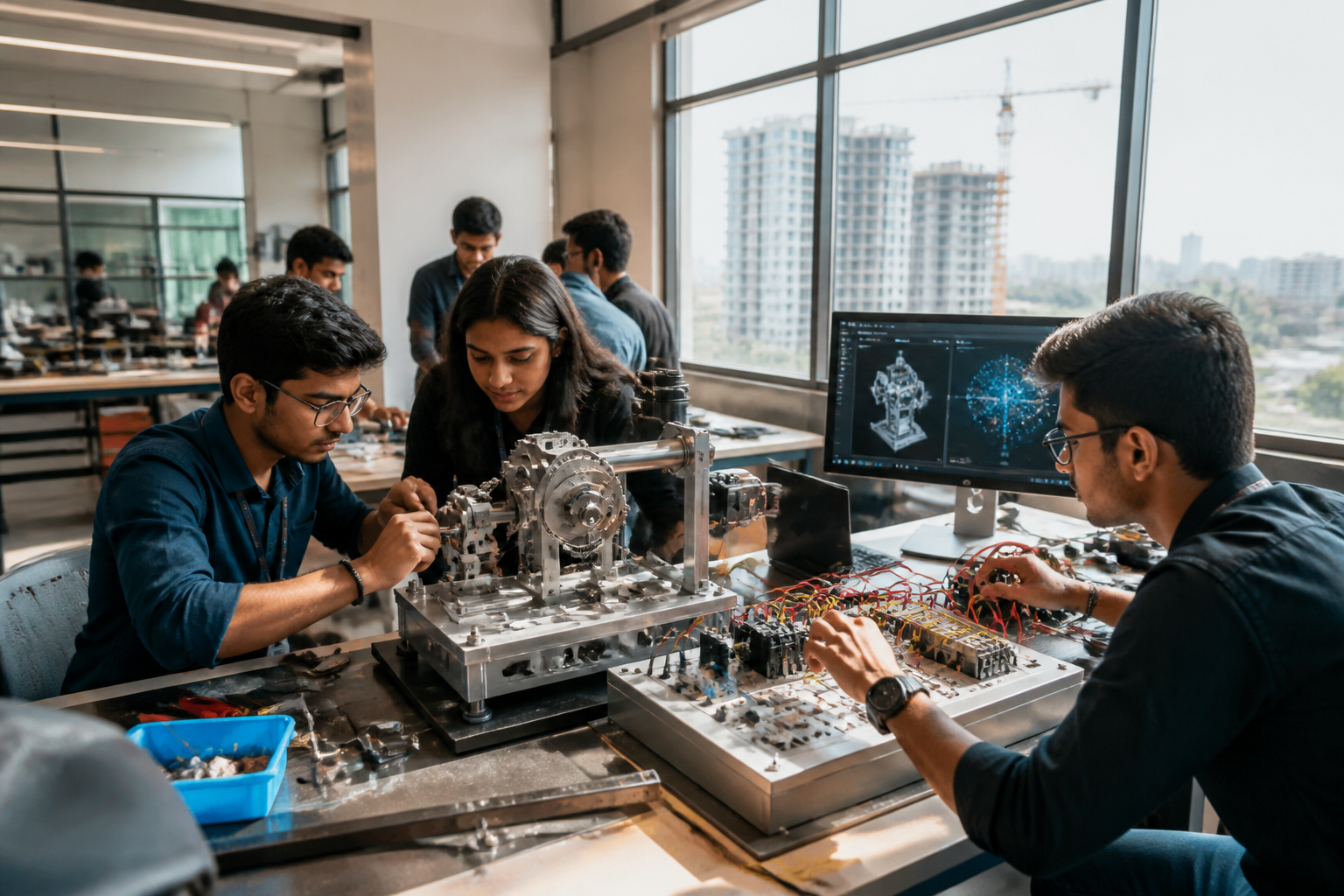
Engineering admissions in Maharashtra are showing a measurable shift towards core disciplines as artificial intelligence changes hiring patterns in the information technology sector. Data from the State Common Entrance Test Cell shows that admissions in mechanical, civil, electrical and electronics and telecommunication engineering increased between 2024-25 and 2026-27, even as computer engineering remained the single largest branch by enrolment.
The change is important because it points to a reassessment of what an engineering degree is expected to provide. For several years, student demand was strongly associated with computer-focused courses and the employment opportunities offered by information technology services and product companies. The latest admissions figures indicate that students are now looking at a wider combination of skills: technical knowledge of a specific sector, combined with the ability to work with AI systems.
According to the CET Cell data cited by Loksatta, 1,81,927 students confirmed admission to first-year degree engineering courses across 387 colleges. Computer engineering attracted the highest number, with 28,170 admissions. The figures therefore do not show a decline in interest in computing. Instead, they show that the broader engineering system is becoming less concentrated around a single group of technology-oriented branches.
The strongest increase was recorded in mechanical engineering. Admissions rose from 16,122 in 2024-25 to 17,115 in 2025-26 and 19,702 in 2026-27. Civil engineering admissions increased from 10,719 to 12,415 and then to 14,213 over the same period. Electrical engineering admissions stood at 9,963 in 2024-25, dipped marginally to 9,910 in 2025-26 and then rose to 11,726 in 2026-27.
Electronics and telecommunication engineering also recorded sustained growth. Admissions increased from 17,343 in 2024-25 to 17,878 in 2025-26 and 18,895 in 2026-27. Across these four branches, the movement is consistent enough to indicate a change in student preference rather than a one-year fluctuation in a single discipline.
The numbers do not, by themselves, establish that AI caused the increase. However, the explanation provided by Dr Sheetalkumar Ravandal, president of the Maharashtra Training and Placement Officers Association, links the shift to changing recruitment requirements. He said information technology services companies are using AI more widely, affecting the volume of recruitment, while companies increasingly want engineers who understand a sector and can also work with AI.
That distinction is central to understanding the admissions trend. AI can be treated as a general-purpose capability that operates across industries, but the work it supports still depends on knowledge of a particular field. A mechanical engineer may work with manufacturing processes, an electrical engineer with power systems, a civil engineer with construction or infrastructure, and an electronics engineer with communication and control systems. The source material does not provide placement figures by branch, but the comments from the training and placement association suggest that employers are placing greater emphasis on the combination of domain knowledge and AI familiarity.
## What the engineering admissions data shows
The admissions pattern has a direct connection with the built environment and the urban economy. Civil, mechanical, electrical and electronics engineers are involved in the systems through which cities are planned, built, powered and connected. Their work extends across construction, transport equipment, utilities, industrial production, communications and other technical functions that support urban growth.
For cities, the significance of the trend lies in the potential alignment between education choices and the complexity of urban systems. A city is not only a software platform or a network of digital services. It also depends on physical infrastructure, construction activity, energy systems, manufacturing capacity and communications networks. Each of these areas requires technical workers who understand how physical systems operate.
The renewed interest in core branches may therefore reflect a broader recognition that technology cannot be separated from the sectors in which it is deployed. AI tools may alter how design, monitoring, modelling or operations are carried out, but they do not remove the need to understand materials, machines, electrical networks, structures or communications equipment. The available evidence supports this as an explanation offered by an industry representative, not as a definitive causal finding established by the admissions data.
The figures also complicate the idea that students are moving away from technology. Electronics and telecommunication admissions rose throughout the three-year period, while computer engineering remained the largest branch. This suggests that the emerging preference may not be for traditional engineering instead of technology, but for engineering disciplines that combine technology with an identifiable application area.
## The institutional signal behind the shift
The CET Cell’s role is significant because its admissions data captures decisions made across 387 engineering colleges in the state. It provides a system-wide view of enrolment rather than an isolated account from one institution. The three-year comparison also makes it possible to identify whether a branch is gaining or losing student interest over time.
At the same time, admissions data has limits. It records students who confirmed admission, but it does not explain their individual motivations, the quality of the institutions they selected, their later academic performance or their eventual employment outcomes. It also does not indicate whether the increase in admissions corresponds to stronger demand from employers or whether colleges changed seat availability in these branches.
Those distinctions matter for interpreting the numbers. A rise in admissions can indicate improved student confidence, changing perceptions of job prospects, altered counselling practices or changes in the availability of seats. The material supplied does not identify which of these factors contributed to the trend. The most defensible conclusion is that interest in core branches has increased while the labour-market explanation is being framed around AI-enabled changes in recruitment.
The comments from the Maharashtra Training and Placement Officers Association add an institutional perspective that is not visible in the raw numbers. Placement officers sit between colleges and employers and observe changes in recruitment requirements. The association’s position is that companies increasingly seek engineers with both domain knowledge and an understanding of AI. That claim helps explain why core branches may be regaining relevance, although the supplied report does not include a separate employer survey or placement dataset to measure the change.
## AI shift and the future of technical skills
The reported trend points towards a skills model in which AI is layered onto existing engineering knowledge. This is different from treating AI as a standalone substitute for disciplinary expertise. In this model, the engineer’s value depends partly on knowing what problem needs to be solved, what technical constraints apply and how a result should be tested in a real operating environment.
That distinction is especially relevant to the built environment. Infrastructure and construction projects are shaped by site conditions, safety requirements, materials, regulations, network constraints and long operating lives. Digital tools can assist such work, but the source material does not claim that they replace the underlying engineering disciplines. Instead, the reported demand is for professionals who can understand their sector and use AI effectively within it.
For engineering colleges, this creates a curriculum challenge. The admissions figures show where students are choosing to study, but they do not establish whether institutions are prepared to combine core engineering education with AI capability. The available report also does not specify any changes in syllabi, faculty training, laboratory infrastructure or placement programmes. These are therefore areas that require further evidence rather than assumptions.
For students, the pattern may be read as a warning against a narrow understanding of employability. Computer engineering remains the most popular branch in the reported admissions, but the growth in other disciplines suggests that the market value of technical education may increasingly depend on application and adaptability. The central question is not simply whether a student studies AI, but whether AI can be used meaningfully in a field where the student has substantive knowledge.
The urban economy depends on this relationship between education and work. Cities require engineers for both digital services and physical systems, and the changing recruitment environment may influence how young people assess those career paths. If core engineering branches continue to attract more students, colleges and employers will need to demonstrate how those qualifications connect with contemporary work, including AI-enabled processes.
The current data confirms a clear admissions movement: mechanical, civil, electrical, and electronics and telecommunication engineering all recorded higher enrolment in 2026-27 than in 2024-25, while computer engineering remained the largest branch. It also records an attributed industry explanation linking the change to AI’s growing role in recruitment. What remains unestablished is the precise contribution of AI to student choices and whether the rise in admissions will translate into stronger placement outcomes. Future CET Cell admissions data, branch-wise placement figures and documented changes in engineering curricula will show whether this is a short-term perception shift or a deeper reset in the relationship between core engineering and technology employment.
