


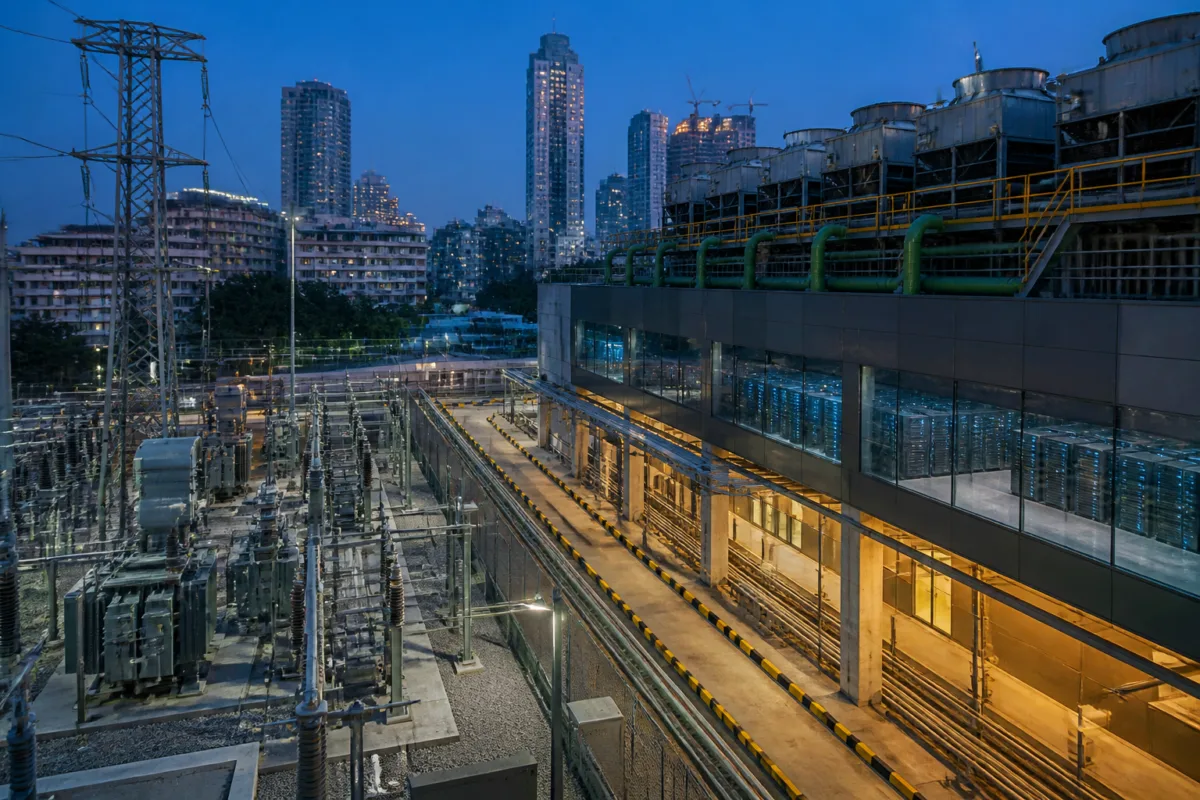
Hitachi India’s research agenda is moving towards a problem that will increasingly define the performance of Indian cities: how to manage electricity systems that are more digital, more distributed and more dependent on uninterrupted power. The company’s 40-member India R&D centre is working on peer-to-peer energy trading, grid stabilisation, cybersecurity for remotely controlled energy equipment and artificial intelligence-led cooling for data centres, according to Kingshuk Banerjee, Director-Research and Development, Hitachi India.
The significance of this shift lies less in any single product than in the changing architecture of urban infrastructure. Electricity networks are no longer only systems that generate power at large plants and deliver it one way to consumers. The research areas outlined by Hitachi point towards a network in which equipment can be remotely monitored, consumers or distributed assets can potentially exchange energy, and software can influence how critical infrastructure responds to changing conditions.
That transition is already visible in the sectors where Hitachi operates. Banerjee said artificial intelligence and digital engineering now function as a horizontal layer across the company’s energy, mobility and industrial portfolios. These include power equipment, rail systems, elevators, data centres and space technology. The underlying engineering disciplines remain electrical, mechanical and electronics engineering, but embedded intelligence is increasingly being used to determine how systems perform and how differentiated they become.
For cities, this is an important distinction. AI in infrastructure is not limited to chatbots or cloud-based services. It can sit inside a power device, a rail system, an elevator controller or a compact chip. The technology must then operate within physical constraints, respond to real-world conditions and remain dependable when the network around it is under stress. That makes the quality of the engineering, the design of safeguards and the security of connected equipment as important as the software itself.
The India centre’s energy research is being shaped by two linked pressures identified in the interview: rising electricity demand and the expansion of data centres. Banerjee said demand for electricity will continue to grow exponentially, particularly as data centres expand. The interview does not provide a forecast for demand, new generation capacity or data-centre consumption, but it establishes the direction of the challenge. More digital infrastructure creates more demand for reliable electricity, while the infrastructure used to supply that electricity becomes more digitally connected.
This creates a difficult operational balance. Grid operators must maintain stability while dealing with equipment that may be remotely controlled and with demand that can change across locations and time periods. Hitachi’s work on grid stabilisation and peer-to-peer energy trading addresses different parts of that problem. Grid stabilisation concerns the ability of the electricity system to remain balanced and functional. Peer-to-peer trading points towards a model in which energy transactions could involve a wider set of participants rather than only the traditional relationship between a central supplier and an individual consumer.
The interview does not establish that either system has been deployed commercially in India. It says the centre’s research process generally begins with a seed idea, followed by a proof of concept and a proof of technology. Some technologies have been commercialised, while others are moving towards commercialisation. That distinction matters because a research direction is not the same as an operational utility, a regulatory approval or a citywide infrastructure programme.
It also reveals where the institutional complexity of digital infrastructure is likely to increase. Remote terminal units, or RTUs, are among the equipment cited by Banerjee in relation to cybersecurity. Such equipment can allow energy assets to be monitored or controlled remotely. Connecting more equipment can improve visibility and enable quicker intervention, but it also creates more points at which a failure, intrusion or poorly controlled instruction could affect operations. The interview identifies cybersecurity as a research area, but does not provide details of the security architecture, standards or incident record involved.
The issue is particularly relevant to municipal and metropolitan systems because power infrastructure rarely operates in isolation. Elevators depend on electricity for vertical mobility in high-rise buildings. Rail systems require dependable electrical and control systems. Data centres support digital services while also adding concentrated demand to the power network. A weakness in one layer can therefore create operational consequences beyond the asset where it originates, although the supplied interview does not quantify such risks or describe a specific failure.
Hitachi is also researching AI-led cooling for data centres. Cooling is a core engineering requirement for facilities that house computing equipment, and the company places this work within a broader effort to use AI across its energy and industrial portfolio. The interview does not specify the cooling technology, energy savings or sites involved. Its importance in the research agenda nevertheless reflects the close connection between computing growth and physical infrastructure: more digital capacity requires not only servers and connectivity, but also power management and thermal control.
The company’s approach to AI development also provides a useful indication of how industrial research is changing. Banerjee said a prototype that once took three months can, in some cases, be assembled within a few hours with coding assistance. He did not suggest that researchers had become unnecessary. Instead, the stated expectation is that researchers will spend less time on routine implementation and more time on knowledge, imagination and innovation. Hitachi’s cautious hiring approach, he said, reflects the need to understand an area thoroughly before scaling it rather than fear of AI.
That principle is especially relevant when AI moves from an office workflow into physical infrastructure. A coding assistant can accelerate the creation of a prototype, but a system controlling energy equipment must also meet engineering, safety and security requirements. The supplied material does not set out Hitachi’s validation process in detail, but its reference to proof of concept and proof of technology suggests a staged path between an initial idea and possible commercialisation.
The India centre’s work on fintech illustrates another part of this transition: the attempt to move intelligence closer to the device. Hitachi is researching agentic and frictionless payments, including identity checks, counterparty validation and transaction processing. Banerjee said the system should be able to understand local languages, pronunciation and regional accents, while the required intelligence should be compact enough to run on a small device or chip. Although payments are outside the core energy story, the technical objective is relevant to infrastructure more broadly. It reflects a push towards systems that can make or support decisions at the edge rather than depending entirely on a distant cloud.
That same requirement appears in the centre’s work supporting selected space initiatives. Banerjee said space systems face strict limits on energy, bandwidth and computing capacity, creating a need for compact systems, embedded intelligence and a high degree of autonomy. An onboard system may need to navigate, make decisions or conduct experiments without consulting ground stations. The India team’s stated contribution is primarily in AI and autonomy, while most of Hitachi’s space research remains based in Japan.
The contrast between space systems and urban energy systems is revealing. One operates under extreme limits of communication and power; the other operates within a dense, interconnected civic network. Yet both require intelligent systems to function safely when continuous human intervention or cloud access is not guaranteed. Banerjee identified safety and intent preservation as the central guardrails for AI in space, saying an autonomous system must remain within its intended purpose and must not take unsafe or hostile action. The same broad principle is relevant to connected urban infrastructure, even though the interview does not apply it directly to grid operations.
For policymakers and infrastructure institutions, the emerging question is therefore not simply how quickly AI can be introduced. It is how responsibility is allocated when software becomes part of equipment that manages electricity, mobility or building operations. The supplied material identifies the research priorities but does not specify the regulatory framework, procurement model or public authority responsible for overseeing these applications in India. Those details will determine how research moves from corporate laboratories into infrastructure used by citizens.
The evidence currently supports a measured conclusion. Hitachi India R&D is expanding its work into energy trading, grid stabilisation, cybersecurity, data-centre cooling and autonomy, while applying AI across energy, mobility and industrial systems. Some technologies have already reached commercial use, others are moving towards it, and several remain at the research or proof stage. The immediate urban significance is that infrastructure capacity will increasingly depend on the interaction between physical engineering and embedded intelligence. What remains to be established is the scale of deployment, the performance gains, the safeguards and the institutional rules that will govern these systems as they move beyond the laboratory.

