


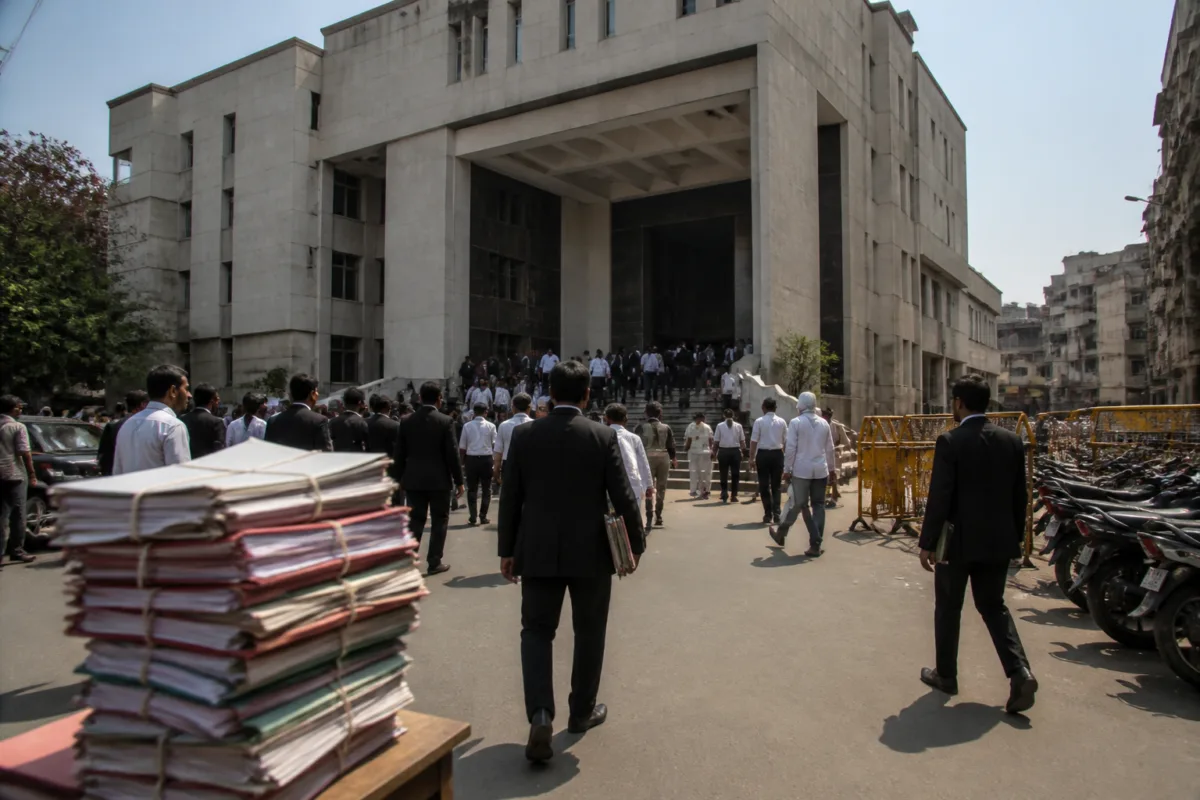
Ahmedabad’s district court pendency has reached about 3.6 lakh cases, making it the fourth-highest among India’s judicial districts, while Surat has around 1.3 lakh pending matters. The numbers have prompted a Ministry of Law and Justice-backed exercise in which Gujarat National Law University will work with both district courts to identify why cases remain unresolved and what can reduce the backlog.
The intervention matters beyond the judicial system. District courts are part of the infrastructure through which cities settle disputes over property, contracts, employment, debt, family matters, criminal allegations and public administration. When cases remain unresolved for years, the consequences extend into housing transactions, redevelopment, construction activity, business operations and household security. Court pendency is therefore not only a legal statistic; it is also an indicator of how effectively an urban economy can resolve conflict.
The Ministry has identified 100 judicial districts as pendency hotspots. According to its release, more than 5.8 crore cases are pending across courts in India, with the majority located in district and subordinate courts. The 100 identified districts account for more than half of all district-court pendency. This approach shifts attention from the national total to the specific districts where the accumulated workload is most concentrated.
That shift is significant because aggregate pendency can conceal very different local problems. Two districts may have similar case totals but face different combinations of vacant posts, adjournments, missing documents, absent parties, inadequate representation, procedural delays or high volumes of particular case categories. The proposed work in Ahmedabad and Surat is intended to establish that local picture rather than treat all pending cases as one uniform administrative problem.
Available dashboard data indicates that about 5% of Ahmedabad district’s pending cases are more than 10 years old, while around 10% have been pending for five to 10 years. These figures describe a sizeable long-duration tail within the backlog. They also show why simply counting total cases is insufficient: the age of cases determines how long litigants have been waiting and whether the original dispute, parties or evidence have changed during the proceedings.
The reported ranking places Ahmedabad fourth nationally, while Surat stands 80th among the 100 identified hotspots. The two Gujarat districts therefore represent different levels of concentration, but both have been included in the same national exercise. The comparison may allow the participating university and court authorities to examine whether the causes of delay are common across districts or shaped by local litigation patterns and administrative conditions.
Prof S Shanthakumar, director of GNLU, said the university would work with officials from the Ahmedabad and Surat district courts. He is expected to lead the project with faculty members and senior students. The stated objective is to assess pending cases, identify the root causes of delay and suggest strategies for reducing pendency.
The Ministry’s discussions with vice-chancellors of 19 national law universities from 16 states identified several possible lines of intervention. These included finding infructuous cases, profiling cases, managing adjournments, using alternative dispute resolution, applying plea bargaining, expanding mediation-assisted settlements and bringing summary-trial processes into wider use. The release also proposed using law university pro bono clubs, researchers and students for ground-level analysis in selected districts.
This design places case-level diagnosis at the centre of the response. A pending case may not be delayed for the same reason as another pending case. Some may involve parties who are no longer available. Others may lack documents, representation or technical compliance. Prof Shanthakumar said preliminary work with judicial authorities had indicated a high prevalence of criminal cases in the pendency and that these cases were affected by multiple causes.
That distinction is important for urban policy because different case types create different administrative demands. A criminal case may be affected by the availability of parties, witnesses, legal representation or documents. A property or construction dispute may involve ownership records, approvals, contracts or multiple stakeholders. Without profiling cases by type, age, procedural stage and cause of delay, a target to reduce total pendency may measure disposal without showing whether the oldest or most consequential cases are being resolved.
The proposed study also illustrates the institutional complexity of judicial reform. The Ministry can identify hotspot districts and frame a national mission, but the actual reasons for delay sit within district-level processes. Courts, prosecutors, lawyers, litigants, police, government departments and document-keeping systems may all influence how quickly a case progresses. GNLU’s role is to provide research and field-level analysis, while district courts and judicial authorities will remain central to identifying workable measures.
The use of law universities creates an additional research capacity for a system dealing with a very large caseload. Faculty members and students can examine files, classify cases and identify recurring bottlenecks under the direction of the university and in coordination with judicial authorities. However, the supplied material does not establish the project’s final methodology, reporting timeline, implementation budget or the specific administrative powers available to act on its findings.
The data currently available confirms the scale and age of part of Ahmedabad’s backlog, but it does not yet explain how many cases could be resolved through mediation, how many are affected by adjournments, or how many are stalled because of missing parties or documents. Nor does it establish whether the same causes apply in Surat. Those are precisely the questions the proposed case analysis is expected to address.
For cities, the larger issue is the reliability of institutions that convert rights into outcomes. A property title, a construction contract or a criminal complaint has limited practical value if the dispute remains unresolved for a decade. At the same time, faster disposal cannot be assessed only by the number of cases closed; the quality of decisions, procedural fairness and the ability of parties to participate also matter. The Ministry’s focus on profiling, mediation, summary processes and case management indicates that the response is being framed around several possible sources of delay rather than a single remedy.
Ahmedabad’s fourth-place ranking and Surat’s inclusion among the 100 hotspot districts provide a clear starting point, but not a complete diagnosis. The next important stage will be the detailed assessment by GNLU and the district courts: which cases form the backlog, how old they are, where they are stalled and which interventions can legally and practically move them forward. Until that work is completed, the numbers show the scale of the problem more clearly than its solution.

