


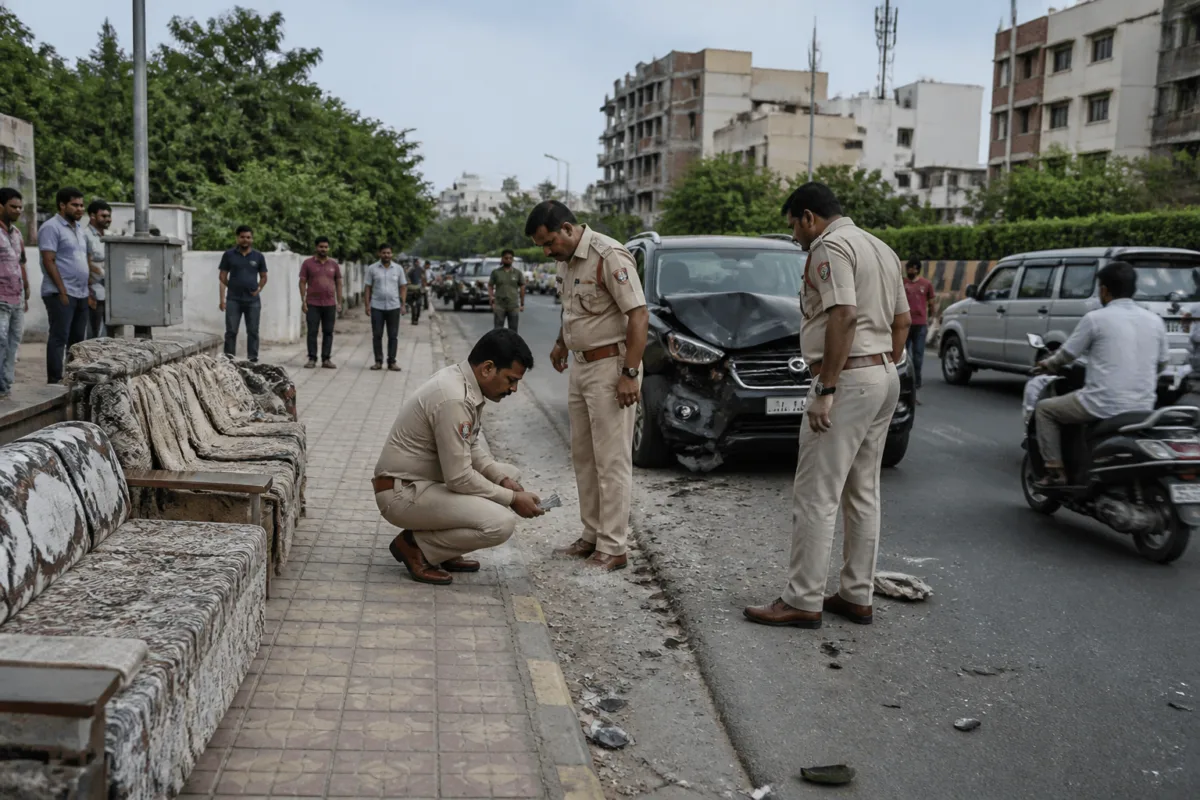
The Ahmedabad SUV crash in Nikol has become more than a fatal road accident after police disclosed that the accused driver had an earlier speeding challan that remained pending. The death toll rose to three when 34-year-old Snehal Vasoya succumbed to her injuries, bringing into focus a central urban safety question: what happens when a known traffic violation is recorded but the enforcement process does not reach its next stage?
The disclosure does not establish that the pending challan caused the November 3 crash. Nor does it, by itself, prove that the driver’s earlier violation was connected to the later deaths. But it shows a gap between identifying unsafe driving and completing the administrative action that is supposed to deter it. In a city where pedestrians, roadside sellers and motorists share narrow and contested spaces, that gap can have consequences well beyond a single traffic record.
The case also illustrates how road safety is shaped by several systems at once. There is the conduct of the individual driver, the work of traffic police, the functioning of the summons and fine process, the design and protection of footpaths, and the speed of investigation after a crash. When these systems are treated as separate matters, the public record tends to focus on the driver alone. The Nikol case shows why the chain connecting them deserves scrutiny.
What the police disclosure establishes
According to the report, police said the accused, Viral Chaudhary, had previously been issued a speeding challan by the traffic police. Inspector Salma Sumra of I Division traffic police said the driver had not been summoned to pay the fine and that the challan remained pending. The report does not specify when the challan was issued, the recorded speed, the amount of the fine, or the precise reason the summons was not followed up.
Those missing details matter because a challan is not the same as completed enforcement. The first step records an alleged violation. The next steps determine whether the notice reaches the person concerned, whether payment or a hearing takes place, and whether the matter is closed or escalated under the applicable process. In this case, the supplied report identifies the pending status but does not explain where the process stopped or which agency was responsible for the follow-up.
That distinction is important for public accountability. If a violation is detected but remains unresolved, the record may create the appearance of action without producing its intended effect. At the same time, the pending challan should not be presented as proof that the crash was preventable or that officials knowingly allowed a dangerous driver to continue on the road. Establishing that would require evidence about the timing of the violation, the notifications issued and the administrative steps taken afterwards.
The crash and the people affected
The SUV allegedly mounted the footpath near Akshar Hospital and Devasya School in Nikol. Poonam Nagwadiya, 30, and her 15-year-old son, Sagar, were selling sofa covers on the footpath when the vehicle allegedly rammed into them. Both died in the accident. Snehal Vasoya was shopping for sofa covers with her husband, Kartik, when she was struck. She later died at Civil Hospital after suffering critical injuries.
Kartik, who was also hit and lost consciousness, was later discharged from hospital. He works in the administration department of DPS School, Hathijan, and is the complainant in the case. Snehal was the mother of four-year-old twins, according to the report. These details show that the crash affected people using the same roadside space for different purposes: informal selling, shopping and walking.
That ground-level reality is central to the urban meaning of the case. A footpath is not only a strip beside a carriageway. It can function as a pedestrian route, a market space and a place where residents pause or conduct daily transactions. When a vehicle leaves the road and enters that space, the consequences are especially severe because pedestrians and roadside workers have little protection. The report does not provide details about the footpath’s width, barriers, surface condition, encroachments or separation from traffic. Those facts remain relevant to any fuller assessment of the location.
The pending challan and the enforcement chain
Traffic enforcement depends on continuity. A violation has to be detected, recorded, communicated and resolved. Each step may involve different staff, databases or administrative procedures. A failure at any point can weaken the deterrent effect of the entire system. The police statement in this case points to a pending challan, but the available material does not identify whether the delay resulted from an address problem, a procedural lapse, an incomplete summons process or another cause.
That uncertainty should not be filled with assumptions. It should instead be treated as an administrative question for the investigation and the traffic department: how are pending speeding challans tracked, how quickly are drivers summoned, and what happens when a notice remains unresolved? The answer would help establish whether this was an isolated lapse or part of a wider process problem. The supplied report does not provide data on the number of pending challans in Ahmedabad or on the rate at which speeding cases are completed.
The distinction between recording violations and acting on them is particularly important in cases involving repeat-risk behaviour. Police sources said the driver had earlier received a speeding challan, while acquaintances reportedly told investigators that he was a habitual drinker and frequently drove after consuming alcohol. Police are verifying those allegations. At this stage, the claims about alcohol use remain part of the investigation and cannot be treated as established facts.
The report also does not state whether the accused was medically tested for alcohol after the crash, what the results were, or whether investigators have formally charged him with drunk driving. Those details are significant because an allegation based on acquaintances’ accounts has a different evidentiary status from a test result or an official finding. Maintaining that distinction is essential in a case involving deaths and possible criminal liability.
A wider urban safety problem
The Nikol crash exposes the vulnerability created when high-speed traffic operates alongside unprotected pedestrian activity. The location mentioned in the report is near a hospital and a school, while the victims were using the footpath for commerce and movement. Even without drawing conclusions about the road’s design, the incident raises questions about how pedestrian space is protected near places that attract regular foot traffic.
The fact that the vehicle allegedly mounted the footpath also makes the boundary between roadway and pedestrian space a central part of the inquiry. The available report does not establish whether the SUV crossed because of excessive speed, loss of control, a collision, deliberate manoeuvring or another cause. It does establish the outcome: a vehicle entered a space occupied by pedestrians and roadside sellers, causing multiple deaths and serious injury.
For municipal and traffic authorities, the case therefore has two separate accountability tracks. The first concerns the individual crash investigation, including the driver’s conduct, the role of the absconding passenger and the evidence related to speed or alcohol. The second concerns the functioning of the traffic enforcement system and the physical safety of the location. One track should not be used to obscure the other.
The role of the wider investigation
The accused, Viral Chaudhary, 36, operates a unit manufacturing equipment for steel product plants in Nana Chiloda, according to the report. His friend, Sagar Chaudhary, who was travelling in the SUV at the time of the crash, remains absconding. The report identifies Viral Chaudhary as the accused driver and Kartik as the complainant. It does not provide the current status of the criminal case, the sections invoked, the vehicle’s registration details or the outcome of any forensic examination.
These details will determine how the case develops, but they should not be conflated with the administrative issue surrounding the pending challan. A criminal investigation examines responsibility for the crash. A review of the challan process examines whether an earlier traffic violation was properly pursued. A road-safety assessment examines whether the physical environment gave pedestrians adequate protection. Each produces a different kind of finding.
The immediate public record, then, is clear on the human cost but incomplete on the institutional chain. Three people are dead, one person was injured, a speeding challan allegedly remained pending, and police are examining claims about alcohol use. What remains to be established is how the earlier violation was handled, what the investigation finds about the crash itself, and whether the footpath and roadway design contributed to the severity of the incident.
The Ahmedabad SUV crash is therefore a test of whether urban road safety is understood as an enforcement event or as a connected system. The evidence presently available supports scrutiny of both the driver’s alleged conduct and the processes that were supposed to respond to earlier violations. Further clarity will depend on police findings, documentary details of the challan, the status of the absconding passenger and any official assessment of the crash site.

