


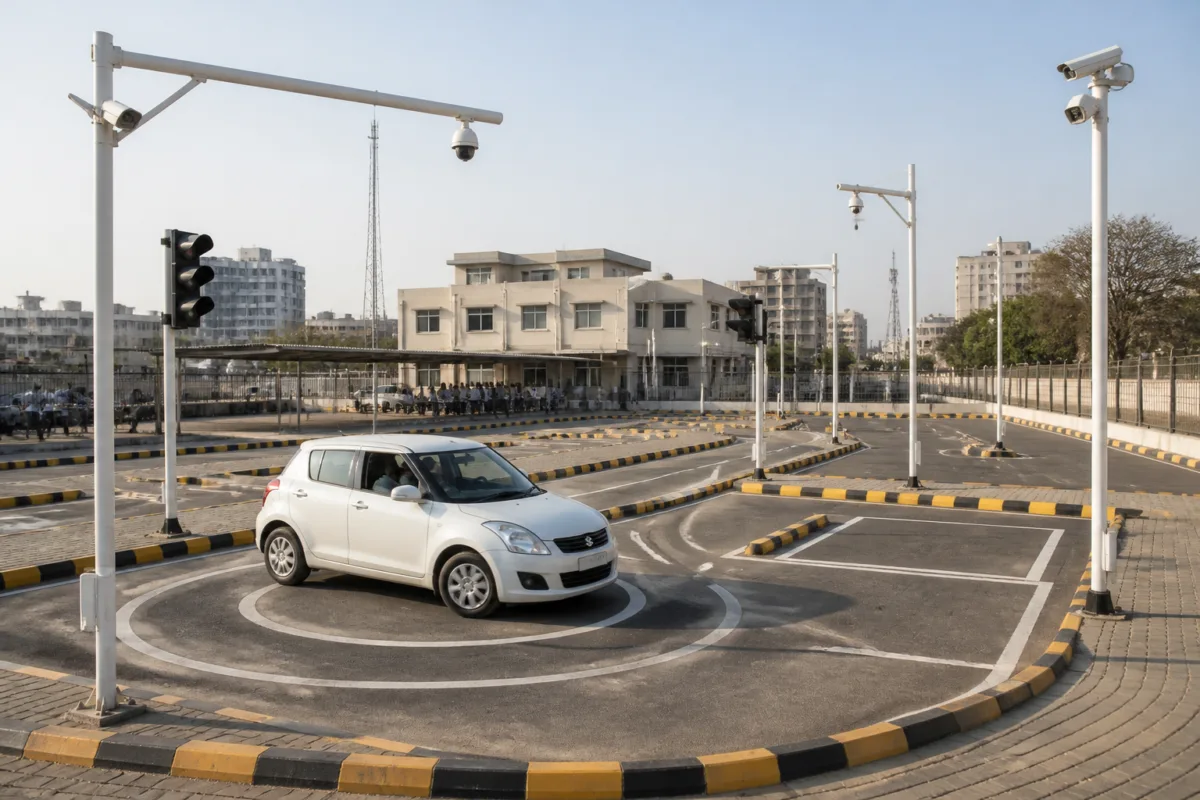
Ahmedabad’s Subhash Bridge Regional Transport Office is recording an 80% failure rate in car driving tests conducted on its AI-monitored track, leaving applicants facing a reported waiting period of up to two months for appointments. The testing system uses 16 AI cameras and five CCTV cameras to record driving performance and assess applicants’ compliance with the track’s rules.
Applicants taking the four-wheeler test must first register after receiving an appointment and watch a mandatory instructional video before entering the track. The test must then be completed within seven minutes and includes reversing, negotiating a figure-eight route, box parking and driving up a slope.
According to the report, applicants are required to complete reversing and the figure-eight manoeuvre within specified time limits. Box parking has a 90-second limit, while the slope section has a 120-second limit. The track also includes traffic signals, and applicants can fail if they cross a red signal during the test.
The testing system is designed to record the process through cameras positioned around the track. The report says that even educated applicants are failing because they make mistakes while following the prescribed manoeuvres, breach traffic rules or cannot complete the sequence within the allotted time.
The reported failure rate has increased pressure on the appointment system. The Subhash Bridge RTO had earlier allowed 130 vehicle applicants to take the driving test from morning until evening. To reduce the waiting period, the transport administration has increased the daily capacity to 160 applicants, with testing scheduled from 7am until evening.
The operating hours are also linked to the camera system’s performance. The report says testing cannot continue after dark because the AI cameras do not capture the track adequately in low-light conditions. This creates a fixed limit on the number of applicants who can be tested each day, even after the number of available slots has been raised.
The same track is used for two-wheeler testing, where applicants must complete a figure-eight manoeuvre within 60 seconds without putting a foot on the ground. For car applicants, the combination of timed manoeuvres, signals and camera-based recording makes the test dependent on both driving control and the ability to follow a tightly prescribed sequence.
The immediate response from the RTO administration has been to increase the number of daily test slots. The report does not provide a revised estimate for when the two-month waiting period will fall or indicate whether changes to the test design, time limits or camera operations are being considered.

