


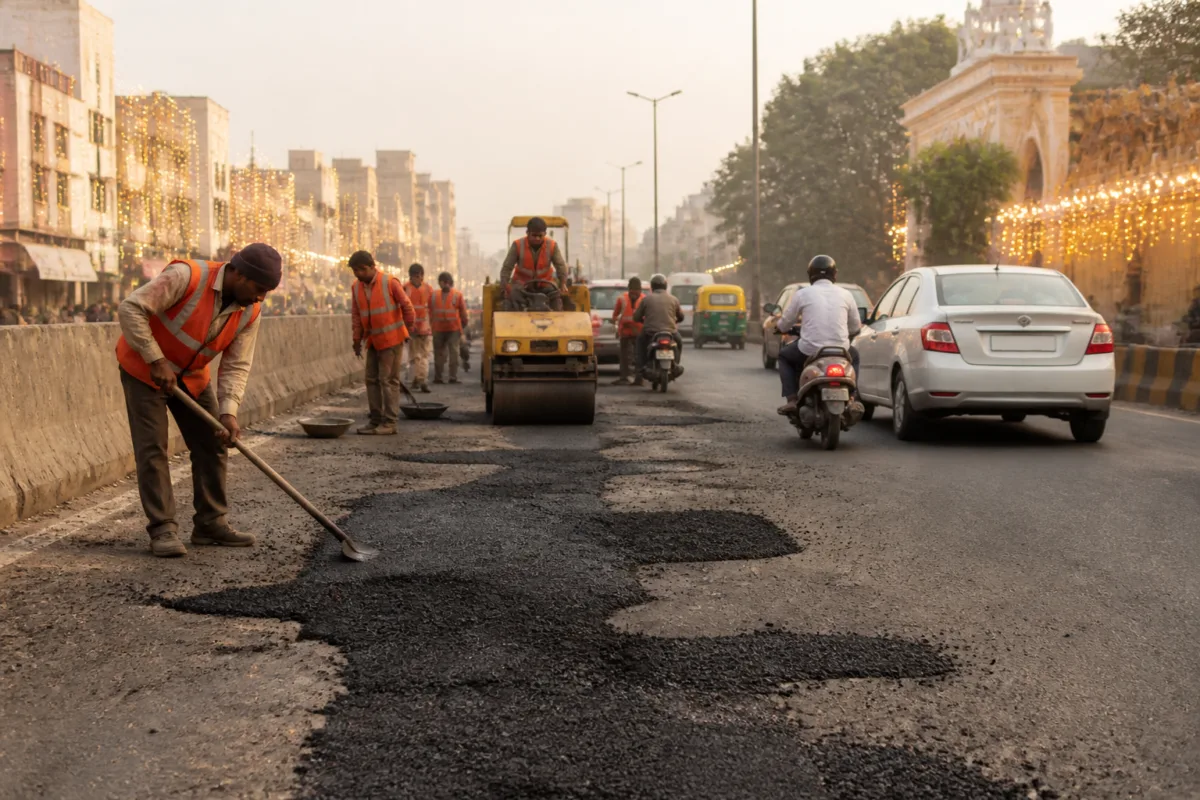
Ahmedabad Municipal Corporation has begun patching damaged roads across the city ahead of Diwali, but the work has triggered allegations that contractors are carrying out superficial repairs that may fail quickly and waste public money.
According to a report by Gujarat Samachar – Ahmedabad, patchwork activity has accelerated as the festival approaches. The report says some repaired sections began breaking apart or disappearing within a day, raising questions about the quality of the work and the way road-repair contracts are being executed.
The central concern is not only the timing of the repairs but also the method reportedly being used. Road potholes are generally expected to be prepared with suitable layers of metal, smaller aggregate and other material before a roller is used and hot-mix asphalt is applied. The report alleges that contractors are instead placing large pieces of metal directly into potholes and spreading only a thin layer of asphalt or hot mix over them.
Such work, if carried out as alleged, can leave the repaired surface vulnerable to early failure, particularly under regular traffic. For motorists, repeated deterioration means the return of potholes, uneven surfaces and potentially unsafe riding and driving conditions soon after repairs are completed.
The report also raises questions about the cost of the exercise. It alleges that patchwork is being carried out at a cost that may be twice the expense of constructing a new road. The report does not provide contract-wise cost figures, tender documents or an independent engineering assessment, so the financial allegation remains to be established through official records.
The issue points to a recurring municipal challenge: emergency-looking road repairs can improve the appearance of a street temporarily without addressing the underlying failure of the road surface. When patchwork is repeated on the same stretches, the city must spend again while residents continue to face damaged roads and traffic disruption.
For the AMC, the immediate administrative questions include the specifications used for the repairs, the quality-control process, the inspection responsibility and the contractor liability for failed work. The report alleges that established technical procedures have been bypassed, but it does not include an official response from the civic body or the contractors named in connection with the work.
The road repairs are being undertaken before Diwali, making their durability especially important as traffic and local movement increase around commercial areas and residential neighbourhoods. The report’s account places the focus on whether the ongoing patchwork will meet the required engineering standards and how the AMC will monitor the work after completion.

