


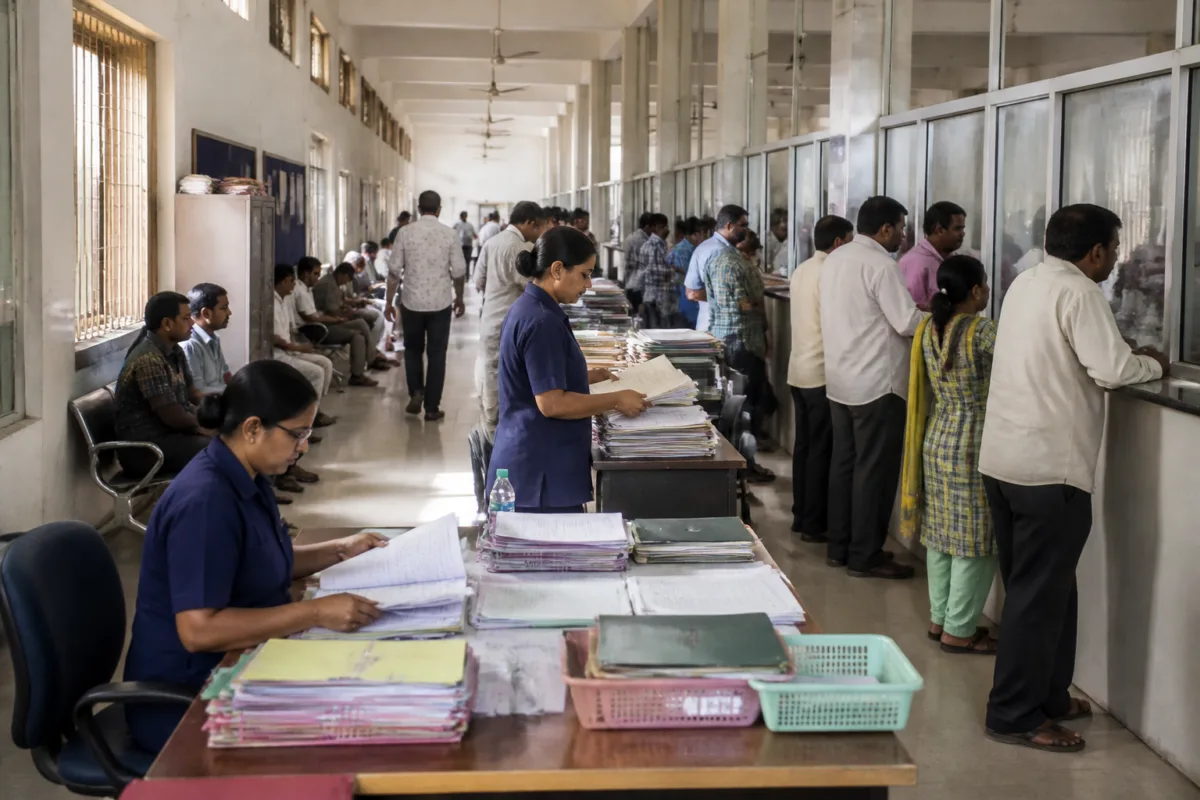
Ahmedabad Municipal Corporation’s decision to obtain 180 peons through existing private manpower agencies exposes a wider staffing problem inside the civic body: hundreds of sanctioned posts remain vacant even as essential municipal work continues to depend on contracted labour. The decision, reported by Nav Gujarat Samay, shifts attention from a single recruitment proposal to the way the corporation is managing vacancies, service expansion and administrative capacity.
According to the report, the corporation has 498 sanctioned peon posts across its departments, but only 131 are currently filled. This leaves 367 vacancies. Of these, 180 positions are now proposed to be filled through outsourcing rather than through direct municipal recruitment. The proposal was approved by the Standing Committee, although the administration subsequently amended the proposed contract period.
The immediate explanation offered by the civic administration is that the outsourced peons will be engaged for three months while a fresh tendering process is completed. Standing Committee chairman Kamleshbhai Patel told the publication that the agencies would supply peons only during this interim period and that the new tender process would be completed within those three months. The report, however, notes that the practical outcome could still be a longer-term outsourcing arrangement rather than recruitment to municipal posts.
That distinction matters because a vacant sanctioned post and a contracted manpower position are not administratively equivalent. A municipal employee occupies an approved post within the corporation’s staffing structure, while an outsourced worker is supplied through an external agency under a service contract. The two models can place different responsibilities on the employer, alter supervision arrangements and affect how continuity is maintained when contracts change.
The staffing gap has emerged as Ahmedabad’s municipal limits have expanded. The report states that the corporation has not recruited the additional staff required for the new areas incorporated into its jurisdiction. At the same time, the existing workforce has gradually declined. The result described in the report is a mismatch between the corporation’s territorial responsibilities and the personnel available to carry them out.
This is not limited to peons. The article says that recruitment has been concentrated in a few departments, while other departments have been given manpower through private agencies. It also reports that some posts listed in the staffing schedule have been abolished instead of being filled. The broader issue, therefore, is whether the corporation is treating vacancies as a temporary administrative gap or using them to redesign its workforce around outsourcing.
The proposed arrangement draws on three agencies already engaged by the municipal health department: Ultra Modern, Clean India and Shashwat Safalya Private Limited. These agencies supply manpower for urban health centres and UHCs, including peons, ward boys and support staff such as attendants and sanitation workers. The report states that the three agencies receive approximately Rs 16 crore annually for this work.
The Standing Committee’s decision to obtain the additional 180 peons from the same agencies was reportedly taken without a separate tender or quotation process. The administration’s subsequent amendment limiting the arrangement to three months was presented as a bridge until a new tender could be completed. The available report does not provide the committee resolution, the amended contract document, the tender terms or the proposed cost of the additional 180 workers. Those documents would be necessary to establish the full financial and procedural implications.
The case illustrates the administrative pressure created when city boundaries expand faster than municipal staffing systems. New areas require field offices, health facilities, sanitation operations, records management and support personnel. If recruitment does not keep pace, the corporation has limited choices: leave posts vacant, redistribute existing employees, create new sanctioned posts, or buy manpower from the market. Outsourcing can provide a faster response, but it does not by itself resolve the underlying question of how many workers the corporation needs and where they should be deployed.
For residents, the staffing model is most visible through routine services rather than through the contract itself. Peons and other support workers help keep offices and health facilities functioning, move records and supplies, assist frontline teams and support daily public-facing operations. When staffing is inadequate, the effect can appear as slower internal processing, overburdened employees or interruptions in the basic functioning of municipal facilities. The supplied report does not quantify any service delays, so the citizen impact should be understood as a capacity concern rather than as a documented finding of specific service failure.
The health department’s existing manpower contracts also show how outsourcing can become embedded in municipal operations. Once agencies are already supplying multiple categories of workers across health facilities, extending their role into other departments may appear administratively convenient. But convenience can also blur the boundary between a temporary stopgap and a permanent staffing strategy. The key question is whether the three-month arrangement will lead to a genuinely competitive tender, direct recruitment, or another extension of contracted manpower.
The report further alleges that the agencies have political backing and that municipal officials are unable to act against them. That is an allegation carried by the source and has not been independently established in the supplied material. It should not be treated as a proven finding without documentary evidence or responses from the named agencies and relevant officials. The verifiable institutional issue is narrower but significant: the corporation has a large vacancy burden, has approved an interim manpower arrangement, and is relying on agencies already contracted by its health department.
The financial comparison is also not yet available. The reported Rs 16 crore annual payment covers manpower supplied to the health department and does not establish the cost of the additional 180 peons. A proper assessment would require the number of worker-days, wages, agency fees, statutory contributions, supervision costs and the value of any direct municipal recruitment option. Without those figures, it is not possible to conclude whether outsourcing is cheaper or more expensive over the full contract period.
Procurement procedure is another unresolved part of the story. The report says the proposal to take 180 peons from the three agencies was approved without a tender or quotation, while the administration later stated that a fresh tender would be completed within three months. The relevant committee papers, legal basis for the interim engagement and terms governing the transition would clarify whether the arrangement is an emergency deployment, a variation to an existing contract or the beginning of a new procurement.
Ahmedabad’s staffing question is ultimately a governance question. Municipal corporations are judged by the services they deliver, but those services depend on internal systems that are less visible: sanctioned posts, recruitment calendars, workforce planning, departmental supervision and procurement controls. When vacancies persist across an expanding city, outsourcing can keep facilities operating while allowing the underlying staffing deficit to remain unresolved.
The evidence supplied by Nav Gujarat Samay confirms a substantial gap between Ahmedabad Municipal Corporation’s sanctioned peon strength and its filled posts. It also records the Standing Committee’s decision to use three existing manpower agencies for 180 positions, subject to an administration-stated three-month interim period and a proposed fresh tender. What remains unclear is whether the corporation will fill the vacancies through regular recruitment, institutionalise outsourcing, or revise its staffing structure. The next tender, the committee’s formal documents and the corporation’s recruitment plans will determine which of those paths Ahmedabad follows.

