


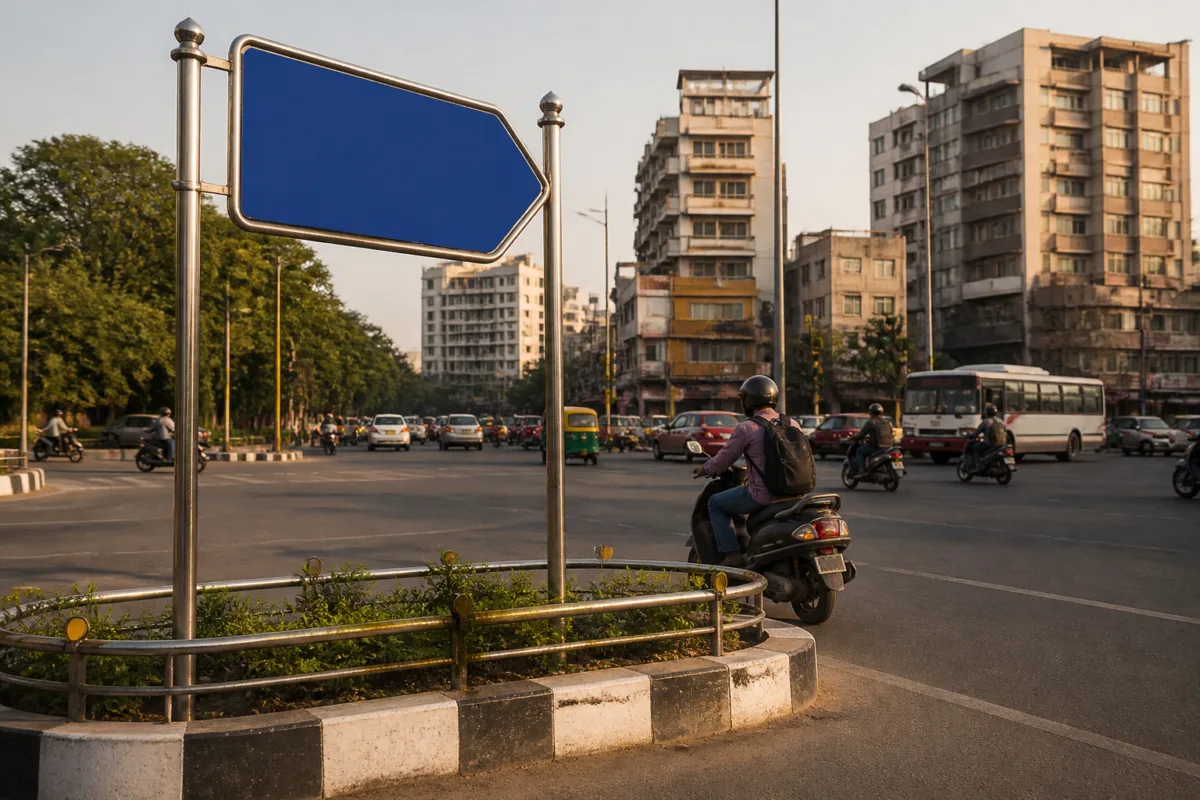
A controversy over the naming of roads and traffic circles in Ahmedabad has exposed a basic weakness in civic recognition: the absence of a clearly stated public policy defining who should be honoured and why. A report by Nav Gujarat Samay says political recommendations can influence the naming of public spaces, including in cases where the individuals concerned may not have made a demonstrable contribution to the city or wider society.
The issue is not only about the names displayed on road signs. Naming public infrastructure is a municipal act of recognition. It determines whose contribution is remembered in the everyday geography of a city and gives an official stamp to a person’s association with public space. When the criteria are unclear, the process can become vulnerable to influence, family pressure or short-term political calculations.
According to the report, sources in the Ahmedabad Municipal Corporation’s Estate and Town Development Officer department said political recommendation is required for naming public roads and circles. The report also said that names of people without an identifiable contribution to the city or to all sections of society can become attached to civic infrastructure.
These claims were not presented as a new municipal rule. Rather, they describe a practice that the report says has continued for several years. That distinction is important. A continuing practice may be familiar within an administration, but familiarity does not by itself establish a transparent or publicly defensible standard.
The report quoted Bhagyesh Patel, chairman of the municipal Town Planning Committee, as acknowledging that a specific policy for naming roads and circles is necessary. Patel said such a policy would help ensure that the right people receive appropriate recognition and justice. His response points to the central institutional gap: the municipality appears to recognise the need for criteria, but the report does not identify a publicly available framework that sets them out.
A policy would have to answer several questions before a naming proposal reaches a municipal committee. What level of contribution should qualify? Should the contribution be to a neighbourhood, Ahmedabad, Gujarat or the country? Should public service, social work, employment generation, cultural contribution and national service be assessed through the same standard? How should the municipality handle people whose public role is contested? And should living persons, elected representatives, former councillors or relatives of serving politicians be subject to additional safeguards?
The source report itself draws a contrast between earlier forms of recognition and more recent naming decisions. It says roads were previously named after saints and religious figures, prominent industrialists credited with creating employment, and freedom fighters. It argues that current decisions are sometimes perceived as attempts to satisfy a particular community or politically influential individuals through large naming ceremonies.
That comparison should not be treated as proof that every earlier naming decision was fair or that every recent one is improper. It does, however, reveal the absence of a shared civic principle. Recognition can be based on many kinds of contribution, but the municipality needs to explain the basis consistently. Without that explanation, a road name can appear less like a public record of service and more like an extension of local patronage.
The report also cited an unnamed influential municipal BJP councillor describing an earlier instance in which another councillor allegedly pressured the civic administration to name a road after his father. According to the account, the proposal was challenged with a question: what had the person done for the area, the city or society? The proposal was then not pursued, the councillor said.
This anecdote is not an official record of the naming process and the identities of the people involved were not disclosed. Its value lies in showing how decisions may be negotiated informally before or instead of being assessed under a published standard. If a proposal can be accepted or rejected depending on the position of the person making the request, the process becomes difficult for residents to understand or scrutinise.
For Ahmedabad residents, the consequences are practical as well as symbolic. Road and circle names are used in addresses, navigation, emergency response, property records, delivery systems and public communication. Any change creates administrative and social costs, especially when a familiar name is replaced. The more frequently names are assigned or changed without a clear rationale, the greater the risk of confusion for residents and public agencies.
The names also shape how a city tells its own history. Ahmedabad’s streets and public spaces are not neutral labels; they form a distributed archive of the people, movements, occupations and communities that have influenced the city. If recognition is concentrated among politically connected individuals, the public map can become narrower than the city’s actual social history.
At the same time, the issue cannot be reduced to whether a person was a former councillor. Holding elected office does not automatically establish a contribution worthy of permanent civic recognition, but public service may also take forms that are not captured by employment figures or citywide fame. A fair policy would therefore need both a threshold and a process for evaluating evidence. It should distinguish between routine political office, exceptional public service and private prominence.
The report indicates that the municipal administration and the ruling BJP have not objected strongly to the continuation of the practice. It does not provide a formal response from the full municipal corporation, a published list of existing naming criteria, or documentary details of recent proposals. Those omissions limit what can be established from the report. The central concern, however, remains clear: the public has no evident way to know whether a proposed name has been tested against consistent standards.
A transparent framework would not necessarily remove political involvement. Naming roads and circles is a public decision and elected representatives are legitimate participants in municipal governance. The concern is whether political recommendation is the starting point, the decisive factor or merely one input in a documented process. The distinction affects accountability. A recommendation supported by a public biography, evidence of contribution and a recorded committee decision is different from an informal request made through personal influence.
The municipality could also separate the decision to name a new road from the decision to rename an existing one. New roads may offer opportunities to recognise significant contributors without disrupting established addresses. Renaming an existing road should require a higher threshold because it affects residents, businesses, postal records, emergency services and local identity. The supplied report does not state whether Ahmedabad follows such a distinction.
Public participation is another unresolved question. The report does not say whether residents are consulted before roads or circles are named, whether objections are invited, or whether proposed names are published before approval. These mechanisms would not guarantee consensus, but they would make the process visible and allow factual errors or conflicts to be identified before a name becomes permanent.
The question is therefore larger than the immediate controversy. It is about how municipal power converts private reputations into public memory. A road is built, maintained and used through public resources. Its name should consequently meet a public-interest test, even when the proposal originates with an elected representative or a community organisation.
Ahmedabad’s Town Planning Committee chairperson has acknowledged the need for a specific naming policy. The next substantive step is whether that acknowledgement becomes a written, accessible framework covering eligibility, evidence, conflict-of-interest safeguards, public notice, committee approval and the treatment of existing names. Until those details are placed in the public domain, the controversy will continue to be driven by individual recommendations rather than a standard that residents can examine.
The evidence supplied in the report establishes a dispute over the practice and records a senior municipal committee chairperson’s support for clearer rules. It does not establish how many roads or circles were named under disputed circumstances, how many proposals were rejected, or whether a formal policy is now being drafted. Those are the facts that Ahmedabad’s municipal administration would need to clarify if civic naming is to function as public recognition rather than political influence.

