


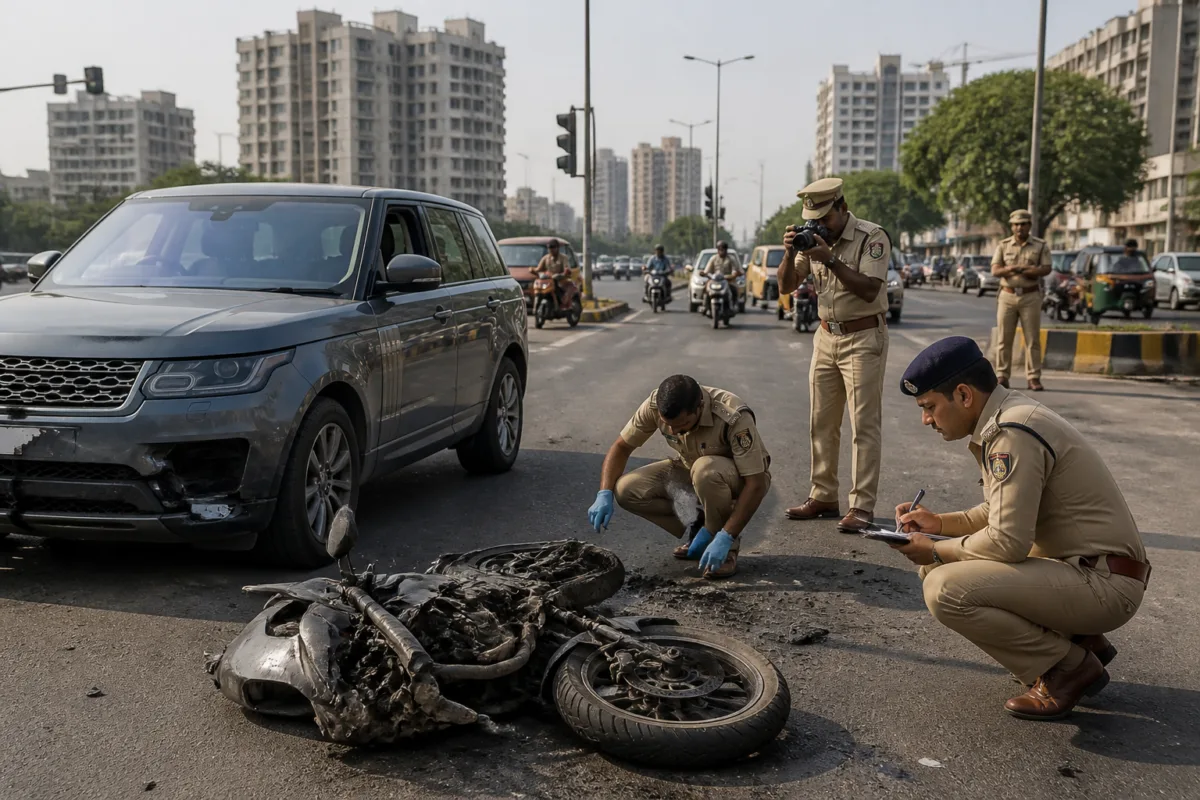
The Ahmedabad Range Rover accident investigation has moved beyond the question of how the crash occurred. It now raises a more fundamental issue: whether the evidence-gathering process was clear, timely and consistent in a fatal road case involving the nephew of a sitting legislator.
According to Divya Bhaskar – Ahmedabad, the crash took place near Shilaj Circle, close to Gurukrupa Traders crossroads, at about 7 am on November 11. A Range Rover allegedly struck a Rapido motorcycle carrying rider Pradeep Kumar and passenger Harshadkumar Purbia, 35. Harshadkumar died from serious injuries. The report says the Range Rover driver, identified as Raghavendra Kushwah, left the scene after the collision and was arrested by Bopal police about 15 hours later. He was subsequently granted bail.
The immediate event is a road fatality. The larger urban issue is the credibility of the investigation that follows one. In any serious crash, the treatment of physical and documentary evidence can influence the legal process, the rights of the accused, the prospects of accountability and the confidence of families and residents who expect the police to establish what happened. When the public record contains conflicting explanations about a basic investigative step, that confidence becomes harder to sustain.
The disputed issue in this case is the blood sample or blood test of the accused. Divya Bhaskar – Ahmedabad reported that Deputy Superintendent of Police Neelam Goswami did not respond when asked when and where the blood test was conducted. The in-charge police inspector, however, reportedly said that the test had been completed. Kushwah also told the media that a blood test had taken place, but could not identify the hospital where it was conducted.
These statements do not establish whether a test was or was not performed. They establish that the available explanations do not match on important details. The report does not provide a laboratory report, hospital record, collection time, sample number or other primary document that would independently settle the question. That limitation matters because the timing and chain of custody of a medical sample can be central to a road-crash investigation, particularly when the vehicle is alleged to have been travelling at high speed and the occupants were returning from a party.
The report says Kushwah was returning with four friends after a New Year party organised by a friend near a fair in Kalol. It also says that he told the media he left the crash site because he feared that people would assault him. That explanation is attributed to the accused and should not be treated as an established account of the incident. The same applies to the circumstances surrounding the blood test until official records are made available.
The sequence described in the report also highlights the importance of the first hours after a fatal crash. The vehicle driver allegedly fled the scene, while the police arrested him approximately 15 hours later. The report does not state when the vehicle was secured, whether a forensic examination was conducted, when witnesses were interviewed, or whether traffic-camera footage was collected. These details may exist in the case records, but they are not available in the supplied account. Their absence means that the public cannot yet assess the completeness of the investigation.
For urban residents, this is not merely a high-profile dispute involving a particular family or a particular vehicle. Ahmedabad’s roads are shared spaces where differences in vehicle size, speed and vulnerability can have fatal consequences. A motorcycle rider and passenger have substantially less physical protection than occupants of a large sport utility vehicle. That underlying imbalance makes the quality of enforcement and post-crash investigation especially important, although the supplied report does not provide technical findings on the speed of the Range Rover or the precise cause of the collision.
The case also illustrates how public communication can become part of an investigation’s credibility. The report attributes one position to the deputy superintendent, another to the in-charge inspector and a third to the accused. The divergence is not proof of wrongdoing by any individual. It does, however, leave basic questions unanswered: who collected the sample, at what time, at which facility, under whose supervision and where the record is now held. A clear official chronology would help distinguish an administrative communication failure from a substantive gap in evidence handling.
That distinction is important in cases involving public figures or politically connected individuals. The report identifies Kushwah as the nephew of Dineshsinh Kushwah, a legislator from Bapunagar. The family relationship does not establish preferential treatment, and no such conclusion can be drawn from the supplied material. But the presence of a political connection increases the need for transparent documentation because public scrutiny is likely to be greater and trust can be affected by even unexplained inconsistencies.
The reported decision to grant bail after the arrest is also part of the public discussion, but bail itself does not determine guilt or innocence. The supplied material does not include the bail order, the sections applied in the case, the prosecution’s submissions or the court’s reasoning. It would therefore be inaccurate to use the bail decision as evidence that the investigation was either proper or inadequate. The relevant question for the investigation is whether all legally required procedures and evidentiary safeguards were followed and recorded.
The institutional responsibilities in such a case are divided. The police must document the crash, identify and question witnesses, secure relevant vehicles and material, record medical and forensic evidence, and present the investigation before the appropriate legal forum. Medical facilities and laboratories, where involved, must maintain accurate records of sample collection and testing. The court must assess the evidence and the legal submissions placed before it. Public statements by officials should reflect the documented position of the investigation rather than leave conflicting versions in circulation.
The supplied report does not identify the investigating officer responsible for the overall case, the hospital involved, the laboratory, the exact sections of law invoked or the next scheduled legal proceeding. It also does not provide the post-mortem findings or the medical condition of Pradeep Kumar, the motorcycle rider. Those omissions prevent a complete assessment of the case. They do not remove the public-interest value of the questions raised, but they do limit what can responsibly be concluded at this stage.
There is also a timing issue in the account. The report says the crash followed a New Year party, while placing the accident on November 11. The supplied material does not clarify which New Year celebration is being referenced or whether the description relates to a local calendar or a translation of the original report. That ambiguity should be resolved through the case record before it is used to construct a detailed timeline. A reliable timeline is essential because the interval between the crash, the driver’s departure, the arrest and any medical examination may affect how the evidence is interpreted.
The central fact that is established in the supplied report is that a fatal collision occurred near Shilaj Circle and that the investigation has attracted scrutiny over contradictory accounts of a blood test. The report does not establish the final legal responsibility for the death, the driver’s speed, whether alcohol or another substance was involved, or whether the disputed test was valid. Those matters require documentary and judicial determination.
What should be monitored next is straightforward: the police’s documented explanation of the blood-sample process, the identity of the testing facility, the relevant medical or laboratory records, the investigation’s account of the crash sequence and any subsequent court proceedings. Until those records are disclosed or examined in the legal process, the controversy remains principally one of investigative transparency and inconsistent public explanations rather than a settled finding about the case itself.

