


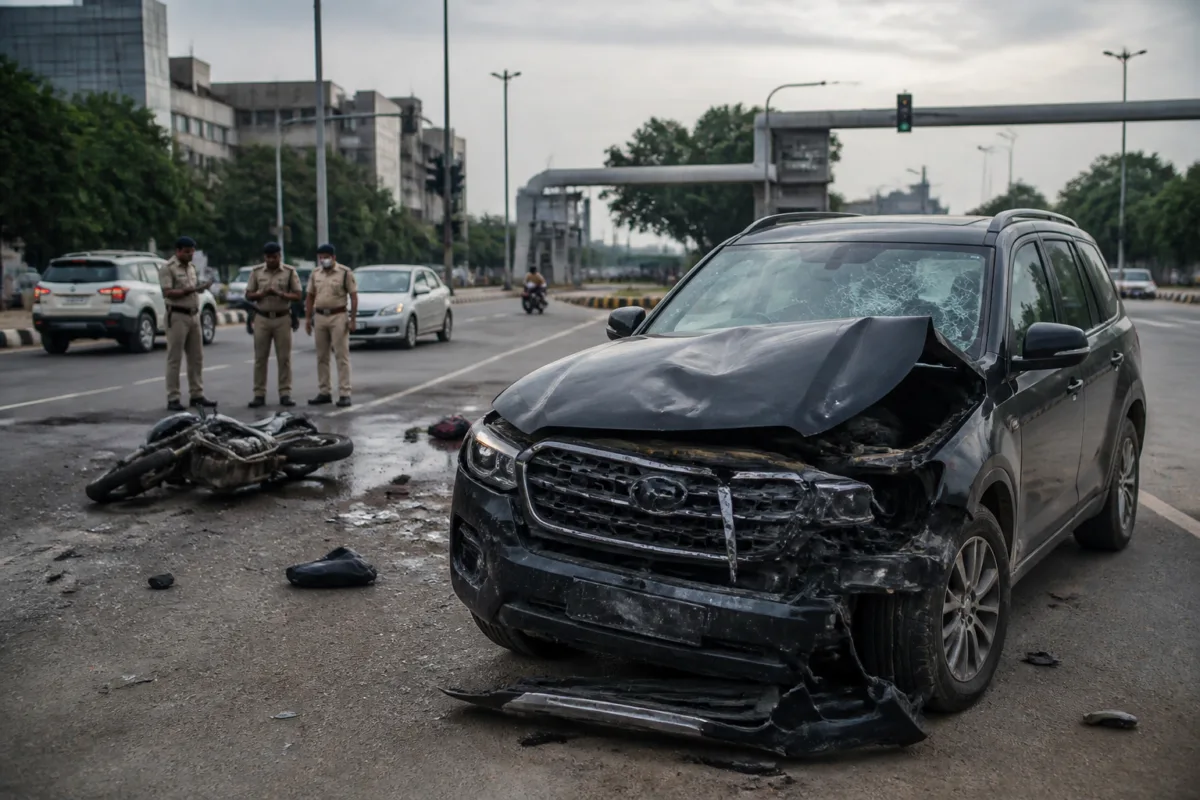
The Shilaj hit-and-run case in Ahmedabad has raised questions about the handling of a fatal road crash after the police account and statements attributed to the accused reportedly differed on the timing and nature of medical testing. The case concerns the death of 35-year-old Harshadkumar Purbia, who was travelling as a passenger on a Rapido motorcycle when a Range Rover allegedly struck the bike near Gurukrupa Traders crossroads at Shilaj Circle.
According to the report by Gujarat Samachar – Ahmedabad, the crash took place at around 7am on November 11, 2026. Purbia, a resident of Shastrinagar and originally from Dhrangadhra in Surendranagar district, died at the scene. The motorcycle rider, identified as Pradeep Kumar, was also involved in the collision. The Range Rover driver allegedly left the scene after the crash.
Police later identified the driver as Raghvendra Kushwaha, who the report said is the nephew of Dineshsinh Kushwaha, the Bharatiya Janata Party MLA from Bapunagar. The vehicle was identified as belonging to Raghvendra’s father, Mahesh Kushwaha. The report said Raghvendra works in construction and real estate.
The most significant unresolved issue concerns the period between the crash and the accused’s arrest. The report said Bopal police arrested Raghvendra about 17 hours after the collision and subsequently released him on bail, according to the in-charge police inspector. The police also seized the Range Rover.
At a press conference, the sub-divisional police officer was quoted as saying that the accused had returned from Kalol after attending a friend’s party when the accident occurred. The officer reportedly said the preliminary investigation did not indicate that the driver had consumed alcohol, while also stating that the investigation was continuing and that a forensic science laboratory examination would be conducted.
The report said the police officer did not directly answer questions about whether a blood sample had been taken. Instead, the officer was quoted as saying that it was understood that the accused had not consumed intoxicants. This account differs from a statement attributed to Raghvendra, who reportedly told the media that his medical examination had taken place when he appeared at the police station. He also said his blood test had been conducted on November 12, but did not identify where it had taken place.
That difference is important because alcohol and substance testing after a serious road crash can become central to the investigation. The supplied report, however, does not provide the medical report, the time at which any sample was collected, the test facility, or the forensic findings. It also does not establish whether the police formally recorded a positive, negative or inconclusive result. Those details would be required to determine what testing was conducted and whether it followed the applicable investigative procedure.
The accused, in his media statement, denied driving at high speed. He said he had been travelling at a normal speed from Shilaj when the motorcycle appeared in front of him. According to the report, he claimed that both vehicles stopped briefly and then moved at the same time, resulting in the collision. He also said he left because he was frightened by the crowd and public reaction. He stated that friends were travelling with him and that he had been returning from a gathering at a friend’s plotting scheme.
The police account, as reported, said the accused went home after the crash and was later arrested. The officer also said that Raghvendra had no previous criminal cases recorded against him so far, although the police would investigate the matter further. The report said his statement had been recorded and that additional legal action could follow if further evidence emerged.
The supplied material contains an important inconsistency about the date of the crash. In most parts of the report, including the description of the fatal incident and the later arrest, the date is given as November 11, 2026. However, one portion quoting the police officer refers to the offence as having occurred on September 11 and says the arrest took place on November 12. The source does not clarify whether this is a transcription error, a reporting error or a separate date reference. Primary documents such as the first information report, arrest record, seizure memo and medical records would be needed to resolve it.
Beyond the immediate case, the episode raises a broader administrative question about how fatal road crashes are investigated when the accused is connected to a politically influential family. That question is not proof of preferential treatment. The supplied report does not establish that police officials deliberately protected the accused, altered evidence or violated a specific legal requirement. It does, however, document a public dispute over the police explanation, the timing of the arrest and the absence of clear information about blood testing.
The difference between a routine road crash and a suspected hit-and-run is institutionally significant. Investigators must establish the sequence of events, identify the driver, preserve the vehicle and other physical evidence, record witness accounts, document injuries and death, and determine whether impairment or reckless driving contributed to the collision. The credibility of the process depends not only on the eventual charge sheet but also on whether these steps are recorded transparently and in a time-bound manner.
The case also illustrates how bail decisions and the framing of offences shape public confidence. The supplied report says the accused was released on bail after arrest, but it does not provide the sections applied, the bail order, the court’s reasons or the conditions imposed. Without those documents, it is not possible to assess whether the police used appropriate provisions or whether the release followed ordinary legal procedure.
Gujarat Samachar – Ahmedabad also referred to two earlier Ahmedabad incidents involving relatives of political figures. Those cases were presented as context for concerns about unequal enforcement, but the supplied material does not provide the relevant police records, court orders or final outcomes. They therefore cannot independently establish a pattern of preferential treatment. Their inclusion does show why such cases attract heightened public scrutiny when official explanations appear incomplete.
For residents, the central issue is not only the identity of the accused but whether a fatal crash is investigated through a consistent process that applies equally to ordinary citizens and politically connected families. The public record presently supplied establishes a death, the alleged involvement of a Range Rover, a delayed arrest as described by the source, the accused’s release on bail and conflicting accounts about medical testing. It does not establish the final finding on intoxication, the precise legal sections invoked or whether any official misconduct occurred.
The next verifiable steps are the release or confirmation of the first information report, arrest and bail records, medical and blood-test documentation, vehicle-forensic findings and the police investigation’s final conclusions. Until those documents are available, claims that the accused was deliberately protected remain allegations rather than established facts.

