


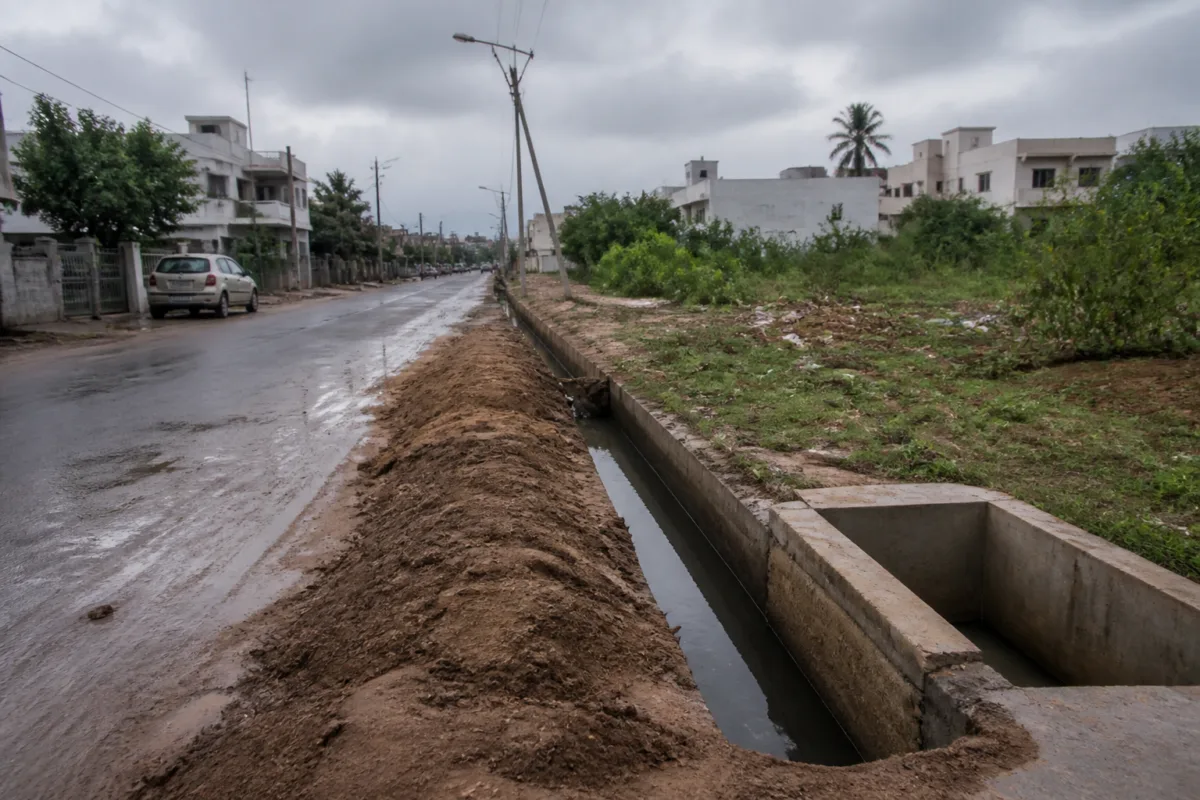
Ahmedabad’s open drainage failure has become a public-safety crisis after a 10-year-old visually impaired girl reportedly fell into an uncovered drain in the Piplej area on October 10 and remained untraced 11 days later. The discovery of suspected human or animal tissue near a river on Tuesday, followed by its dispatch to the Forensic Science Laboratory (FSL), has intensified the case without resolving its central question: what happened to the child and why did the search operation fail to produce a confirmed result?
The incident, reported by Gujarat Samachar – Ahmedabad, began when the girl was with her mother in Piplej. According to the report, the mother was paying an auto-rickshaw driver when the child fell into an open drainage line. Fire department teams have searched the drainage system since then, but the girl has not been found. The report says the operation has been obstructed by chemically contaminated water and heavy sludge inside the line.
That combination matters because an open drain is not merely a local maintenance defect. It is a point at which a city’s drainage network, road design, public access, emergency response and accountability systems meet. Once a person enters such a system, the city must be able to establish the route of flow, secure the entry point, map downstream outlets and deploy equipment suited to contaminated and obstructed conditions. The available report indicates that the search continued for 11 days but does not establish that these capabilities were integrated into a successful rescue or recovery plan.
The report also raises concern over the condition of the drainage line after the child’s disappearance. It states that the opening through which she fell was later covered with soil and closed. This development is significant because the child’s whereabouts had not been established and the search had not produced a conclusive result. The report says the covering of the line could slow or effectively end the search effort, although it does not provide an official explanation for why the opening was closed or whether alternative access points were secured for continued investigation.
The tissue found near the river is not proof of the girl’s death. The report specifically says that the pieces could belong to the missing child or to an animal. Fire department personnel called the police to the site after the discovery, and the material was sent to the FSL for examination. Until the laboratory report is available, the identity of the tissue remains unconfirmed. This distinction is essential in a case involving a missing child, because an unverified recovery cannot be treated as a conclusion about the child’s fate.
The immediate facts point to three separate operational problems. The first is the existence of an open drainage entry in an area used by residents. The second is the difficulty of searching a line carrying chemical-laden water and containing substantial quantities of mud. The third is the absence, at least in the supplied report, of a confirmed outcome after more than a week of search activity. Each problem belongs to a different part of municipal functioning, but the incident shows how quickly they can combine into a single emergency.
An open drainage line is also a form of hidden infrastructure. Most residents encounter the city at street level, while the drainage system remains below roads, pavements and neighbourhood edges. Its risks become visible only when covers are missing, access points are left exposed, flows change or a rescue operation requires the system to be opened and understood. The Piplej case demonstrates the consequences of treating drainage as a back-end utility rather than as public infrastructure that requires routine inspection, access control and risk management.
The report places the incident against Ahmedabad’s claims of being a smart city and its preparations to host the Commonwealth Games. It also refers to the Ahmedabad Municipal Corporation’s annual budget of more than Rs 18,000 crore. These references do not by themselves establish how much money was allocated to drainage maintenance, inspection, emergency rescue equipment or open-access hazard removal. They do, however, frame the institutional question raised by the case: how should a city assess the gap between the scale of its budget and technology-led public image and the safety of basic infrastructure in a neighbourhood where a child can fall into an uncovered drain?
That question cannot be answered by the budget figure alone. Municipal budgets include multiple functions, and the supplied report does not provide a departmental allocation, tender document, maintenance contract or inspection record for the Piplej drainage line. Nor does it identify which agency was responsible for covering the opening, when the opening was last inspected or whether residents had previously complained about the hazard. Those details remain necessary for determining responsibility rather than simply recording failure.
The incident also exposes the limits of describing a search operation only through the number of days it has continued. A prolonged operation does not necessarily mean that the response has been comprehensive. In a drainage network, time can alter the physical evidence: flows move material, sludge obstructs passages and access points may be modified. The supplied report does not state what mapping, cameras, pumps, protective equipment or specialist tools were used. It only records that fire officials cited chemical-laden water and mud as major obstacles.
This is where municipal administration and emergency response overlap. The fire department may lead a rescue search, but the drainage network is likely to involve municipal engineering, sanitation and public works responsibilities. The police become relevant when a person is missing and when unidentified tissue is recovered. The FSL becomes relevant when the identity of the material must be established. A case such as this therefore requires coordination across institutions, not only a field operation by one department. The available report records the involvement of the fire department, police and FSL, but does not establish the full chain of command or the frequency of inter-agency reviews.
The absence of those details is itself important for public understanding. Residents need to know not only whether a search is taking place, but also who is responsible for securing dangerous infrastructure, preserving evidence, communicating verified updates and deciding when an operation can be reduced or stopped. In the Piplej case, the report says the drainage line was covered despite the girl remaining missing. It does not state whether this was a temporary safety measure, a search-related decision or a permanent closure. That unresolved point deserves official clarification.
The case also underlines why open drains cannot be treated as a narrow sanitation issue. They affect mobility, child safety, accessibility and the reliability of neighbourhood infrastructure. A visually impaired child is especially vulnerable to an uncovered opening, but the hazard is not limited to people with disabilities. Children, older residents, pedestrians travelling at night and anyone navigating poor visibility face similar risks. The report does not establish whether warning barriers, lighting or signage were present at the location before the incident.
What the evidence confirms is limited but serious. A 10-year-old girl reportedly fell into an open drainage line in Piplej on October 10. A search operation continued for 11 days without locating her, according to the report. Fire officials identified contaminated water and heavy sludge as operational barriers. Tissue recovered near a river was sent for FSL examination, but its identity was not confirmed. The drainage opening was subsequently covered with soil, although the report does not explain the decision.
What remains unconfirmed is equally important. The supplied material does not establish whether the recovered tissue belongs to the child, whether the child travelled through the drainage network to the river, whether the drain was legally or operationally required to be covered, or whether any municipal officer or contractor has been held responsible. It also does not provide the FSL findings, a police statement, a municipal response or an account from the child’s family beyond the circumstances of the fall.
The next stage should therefore be governed by documentary clarity rather than assumption. The FSL report may establish whether the recovered material is relevant to the missing-child investigation. The authorities’ account of the search may clarify the route examined, equipment used and points where the operation was obstructed. Municipal records may show who maintained the drainage line and whether the opening had been identified as a hazard. Until those facts are available, the case remains both a missing-child investigation and a warning about the consequences of leaving critical urban infrastructure exposed.
The larger issue is not whether Ahmedabad can describe itself as modern or smart. It is whether its most ordinary systems—drains, covers, inspections, access barriers and emergency protocols—work together when a resident is in danger. The Piplej case has made that question unavoidable. The FSL examination, the official account of the search and a clear explanation of the drainage line’s closure are the immediate developments that will determine what is known next.

