


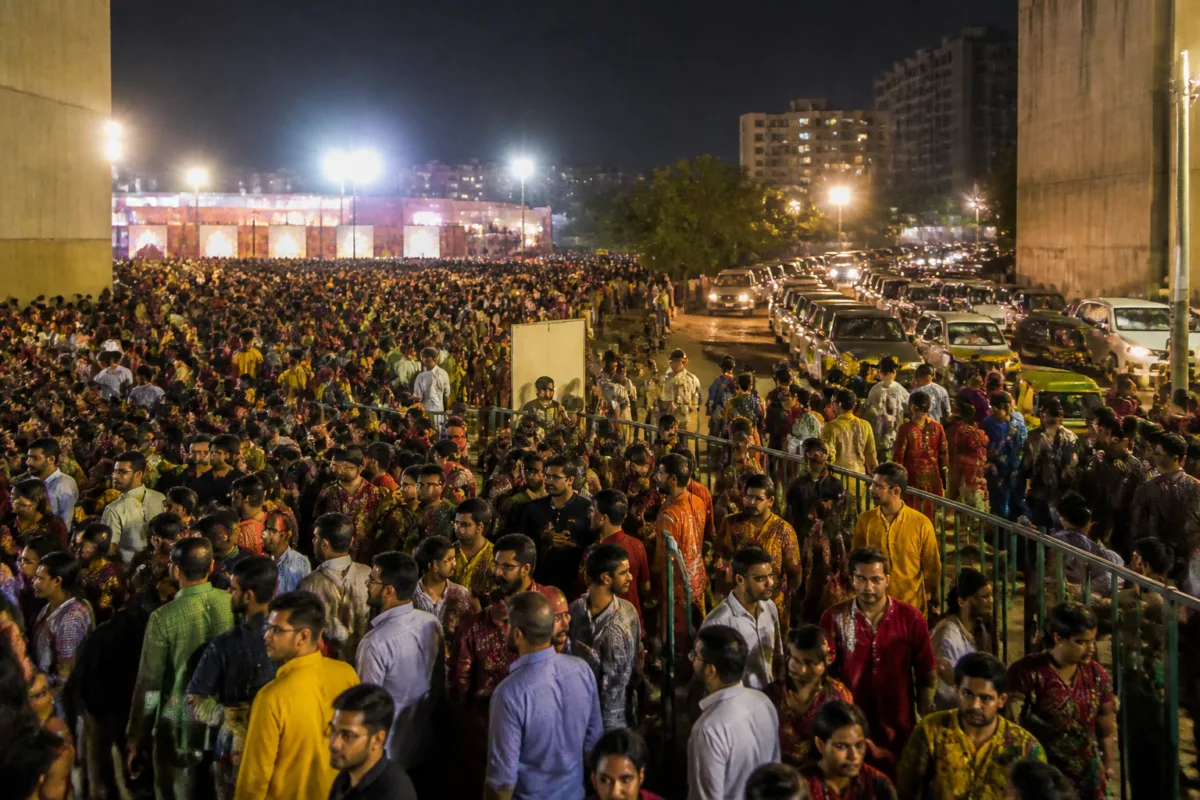
Ahmedabad’s Navratri garba season has exposed a familiar urban problem: the scale of an event can grow faster than the systems needed to manage it. A report by Gujarat Samachar – Ahmedabad says videos showing crowding, inadequate standing space, food-court congestion, difficult parking and traffic disorder circulated widely this year, even as organisers promoted large venues, elaborate stages and expensive passes.
The central issue is not only whether individual venues were crowded. It is whether the commercial promise attached to a premium public-facing event was matched by the physical capacity and operational planning required to deliver it. When visitors pay up to Rs 15,000 for a pass, the transaction is no longer limited to access to music and dancing. It creates an expectation of a reasonably safe, usable and organised environment, including entry, movement within the ground, parking, food and exit.
The Gujarat Samachar report does not provide independently measured attendance figures, venue-wise capacity data or an official response from organisers or civic authorities. Its account is based on videos circulated on social media and complaints attributed to attendees. Those limitations matter. Viral footage can show a real problem, but it cannot by itself establish the total number of visitors, the duration of congestion or whether every venue faced the same degree of difficulty.
Even with those qualifications, the reported pattern is important because the complaints extend across several parts of the event system. Visitors reportedly described a lack of space to stand or play garba, crowding at food counters, uneven parking areas and traffic disruption near venues, including grounds located close to the S.P. Ring Road. These are connected operational issues rather than isolated inconveniences. A venue may have a large stage and strong publicity, but its performance also depends on how people arrive, circulate, eat, find their vehicles and leave.
That makes capacity the first institutional question. The report says allegations emerged that more passes were sold than some grounds could comfortably accommodate. It does not establish the number of passes issued or the approved capacity of any particular venue. But the basic planning principle is clear: ticket volume cannot be determined only by expected demand or the size of the plot. Usable event capacity depends on the area available for dancing, circulation, emergency access, food and service operations, entry and exit gates, security arrangements and the time required to move people through those spaces.
A ground that appears large from outside may have considerably less usable space once stages, barricades, stalls, lighting structures, sponsor installations, backstage areas and vehicle movement are accounted for. The report’s description of visitors being unable to find adequate standing or dancing space points to the difference between nominal site size and operational capacity. Without venue plans or official capacity calculations, the extent of that gap cannot be measured from the supplied material. The complaints nevertheless show why the distinction matters.
The same logic applies to the food court. Food services are often treated as an add-on to an event, but they function as a significant crowd-attracting zone. People arrive at different times, take breaks during performances and converge at counters in short periods. If the number of counters, payment points, preparation areas and circulation lanes is not matched to the visitor load, congestion can spread beyond the food area. The report describes crowding and pushing at food counters at a venue where passes reportedly cost up to Rs 15,000, producing a sense among some visitors that the experience did not match the price paid.
That response is not simply a consumer complaint. It reveals how private event infrastructure increasingly occupies a public urban system. The event may be organised by private operators, but its consequences are experienced on public roads, at junctions, in adjoining neighbourhoods and along access corridors. Traffic management, parking spillover, pedestrian movement and emergency access can therefore become matters of municipal and police coordination, even when the event itself is commercially run.
The parking complaints described in the report illustrate this interdependence. Uneven or poorly organised parking areas can create delays before visitors reach the venue, make vehicle retrieval difficult at the end of the night and push cars onto surrounding roads. Near major urban corridors such as the S.P. Ring Road, the impact may extend beyond ticket holders to other road users. The supplied report does not quantify the traffic disruption or identify which agency handled traffic arrangements, so the institutional responsibility remains unclear. That uncertainty is itself a recurring feature of large urban events: several agencies may be involved, while accountability for the total visitor experience remains fragmented.
Social media has changed how that fragmentation is seen. Earlier, the success of a garba event could be communicated through stage design, celebrity performers, lighting, attendance claims and promotional imagery. This year’s circulation of videos showing congestion and disorder created a competing record from the ground. Mobile phones allow visitors to document the gap between promotional presentation and lived experience almost immediately.
That evidence should be read carefully. A short video can be selective, lack a timestamp or represent one congested moment rather than the entire event. It cannot replace inspection records, ticketing data, crowd counts or emergency logs. But it can identify questions that formal systems should answer. If several venues generate similar complaints about movement, parking and food services, the relevant response is not only to dispute individual videos. It is to examine whether event approval and monitoring processes test the full operating system before the gates open.
The report also points to a regulatory gap in the way premium event experiences are understood. A high pass price does not automatically guarantee a particular service level unless the terms of access clearly specify it. Yet price influences demand, expectations and the perception of fairness. Visitors who spend substantially more may be especially sensitive to overcrowding because the event has been marketed as exclusive or superior. When the physical experience resembles an overfilled mass gathering, dissatisfaction becomes a question of trust as well as comfort.
For organisers, the operational challenge is to convert sales ambition into capacity-led planning. That means determining the maximum number of passes only after accounting for the usable ground area and the requirements of movement, food, parking, security and emergency response. The source report makes this principle explicit through its criticism that pass numbers should be fixed only after considering the venue’s actual capacity. It does not establish whether any organiser breached a specific rule, and no such conclusion can be drawn from the available material.
For public authorities, the issue is coordination. A venue approval process that checks the ground in isolation may miss pressure points outside its boundary. Parking layouts, road access, pedestrian routes, traffic diversions and emergency corridors need to be considered as part of one event plan. The supplied report does not state what permissions were granted, what conditions were imposed or whether inspections took place. Those are the documents and official responses needed to move from public complaint to institutional assessment.
The distinction between temporary inconvenience and a serious safety concern also requires evidence. The report describes crowding and disorder, but it does not report injuries, evacuation failures, arrests or a specific emergency. It would be inaccurate to infer such outcomes. At the same time, the absence of a reported major incident does not prove that planning was adequate. Dense crowds, blocked movement and difficult vehicle access are conditions that authorities generally need to monitor precisely because their consequences can escalate quickly.
Ahmedabad’s Navratri events therefore offer a useful test of how the city manages privately organised mass gatherings. The question is not whether large celebrations should be held or whether premium passes should be sold. It is whether commercial scale, advertised exclusivity and physical capacity are being treated as parts of the same planning equation. The available report confirms a visible disconnect between promotional claims and the experiences described by some attendees, but it does not yet establish its full scale or cause.
The next stage of accountability would require venue-wise pass numbers, approved capacities, parking and traffic plans, inspection records and responses from organisers and relevant authorities. Until those details are available, social-media footage and attendee complaints should be treated as warning signals rather than a complete audit. They nevertheless make one point difficult to ignore: in a crowded city, the quality of an event is determined not only by what happens on the stage, but by whether the surrounding urban system can safely carry the people drawn to it.

