


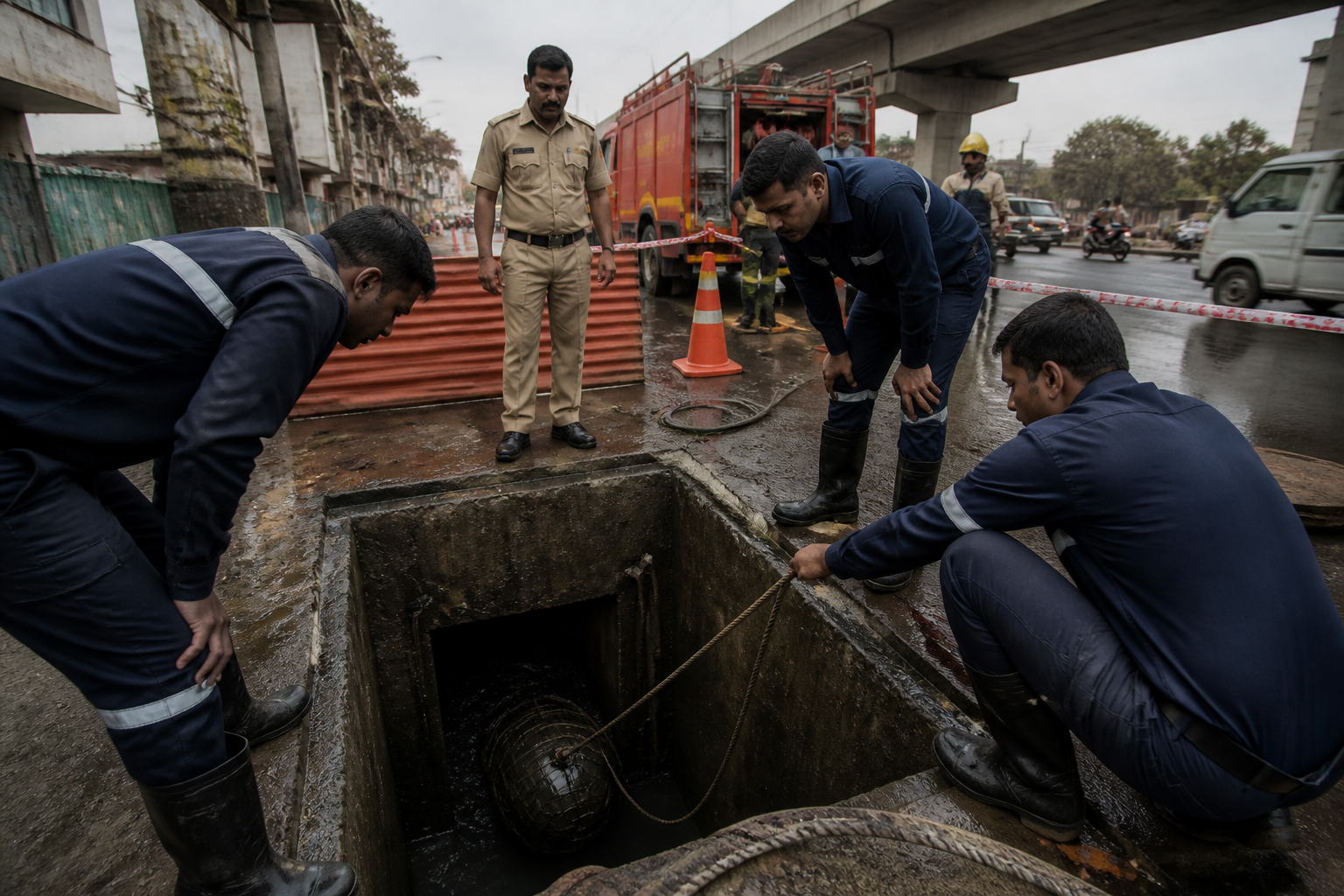
The search for a 10-year-old visually impaired girl who fell into a drainage line on Ahmedabad’s Narol-Pirana Road has entered its sixth day without a confirmed sighting. The case is not only a missing-person emergency; it has also brought into view the physical and institutional risks embedded in a city’s underground drainage system, including deep open access points, fast-moving wastewater, hazardous gases and suspected chemical discharge.
According to Gujarat Samachar – Ahmedabad, the girl fell into an approximately 40-foot-deep drainage line on 10 October. The fire department has continued searching the drainage line, manholes and the river, but has not located her. At a Standing Committee meeting on 15 October, the committee chairperson instructed officials to examine CCTV footage as part of the investigation.
The search has been complicated by the design and operating conditions of the drainage network. Fire department officials told the publication that the line carries a very strong water flow, making it difficult for equipment lowered into the system to remain in position. The manholes are also reportedly releasing hot gas with a strong odour, creating unsafe conditions for personnel attempting to enter or work near the line.
The same account says the drainage water may contain chemicals. The line is described as a main trunk line receiving wastewater from Ahmedabad’s south, east and north zones. Those zones include industrial units, and sources cited in the report have raised the possibility that chemical wastewater could be entering the network through illegal connections or tankers. The report says such activity may take place late at night or early in the morning, but this remains an unconfirmed possibility rather than an established finding.
The distinction matters. The confirmed public issue is the continuing search in a hazardous drainage environment. The suspected illegal discharge is a separate line of inquiry that requires documentary and official confirmation. Treating the allegation as proven would obscure the more immediate question: how can emergency services search a major urban drainage system when the line has high flow, potentially dangerous gases and chemically contaminated water?
## When drainage becomes an emergency environment
Urban drainage is usually understood as a utility for moving wastewater away from homes, roads and industrial areas. In this case, however, the drainage line has become an emergency environment involving rescue, investigation and possible hazardous-material exposure. The reported conditions show how the same network can serve several functions at once: it carries wastewater, connects multiple municipal zones, receives industrial flows and becomes a possible route through which a person may be swept or trapped.
The reported depth of approximately 40 feet adds to the difficulty. A fall into such a line is not comparable to an incident at a shallow roadside drain. Search teams must account for vertical access through a manhole, horizontal movement through the line, water velocity, sediment or mud and the possibility of gases accumulating in confined spaces. The fire department’s reported difficulty in keeping equipment in place indicates that the search is being shaped by the hydraulic conditions of the network, not simply by the availability of personnel.
The report also says that a body would generally rise to the water surface within 24 hours, but that this has not happened in the present case. The committee chairperson has therefore raised the possibility that the girl may be buried in mud. The report does not confirm that explanation, and the search remains continuing. What the absence of a visible trace demonstrates is the uncertainty created when a person disappears inside a deep, fast-flowing and sedimented drainage system.
## The institutional problem is larger than one search
The Standing Committee’s instruction to use CCTV suggests that the investigation is being expanded beyond the drainage network itself. Camera footage could help establish the girl’s movements before the incident, identify the precise location and timing of the fall, and determine whether anyone witnessed what happened. It could also help officials reconstruct the route through which she may have been carried, particularly if the drainage line connects to manholes, treatment facilities or the river.
The source report says that officials have already searched the river, a sewage treatment plant and manholes. Those locations indicate the extent of the connected system being examined. A drainage incident does not necessarily remain confined to the point of entry: water movement can carry material across municipal infrastructure, while manholes and treatment facilities create multiple possible points for inspection.
This makes coordination central to the response. The fire department is responsible for the immediate search, while municipal officials and the Standing Committee are involved in oversight and investigation. CCTV review introduces another administrative layer. If industrial discharge is examined, enforcement agencies and pollution-control authorities may also become relevant. The supplied report does not establish which agency is conducting that inquiry or whether any industrial unit has been identified.
That institutional uncertainty is important because a major trunk line crosses administrative and functional boundaries. It is simultaneously drainage infrastructure, a confined workplace, a potential industrial-waste pathway and a public-safety hazard. A response limited to one department may not be sufficient when the incident involves all these dimensions.
## Chemical wastewater raises a second risk question
The reported presence of chemical-laden water and hot gas has implications beyond the search. Fire personnel working around manholes may face risks that are different from those encountered in ordinary water rescue operations. Equipment may also fail or become unusable in conditions involving strong flow, corrosive substances, sediment or gases. The report says these factors have made the rescue operation dangerous and created several obstacles.
The possibility of illegal connections or tanker discharge is based on sources cited by Gujarat Samachar – Ahmedabad and has not been confirmed in the supplied material. The report names industrial activity in areas including Naroda, Behrampura, Vatva and Narol as a possible source of wastewater entering the line, but it does not identify a specific company or provide test results. Those allegations should therefore be treated as an investigative lead, not as a concluded finding.
Even without a confirmed illegal-discharge case, the reported conditions point to a monitoring challenge. A trunk line receiving wastewater from three zones can carry flows from multiple types of users. If industrial wastewater is entering the system without adequate control, identifying its origin after mixing may be difficult. The report’s reference to possible night-time or early-morning tanker discharge further suggests why CCTV, inspection records and sampling could become relevant to the inquiry. None of those investigative outcomes has been reported as completed.
## What the case reveals about urban safety
The incident exposes a basic conflict in urban infrastructure: systems designed to remain inaccessible to the public can become extremely difficult for emergency teams to enter when something goes wrong. Deep drainage lines, manholes and trunk sewers are essential to city operations, but their safety depends on controlled access, clear mapping, structural maintenance and information about what the network carries.
The supplied report does not establish whether the point where the girl fell was open, damaged, inadequately barricaded or otherwise unsafe. It also does not state whether safety inspections had been conducted before the incident. Those are critical questions, but they remain unanswered in the available account. They should not be filled with assumptions.
What is established is that the search has continued for six days, that the line is around 40 feet deep, that water flow has interfered with equipment, and that officials have reported hot gas, strong odour and possible chemical contamination. These facts describe a system in which both civilians and rescuers face serious exposure when access or rescue becomes necessary.
The case also shows why drainage safety cannot be treated only as a maintenance issue. The condition of underground infrastructure affects emergency response, industrial regulation, municipal accountability and the daily safety of people moving through roads and neighbourhoods. A drain that is hidden from public view can still shape public risk when it is open, poorly secured or connected to high-risk wastewater flows.
The immediate priority remains locating the girl and completing the search safely. The next questions concern the CCTV review, the findings from the drainage, river, sewage treatment plant and manhole searches, and whether authorities confirm the reported presence of chemical wastewater. If illegal connections or tanker dumping are established, the responsible agencies will also need to clarify how such discharge entered a trunk line serving three municipal zones. Until those findings are made public, the incident confirms a dangerous rescue environment but not the full cause of the contamination or the circumstances of the fall.

