


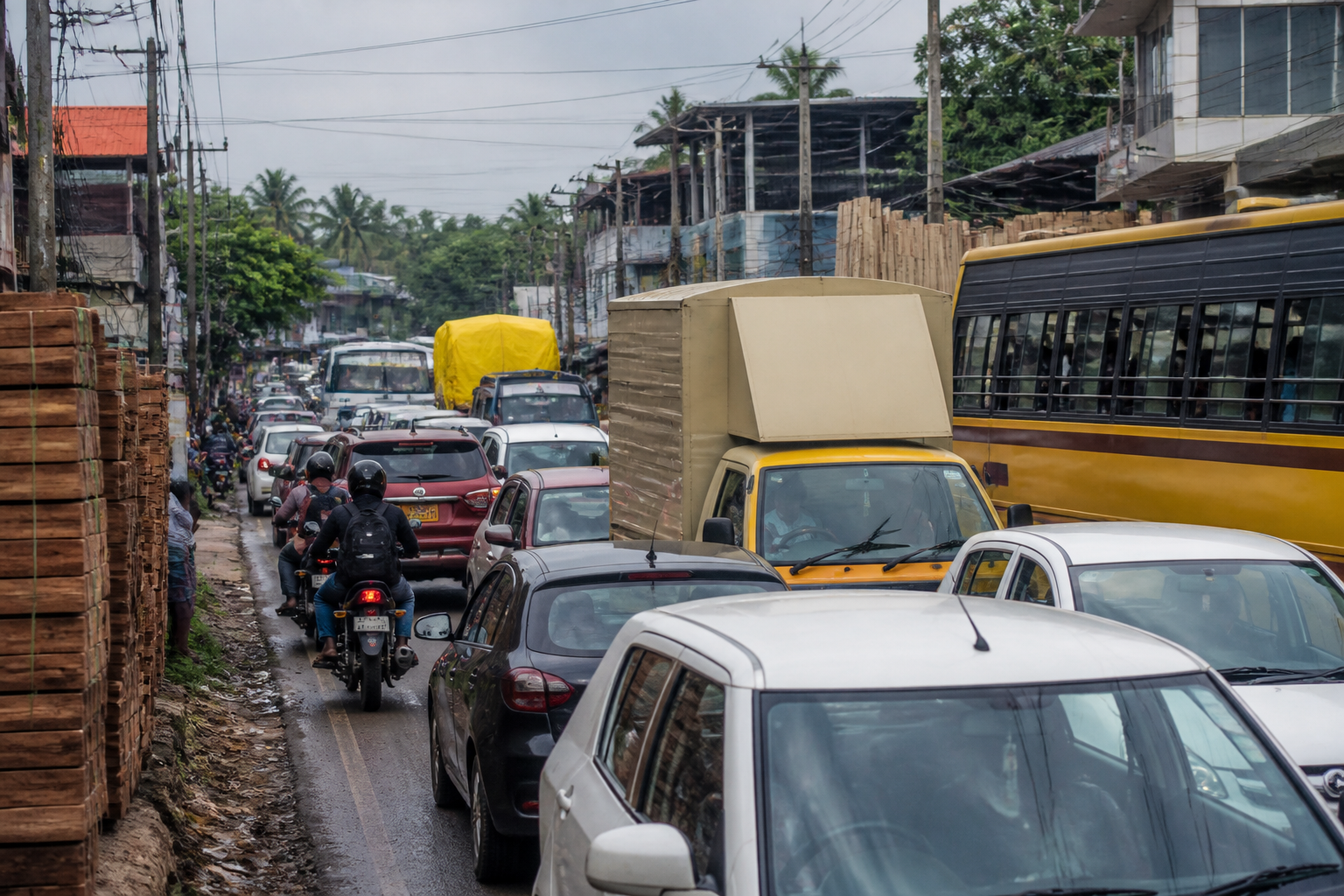
Perumbavoor’s traffic congestion is no longer simply a problem of crowded roads. It is the visible result of an industrial town expanding around a narrow transport network that has not kept pace with its economy, workforce or regional importance. A report by Mathrubhumi says the town’s plywood and timber industries have grown sharply over the past 15 to 20 years, while no new road has been added to match the expansion.
That mismatch has made Perumbavoor a significant bottleneck on routes connecting central Kerala’s industrial, airport, high-range and pilgrimage circuits. The town’s development remains concentrated around the Main Central Road and the Aluva–Munnar Road. As more factories, workers and vehicles have entered the area, these roads have continued to carry local traffic alongside long-distance buses, freight movement and vehicles travelling towards other destinations.
The result is a congestion pattern that is broader than a conventional town-centre traffic jam. Vehicles travelling to Cochin International Airport pass through the town, while long-distance buses use the Main Central Road. Tourist traffic headed towards Munnar and other high-range destinations, Sabarimala pilgrims, and people travelling from Idukki towards Kochi add further pressure. Traffic arriving from the Kalady bridge reportedly reaches Perumbavoor through the Main Central Road, bringing a regional transport burden into an urban area whose physical network has not expanded at the same pace.
The industrial economy is central to understanding the problem. Perumbavoor is widely associated with its timber and plywood-related industries, which have replaced the prominence once associated with Travancore Rayons. Mathrubhumi reports that the town and its surrounding area are estimated to have around 100,000 migrant workers employed across nearly 1,000 small and large work sectors. The industrial growth has also brought thousands of vehicles travelling to and from establishments in the area.
This is the classic infrastructure lag that appears when economic activity grows faster than public investment and urban planning. The town’s industrial success has generated movement, jobs and commercial activity, but the transport system remains organised around routes that were not designed for the current volume or diversity of traffic. Local trips, industrial vehicles, buses and through-traffic are therefore competing for the same limited road space.
The source report identifies a particularly important planning limitation: despite the expansion of vehicles and establishments by more than ten times, Perumbavoor has not received a new road. This does not mean that no infrastructure decisions have been discussed. Rather, it shows the difference between identifying a bottleneck and delivering a functioning alternative network.
For nearly two decades, proposals including a bypass, ring road and flyover have been discussed as possible responses to the congestion. The bypass project, which began around 15 years ago, remains stalled at an early stage, according to the report. About 1.5 kilometres of land acquisition and related work has taken place, but construction has progressed slowly. The project is also designed to serve the Aluva–Munnar Road, and the report says it may not reduce congestion in Perumbavoor town by even 10 per cent.
That assessment points to a basic question in transport planning: does a project address the movement pattern causing the congestion, or does it only divert one part of the traffic? A bypass can be useful when through-traffic is the principal problem. But Perumbavoor’s congestion involves multiple flows, including industrial vehicles, airport traffic, long-distance buses, tourist vehicles, pilgrimage traffic and journeys between Idukki and Kochi. If these movements are not mapped together, a new link may provide limited relief while leaving the town’s main conflict points intact.
The proposed flyover has emerged as the latest possibility. The demand is for a flyover along the busy Main Central Road between Kadavall and Vattakkattupady. Manoj Moothadan, the local MLA, raised the proposal in the Kerala Legislative Assembly, after which the Public Works Department minister reportedly assured the Assembly that a study would be undertaken. The minister also said that an expert team would visit Perumbavoor during the month to examine the project’s feasibility.
A feasibility study is an important administrative step, but it is not the same as an approved project, funded construction plan or operating solution. It can establish whether a flyover is technically possible and what problems it may solve. It must also clarify how the structure would connect with existing roads, what land or junction changes would be required, and whether traffic would simply move to another bottleneck. The supplied report does not provide the study’s findings, a project cost, a funding arrangement, a construction schedule or a final approval.
That gap between proposal and implementation has shaped Perumbavoor’s infrastructure history. Projects have remained at the discussion or preliminary stage while the traffic problem has continued to grow. The bypass has seen some land acquisition but slow progress. The flyover has received a new political push but still awaits feasibility assessment. In the meantime, residents, workers, businesses and through-travellers continue to depend on the same congested corridors.
The institutional structure also matters. A solution will require more than a single road announcement because the traffic is generated by several systems operating together. The Public Works Department has a direct role in state roads and major infrastructure proposals. Local administration must manage town-level traffic conditions and access. Industrial establishments generate freight and employee movement, while airport, tourism and pilgrimage traffic bring seasonal or destination-based flows. The report does not establish a coordinated institutional plan among these actors, but the pattern described makes such coordination a central administrative challenge.
Perumbavoor’s estimated migrant workforce adds another dimension to the transport question. A population of around 100,000 workers connected to the industrial economy represents a substantial daily movement requirement, although the supplied report does not provide a detailed breakdown of their travel modes or residential locations. The available evidence nevertheless shows that the town’s mobility burden is not created only by private cars or occasional tourist traffic. It is tied to the daily operation of an industrial employment centre.
The numbers in the report illustrate the scale and duration of the mismatch. Industrial and commercial establishments have expanded more than tenfold, the estimated migrant workforce has reached around one lakh, and nearly 1,000 employment sectors operate across the Perumbavoor area. Yet the town’s road network has not seen a corresponding new road. The bypass proposal has been under discussion for roughly 15 years, while the broader congestion issue has been debated for about two decades.
These figures do not by themselves establish the precise causes of every delay. They do, however, show that Perumbavoor’s congestion is not a sudden disruption. It is a long-running capacity problem that has survived multiple proposals and changes in the town’s economic profile. The persistence of the problem is itself evidence of an implementation gap: the administrative system has repeatedly recognised the need for intervention without producing a completed network-level response.
The immediate policy question is therefore not only whether Perumbavoor should receive a flyover or bypass. It is whether the town’s transport infrastructure is being planned around its actual role in the regional economy. The town functions simultaneously as an industrial centre, a route to the airport, a passage towards the high ranges, a link between Idukki and Kochi, and part of the travel network used by Sabarimala pilgrims. Each role adds traffic, but the road system remains concentrated around two principal corridors.
Mathrubhumi’s report argues that long-term projects may take years to become reality and that temporary measures are urgently needed in the interim. The available material does not specify what those measures should be, and no short-term package is identified. That absence is significant because a feasibility study or land-acquisition process cannot immediately change the daily experience of people caught in the town’s traffic.
The next confirmed milestone is the proposed visit by an expert team to assess the flyover’s feasibility. The findings of that assessment will determine whether the proposal can move beyond political demand into a technically and administratively defined project. Until then, Perumbavoor remains an example of how industrial growth can outpace the roads that support it, leaving a town to absorb regional traffic through an infrastructure network built for a much smaller economy.

