


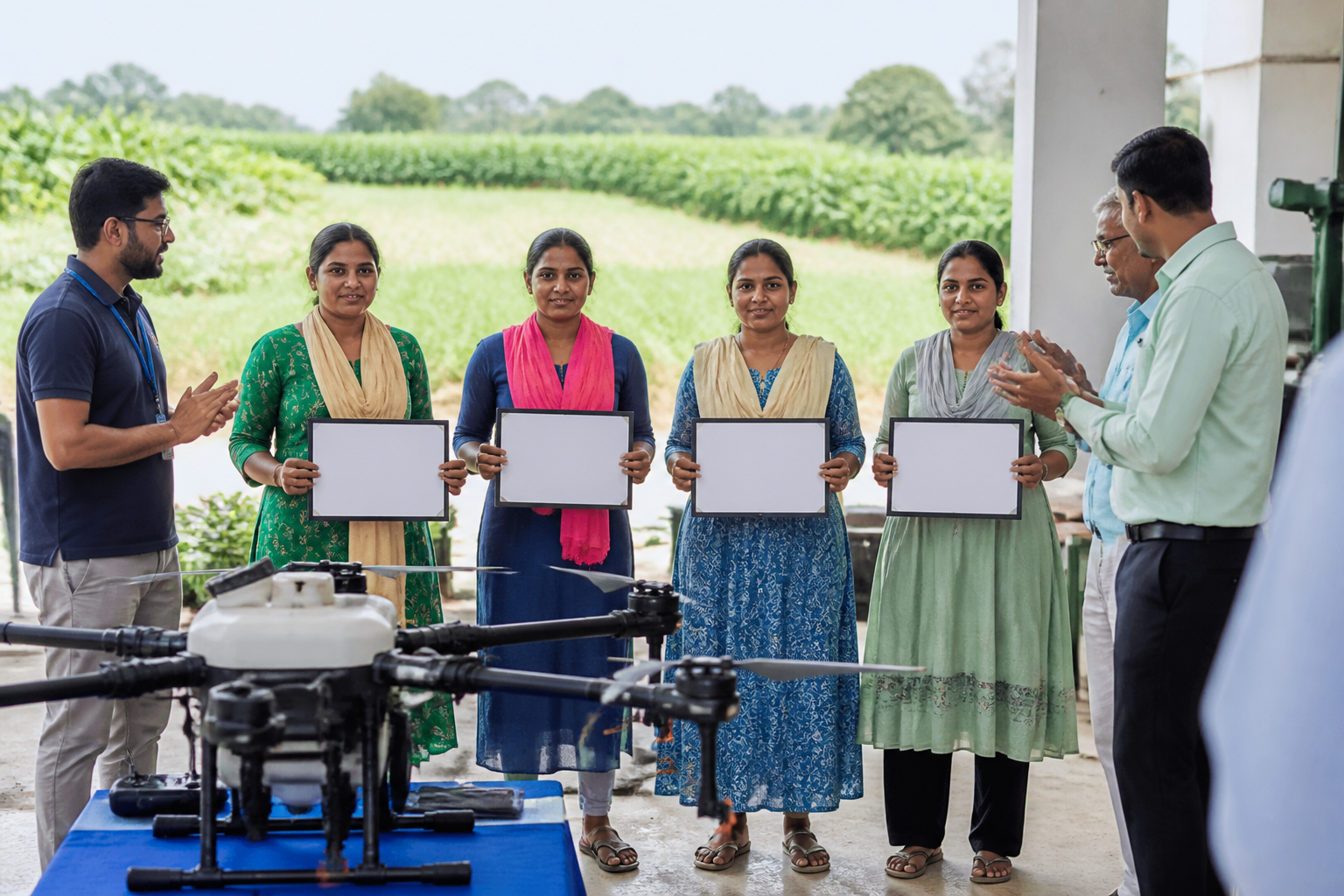
Twenty-five rural women have completed the first cohort of the FlySakhi – Drone Queens of Bharat programme at TiHAN, IIT Hyderabad, qualifying to provide agricultural and rural drone services on a fee-for-service basis.
The graduates received certificates at TiHAN, the technology partner for the programme. FlySakhi is led by the World Cooperation Economic Forum and CNRI, with Syngenta India Pvt. Ltd. supporting the initiative as its CSR partner.
The programme, themed ‘Empowering Women Entrepreneurs through Agricultural Drone Technology’, is designed to train participants not only as drone operators but also as owners of rural drone-service enterprises. Its stated objective is to place agricultural drone capabilities within rural communities, where the graduates can serve farmers, cooperatives and farmer producer organisations.
Training covered drone operation, flight safety, multipurpose agricultural applications and other rural uses. Participants were also introduced to the drone-as-a-Service business model, under which drone capabilities can be offered to users for a fee rather than being limited to individual ownership or one-time deployment.
According to a press release issued about the programme, each graduate can now offer drone services to farmers, cooperatives and farmer producer organisations. The model is intended to create a pathway for the women to earn through service delivery while supporting the use of agricultural technology in rural areas.
The programme also envisages linking graduates with cooperatives, self-help groups and FPOs. The stated aim is to ensure that drone assets and the resulting earnings remain within community-owned structures. This places the initiative’s operational focus beyond individual training, connecting the graduates to institutions that already organise rural production, finance or livelihoods.
The partnership brings together training, technology and corporate support. TiHAN–IIT Hyderabad provided the technology partnership, while WCOOPEF and CNRI led the programme. Syngenta India supported it through its corporate social responsibility programme.
Sangeeta Dawar, Head of Business Sustainability and Corporate Affairs at Syngenta India, said the future of agriculture depends not only on scientific innovation and access to modern solutions, but also on building knowledge, skills and awareness among the people at the centre of the sector.
The first cohort’s completion marks the transition from classroom and technical training to service provision. The graduates’ next role, as described by the programme, will involve applying their drone-operation and safety skills for farmers, cooperatives and FPOs on a commercial service basis.
The available announcement does not provide details on the locations where the 25 graduates will operate, the number of drones assigned to them, the programme’s training duration, or the revenue expected from the service model. It also does not specify the number of farmers or rural institutions that will be served in the next phase.

