


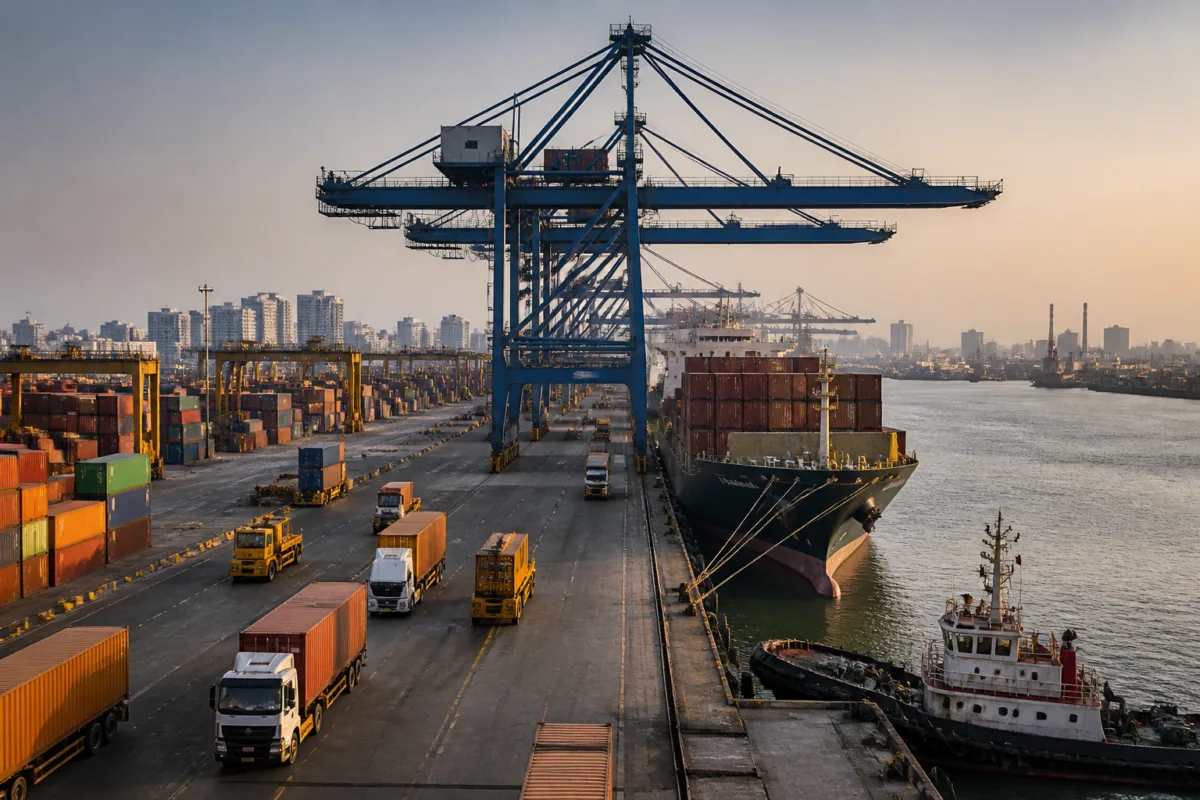
Adani Ports’ strong second-quarter performance and higher FY27 guidance have drawn attention to more than a listed company’s earnings trajectory. They also offer a view of how India’s port and logistics capacity is being consolidated around large private operators, with domestic ports providing the current earnings base while international assets, logistics and marine services are being positioned as the next growth engines.
Shares of Adani Ports and Special Economic Zone rose as much as 3% to Rs 1,805 on the BSE after the company reported a net profit of Rs 3,622 crore for the second quarter of FY27, up 17% from Rs 3,109 crore in the same period a year earlier. Revenue from operations increased 24% to Rs 11,340 crore from Rs 9,167 crore.
The company also raised its full-year guidance after what it described as a strong first half. Revenue guidance was increased by Rs 1,000 crore to Rs 44,000-46,000 crore, while EBITDA guidance was raised by the same amount to Rs 26,000-27,000 crore. The changes were disclosed in a regulatory filing and cited by the company as evidence of the strength of its first-half performance.
The immediate market response was shaped by the gap between reported performance and earlier expectations. Jefferies said September 2026 quarter EBITDA exceeded its estimates by 4%, attributing the outperformance to a sharp ramp-up in international ports. It raised its target price for Adani Ports from Rs 2,160 to Rs 2,180 while retaining a Buy rating. Nomura increased its target from Rs 2,080 to Rs 2,150.
Those target-price revisions are not, by themselves, evidence of infrastructure delivery. They are broker assessments based on earnings estimates, valuation assumptions and management guidance. But the reasons cited by the two brokerages point to the central operational question around Adani Ports: whether the company can convert a large and expanding asset base into sustained cargo, earnings and cash-flow growth without allowing capital expenditure or balance-sheet demands to weaken that expansion.
The answer suggested by the latest results is currently being built around three layers. Domestic ports remain the anchor of the business, according to Ashwani Gupta, the company’s whole-time director and chief executive officer. International ports, logistics and marine operations are described as emerging growth engines. The third layer is capacity expansion, including the company’s stated ambition to reach 1,000 million tonnes per annum, or MTPA, before its earlier calendar 2030 timeline if the current pace of capex is maintained.
This structure matters because ports are not isolated assets. Their economic role depends on the movement of cargo beyond the terminal boundary, the availability of logistics services and the ability of operators to connect maritime infrastructure with inland markets. The supplied results do not provide a breakdown of cargo volumes, individual port performance or the geographic distribution of the company’s international growth. They do, however, show that the company is presenting its future through a wider logistics platform rather than through domestic port operations alone.
### From quarterly earnings to capacity strategy
The revised FY27 guidance is significant in scale. The company now expects revenue of Rs 44,000-46,000 crore and EBITDA of Rs 26,000-27,000 crore. Nomura said the higher guidance represented an increase of Rs 10 billion in both revenue and EBITDA estimates. The company’s longer-term FY31 ambitions are set at revenue of Rs 91,500 crore and EBITDA of Rs 52,000 crore.
The gap between the FY27 guidance and the FY31 ambitions indicates the pace of growth that management is targeting over the period. It also shows why the company’s capital-spending programme is central to the story. Jefferies expects free cash flow to grow at a compound annual rate of more than 20% between FY26 and FY31, even with elevated growth capex. That assessment rests on the brokerage’s estimates and should be read as a forecast rather than an established outcome.
The company’s stated capacity target adds another layer of complexity. Management indicated that 1,000 MTPA could be reached ahead of the previously stated CY30 timeline if the current pace of capex is sustained. The report does not specify how much capacity is currently operational, the projects required to reach the target, or the approvals and land, marine and connectivity arrangements involved. Those omissions are important because capacity announcements become meaningful only when matched by actual terminal development, cargo demand and supporting logistics.
For cities and industrial regions, the relevance of such expansion is indirect but substantial. Ports influence where warehouses, freight services, manufacturing activity and road and rail connections are developed. The supplied report does not identify new urban projects or specific corridors linked to Adani Ports’ guidance. It does establish, however, that the company sees logistics and marine services as part of its growth architecture, making the port operator’s strategy relevant to the wider built environment around trade gateways.
### The international growth question
International ports are the most important change in the earnings narrative presented by the report. Jefferies attributed the quarterly EBITDA outperformance to a sharp ramp-up in international ports, while the company’s management described domestic ports as the earnings anchor and international ports, logistics and marine operations as emerging growth engines.
This suggests a business moving from a primarily domestic port-centred identity towards a geographically broader platform. Such diversification can change the sources of revenue and operating risk, but the supplied material does not provide enough detail to determine how much of the latest quarter’s performance came from domestic and international assets separately. Without that split, the scale and durability of the international contribution remain matters for subsequent disclosures.
The company is also exploring viable inorganic growth opportunities, according to management. That statement places acquisitions or other forms of expansion within the company’s strategy, but it does not identify targets, transaction sizes, locations or timelines. The distinction is important: an intention to explore opportunities is not the same as a completed acquisition or an approved project.
Gupta said the company’s ability to execute at scale with financial prudence allowed it to pursue ambitious growth while using balance-sheet strength and compounding cash flows. He described the second quarter as another strong quarter and said the company was upgrading its FY27 guidance across revenue, EBITDA and capex. These are management statements, and their significance will depend on later operating and financial performance.
For the logistics system, the key issue is whether scale produces better integration or simply a larger collection of assets. The report supplies evidence of scale ambitions and stronger guidance, but not enough operational data to assess service quality, cargo efficiency, hinterland connectivity or the effect on users of port and logistics services. Those are the indicators that would connect corporate growth to the performance of the wider infrastructure network.
### What the numbers establish—and what they do not
The reported numbers establish a strong quarter on the company’s stated measures. Net profit rose 17% year on year, revenue increased 24%, and the company raised its FY27 revenue and EBITDA guidance by Rs 1,000 crore each. Jefferies said EBITDA was 4% above its estimate, while both Jefferies and Nomura increased their target prices.
The numbers also establish that the company is pursuing a larger long-term financial and physical footprint. Its FY31 ambitions are Rs 91,500 crore in revenue and Rs 52,000 crore in EBITDA, while its capacity ambition is 1,000 MTPA. The company is presenting these targets alongside continued capex and potential inorganic growth.
They do not establish that the FY31 ambitions will be achieved. Nor do they establish that the 1,000 MTPA target will be reached before CY30. The earlier timeline is conditional on maintaining the current pace of capex, and the report does not provide a project-by-project implementation schedule. Similarly, the brokerages’ target prices and free-cash-flow projections are estimates rather than guarantees.
This distinction is especially relevant because ports have long development cycles and depend on multiple institutional and physical systems. A terminal’s performance is shaped not only by its own equipment and handling capacity but also by cargo demand, marine access, road and rail connections, logistics services and the ability to expand without disruption. The supplied material confirms the company’s strategy and guidance, but it does not provide the evidence required to evaluate each of those factors.
The immediate stock-market response therefore represents investor interpretation of earnings and guidance, while the infrastructure story is still unfolding. The rise of as much as 3% reflects how quickly financial markets can price expectations around capacity and growth. It should not be confused with proof that the underlying expansion has already produced its intended wider economic effects.
Adani Ports’ latest results place India’s trade infrastructure at the intersection of corporate scale, capital expenditure and logistics integration. The company’s domestic ports remain the stated base of earnings, while international ports, logistics and marine operations are being developed as additional growth engines. The raised guidance and long-term targets show the direction of travel, but the available evidence does not yet detail the projects, cargo flows or connectivity improvements needed to measure delivery.
The next meaningful signals will come from the company’s subsequent operating results, disclosures on capex and international assets, progress towards the 1,000 MTPA target, and any concrete announcements on inorganic growth. Until then, the evidence supports a strong quarterly performance and an increasingly ambitious capacity strategy, while leaving the execution pathway only partly disclosed.

