


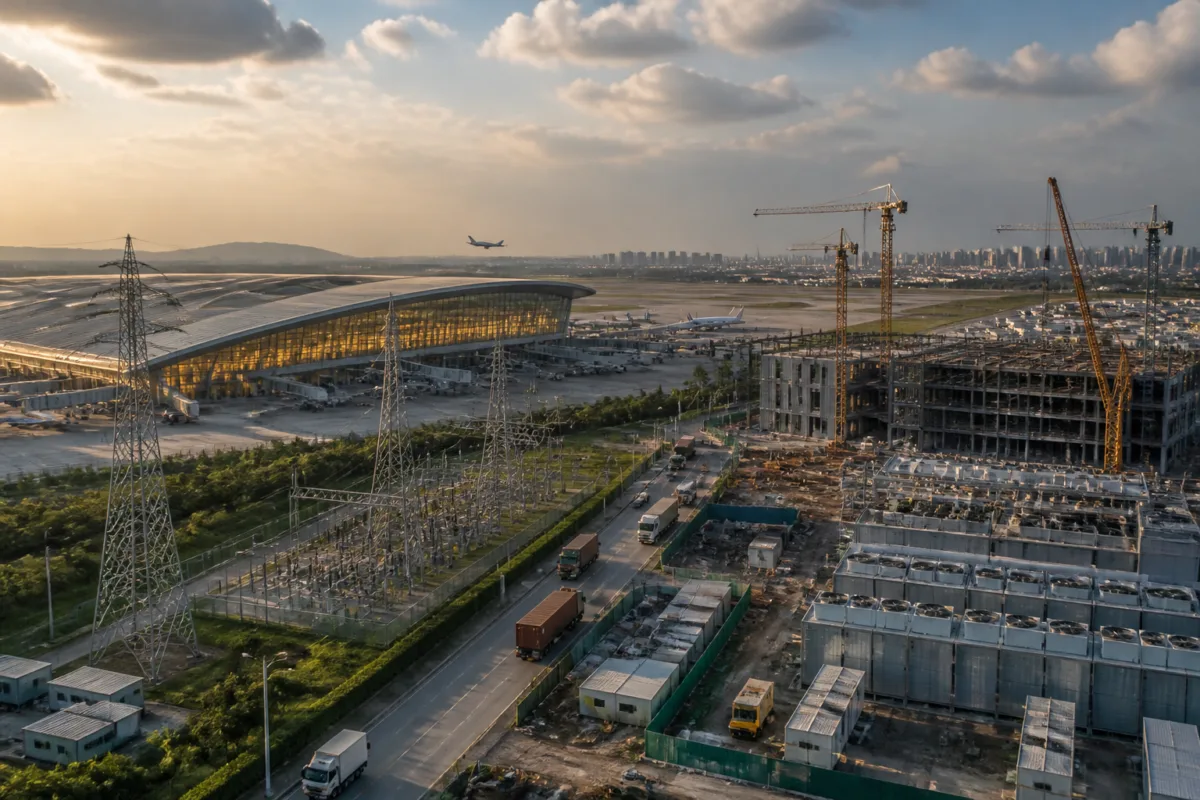
Adani Enterprises plans to invest between ₹35,000 crore and ₹40,000 crore annually over the next two years, with airports, data centres and a PVC manufacturing complex expected to account for the largest share of the spending. The announcement signals a fresh investment phase across infrastructure assets that serve India’s cities, digital economy and industrial supply chains.
Manan Vakharia, head of finance at Adani Enterprises, said during the company’s earnings call that the group expected capital expenditure to run at around ₹40,000 crore, with annual spending likely to remain within the ₹35,000 crore to ₹40,000 crore range over the next couple of years. He identified airports, data centres and the proposed PVC complex as the main investment drivers.
The company reported its highest-ever half-year EBITDA of ₹11,958 crore for the six months ended September 2026, a 56 per cent increase from a year earlier. Consolidated income rose 62 per cent to ₹71,569 crore, while profit before tax from continuing operations increased 45 per cent to ₹3,297 crore.
Chief Executive Officer Arun Bansal said the company was moving progressively from a build-out phase to a value-realisation phase as investments made over recent years began contributing more significantly to earnings. The transition is particularly important for the airport and data-centre businesses, where capital-intensive assets are being developed alongside efforts to increase operating revenue.
Adani Airport Holdings reported a 52 per cent increase in first-half EBITDA to ₹3,275 crore. Its portfolio of eight airports, including Navi Mumbai International Airport, accounts for about 23 per cent of India’s passenger traffic and 29 per cent of air cargo volumes, according to company officials. The airports handled 21.3 million passengers during the September quarter. Revenue rose 20 per cent year-on-year to ₹3,786 crore, while EBITDA increased 55 per cent to ₹1,641 crore. Non-aeronautical revenue grew 57 per cent, compared with a 9 per cent increase in aeronautical revenue.
Navi Mumbai International Airport began international operations on July 15. Management expects the airport to reach its full annual capacity of 20 million passengers by the end of financial year 2028, supported by the expansion of domestic and international routes and the transfer of some international flights from existing Mumbai airports. The timeline will make the airport’s capacity ramp-up a key operational milestone for the group’s planned investment cycle.
Data centres are another major component of the proposed capex. AdaniConneX, the group’s data-centre joint venture, has expanded its contracted capacity to more than 1.2 gigawatts and signed a new 240-megawatt hyperscale contract during the September quarter. Its operational capacity stood at 94.6 MW after an additional 29.2 MW was handed over to customers during the period.
The company expects operational data-centre capacity to reach between 120 MW and 150 MW by the end of the current financial year and approach 500 MW over the following 12 to 18 months. Of the 1.4 GW of capacity under development, 1.2 GW has already been tied up and is at different stages of implementation and construction, management said. The planned expansion will add to the physical infrastructure supporting cloud services, digital platforms and high-volume computing operations.
The group’s other major investment is a 1-million-tonne-per-annum PVC manufacturing complex at Mundra in Gujarat. The project involves capital expenditure of about ₹26,000 crore, with around 60 per cent of spending and construction completed. The first part of the complex is expected to be commissioned in the next financial year. The facility will also include related chemicals and chlor-alkali operations.
Adani Enterprises has separately completed an expansion of its solar module manufacturing capacity to 10 GW and expects to commission 6 GW of solar cell capacity by the end of the current financial year. It sold 1,478 MW of solar modules during the September quarter, up 35 per cent from a year earlier.
The planned spending will require the company to execute multiple large projects while bringing recently commissioned assets to commercial scale. Management did not provide a specific EBITDA forecast for financial year 2027. The next milestones identified by the company are the commissioning of the first PVC complex unit, the expansion of operational data-centre capacity and the continued traffic ramp-up at Navi Mumbai International Airport.

