


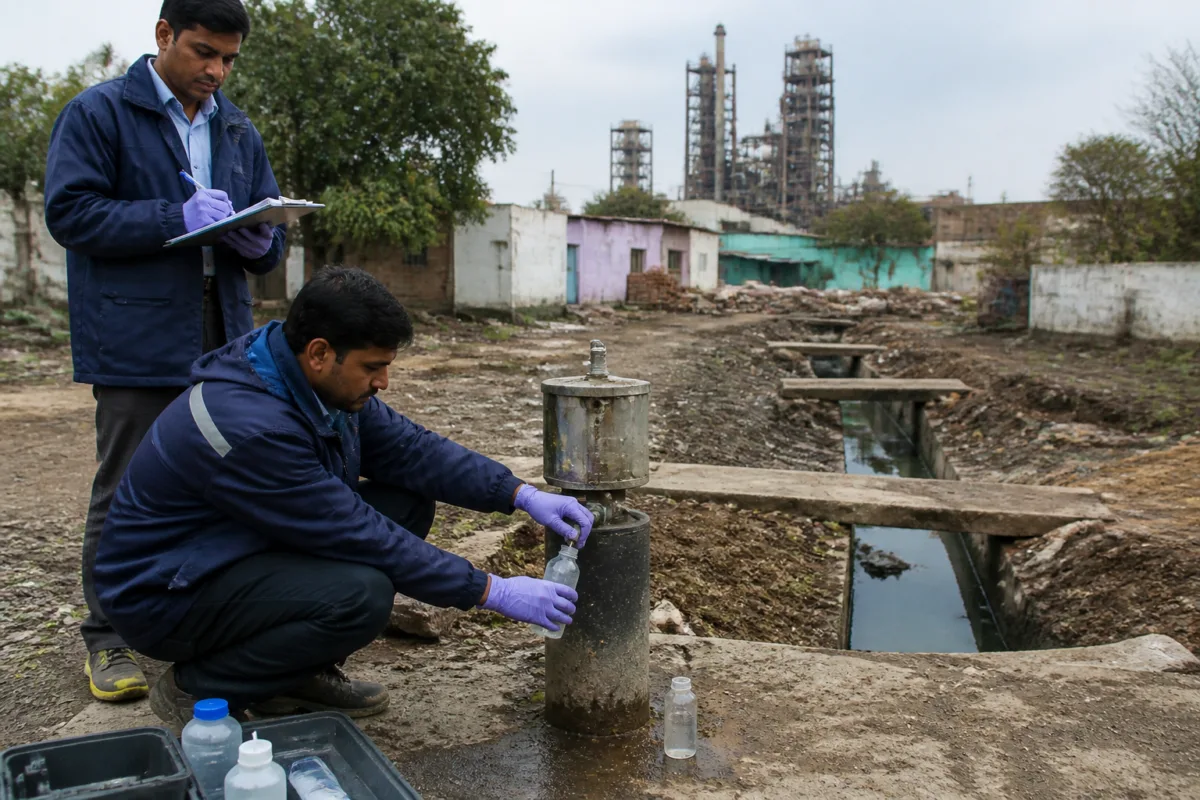
A groundwater contamination assessment around the former Union Carbide plant in Bhopal has covered a two-kilometre radius instead of the 3.5-kilometre area identified for scientific investigation, potentially leaving 46 settlements and about 150,000 residents outside the review, according to a Dainik Bhaskar report published on 28 November.
The report said the Madhya Pradesh gas tragedy relief department awarded a Rs 2.70-crore contract in July 2026 to Gujarat-based Kadam Environmental Consultants. Sampling has been completed and the report is expected by the end of December, according to the department’s director, Somesh Mishra.
The reported gap matters because earlier studies cited in the article found heavy metals, including lead, chromium and mercury, in groundwater up to 3.5 kilometres from the plant. A geographical assessment cited by the report indicated that 71 settlements could fall within the affected area when the potential direction of groundwater movement beyond the 3.5-kilometre radius is considered.
The investigation currently covers 25 settlements, representing about 85,000 people, while 30 settlements with an estimated population of 105,000 were reported to be outside the two-kilometre study area. Another 16 settlements, with about 45,000 residents, were identified as potentially lying along the wider groundwater-flow area beyond 3.5 kilometres. Taken together, the report said, 46 settlements were outside the present investigation’s scope.
The locations identified as potentially affected include parts of Palasi, Badwai, New Bhanpur, Maholi Damkheda, Kokta, Ayodhya Nagar, Narela Sankari, the areas around Meenal Residency, Ratankhedi and Jamuniya Chheer, as well as settlements towards Adampur Cantonment and Sukhi Sewania. The report also listed areas such as Arif Nagar, JP Nagar, Chhola, Nishatpura, Bhanpur, Narialkheda and other neighbourhoods within or beyond the current study area.
The issue is also linked to the time allowed for the assessment. An oversight committee chaired jointly by Union environment minister Bhupender Yadav and then gas-relief minister Vishwas Sarang recorded in June 2023 that a scientific investigation could require 10 to 12 months, according to documents cited by the report. The committee had sought a work plan, including assistance from the National Environmental Engineering Research Institute and the National Geophysical Research Institute, by 19 July 2023.
A departmental meeting on 6 April 2026 reportedly set a 12-month period for the work. The period was reduced to 90 days on 22 April, 16 days later. The company’s technical bid reportedly described the shorter period as risky for drilling, groundwater modelling and laboratory testing, and sought four-and-a-half to five months. The tender documents also included provisions for sampling before and after the monsoon, while different sections of the tender referred to work schedules of 12 weeks and staffing arrangements extending up to 12 months.
The report said officials from the Central Pollution Control Board and Madhya Pradesh Pollution Control Board declined to prepare the tender at a meeting on 5 March 2026, despite an earlier oversight committee recommendation for an advisory group on the study’s scope, tender and technical evaluation. It also pointed to errors in the tender, including a reference to Grasim Industries in Renukoot, Uttar Pradesh, instead of Union Carbide.
The tender reportedly set a minimum turnover requirement of Rs 60 lakh and awarded the contract to the sole bidder, which received 90 out of 100 marks. These details raise questions about how the study’s geographical scope, sampling design, duration and technical scrutiny were determined. The source report does not include the full tender or the completed sampling report, so the claims about the documents and evaluation remain attributable to that report pending public release of the records.
The stakes extend beyond mapping contamination. Documents presented to the oversight committee in June 2023 reportedly referred to 1.1 million tonnes of contaminated soil, 150 tonnes of buried toxic waste, one tonne of dispersed mercury and 1,500 tonnes of contaminated structures and machinery. A reliable assessment of the pollution’s spread would be central to deciding the boundaries, priorities and methods of any cleanup.
Mishra told the newspaper that the work order had been issued before his posting, that sampling was complete and that the report would arrive by the end of December. He said he was not aware of any dispute concerning the work order or the company’s work, and asked the newspaper to provide its report if it wanted an inquiry conducted.
Until the assessment is published, the principal unresolved question is whether the completed sampling adequately reflects the full area of historical contamination and possible groundwater movement. For residents in the settlements identified outside the two-kilometre radius, the answer will determine whether their neighbourhoods are included in future monitoring and remediation decisions.

