


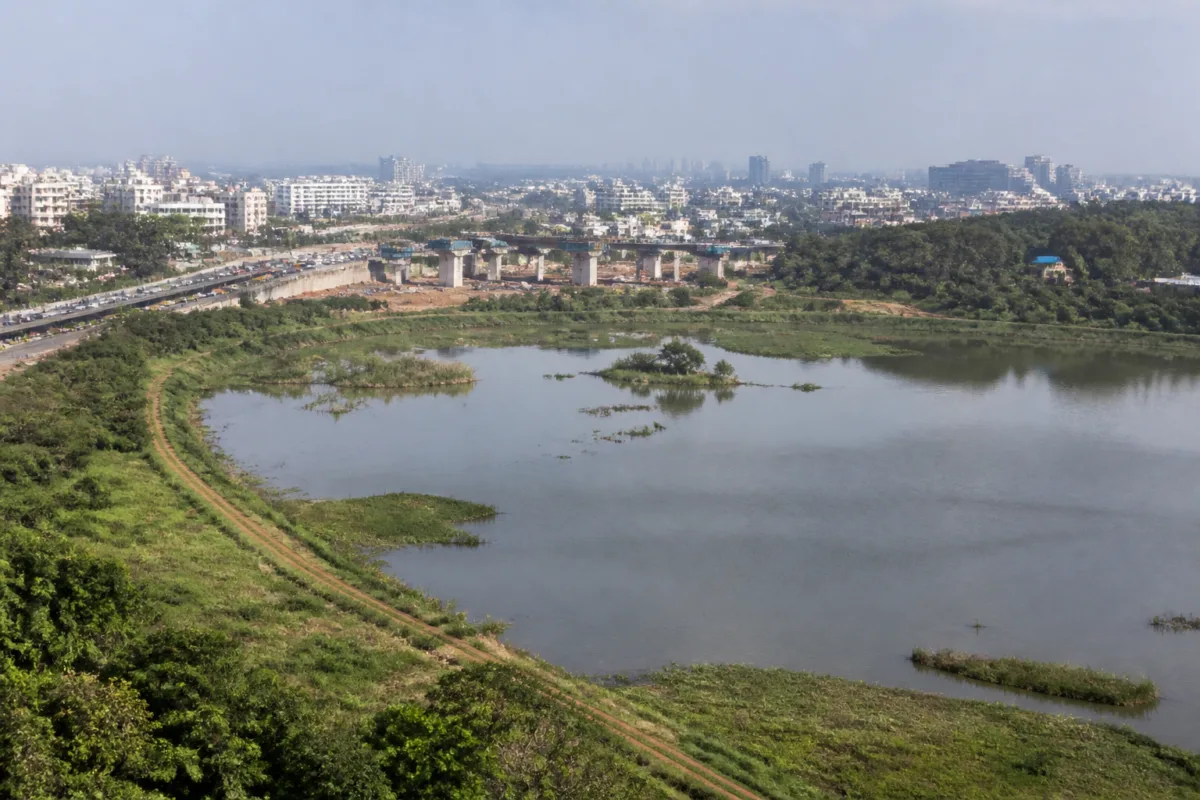
The proposed Hebbal Integrated Bypass Road has turned Hebbal Lake’s legal classification into a central question in Bengaluru’s infrastructure debate. The project includes an elevated road and a short tunnel near the lake, while authorities and environmentalists disagree over whether the waterbody should be treated primarily as a man-made irrigation tank or as a wetland with wider statutory and ecological protections.
The distinction has practical consequences. It could influence how construction around the lake is assessed, which safeguards apply and how the project’s effects on drainage, groundwater movement and flood management are examined. The Bangalore Development Authority (BDA) maintains that Hebbal Lake is a human-made irrigation tank excluded from the statutory definition of a wetland under the Wetlands (Conservation and Management) Rules, 2017. Environmentalists argue that its ecological functions and existing protections cannot be set aside because of its historical origins.
A BBMP project report on restoring the lake’s wetland describes Hebbal Lake as a man-made tank and classifies its ecological condition as mesotrophic, indicating moderate nutrient levels and intermediate biological productivity. The report also records that urban waterbodies can acquire wetland characteristics over time and perform functions such as trapping sediments, mitigating floods, recharging groundwater and supporting migratory birds and aquatic life.
The report proposed several restoration measures, including desilting the wetland, constructing a new bund, restoring inlet streams and installing dedicated sewage-diversion drains. These recommendations indicate that the lake’s environmental role is not limited to its original use for irrigation or drinking water. They also make the condition of its inflows, storage area and surrounding drainage relevant to any infrastructure proposal nearby.
The BDA has taken a different legal position. In its Public Information Dossier and frequently asked questions, the authority cites historical records from the Mysore Gazetteer, including editions from 1897 and 1929–30, to state that Bengaluru’s plateau waterbodies were predominantly human-made irrigation tanks formed by embanking valley streams. According to the BDA, Hebbal Lake was historically known as Hebbal tank and was used for irrigation and drinking water.
The authority relies on Rule 2(1)(g) of the 2017 Wetlands Rules, which excludes specified human-made waterbodies, including those constructed for irrigation and drinking water, from the statutory definition of wetlands. On that basis, it says Hebbal Lake is governed as a tank under the Karnataka Tank Conservation and Development Authority (KTCDA) Act, 2014.
That interpretation does not by itself settle the lake’s environmental status. The report notes that an October 2025 Supreme Court judgment concerning Futala Tank in Nagpur upheld the exclusion of a human-made waterbody constructed for irrigation and drinking water from the statutory definition of wetlands. At the same time, the Court recognised that the Public Trust Doctrine applies to man-made waterbodies and acknowledged their ecological and environmental value.
The Futala judgment therefore does not automatically determine the legal position of Hebbal Lake. Its historical purpose, applicable notifications and specific circumstances would still need to be considered separately. The distinction between statutory classification and ecological function is important: a lake may fall outside one legal definition without becoming free from other environmental or public-trust obligations.
D T Devare, co-founder and trustee of the Bangalore Environment Trust, argues that Hebbal Lake should be treated as a wetland and has raised concerns about the proposed tunnel. He says the tunnel passes through a wetland area, while the BDA maintains that construction would take place beneath the bund rather than through the lake itself. Devare has described the approach as a technical fix and has also referred to Supreme Court directions from 2017 concerning wetlands mapped under the earlier Wetlands Rules, 2010.
He further cites the Ramsar Convention’s broad definition of wetlands, which includes artificial waterbodies. However, the international definition and India’s statutory definition under the 2017 Rules are not interchangeable. The disagreement highlights why the project’s legal and technical assessments need to identify precisely which protections apply to the lake, its wetland area, its bund and its connected drainage system.
Hebbal Lake is recognised as a wetland in an Indian Institute of Science scientific inventory but was not included in the Karnataka Government’s list of 11 wetlands submitted to the National Green Tribunal on 25 July 2022. The report says that formal notification of Hebbal Lake under the 2017 Wetlands Rules has therefore not been established. It also notes that the absence of formal notification does not necessarily mean the lake lacks legal protection, given applicable environmental and lake-protection laws, National Green Tribunal directions on buffer zones and Supreme Court directions concerning wetland identification, demarcation and conservation.
The project’s most immediate environmental questions concern water movement. The proposed tunnel’s proximity to the lake has prompted concerns about groundwater flow, stormwater drainage, flood management and the lake’s storage capacity. The BDA has maintained that the project will not obstruct the lake’s natural inflow or outflow. The KTCDA has granted conditional approval involving 3.3 acres within the lake premises, subject to environmental safeguards.
The Karnataka High Court, while declining to temporarily halt construction in September 2026, directed the government to explain how the project’s design would protect the lake’s water flow. The project’s detailed project report has earmarked Rs 75 lakh for an environmental impact assessment, but the assessment has not been made publicly available. The BDA has described the allocation as a budgetary provision.
A standalone tunnel does not automatically require prior environmental clearance under the Environmental Impact Assessment Notification, 2006, according to the report. That does not remove the relevance of other environmental, lake-protection and court-directed safeguards. The key issue is whether the project’s design and approvals adequately address the lake’s connected hydrology, rather than only whether the tunnel passes directly through the waterbody.
The proposal has also faced financial and planning objections. Karnataka’s Finance Department questioned the Rs 2,215-crore cost and argued that a surface road could provide comparable traffic relief at a substantially lower expense. It also raised concerns about project funding, the absence of an independent feasibility assessment, possible effects on the proposed North-South Tunnel, known as B-SMILE, and the lack of adequate public transport integration.
These objections broaden the public-interest test for the project. The debate is not only about whether a tunnel can be engineered beneath or near a lake. It is also about whether lower-cost alternatives were properly examined, whether the project is integrated with public transport and whether the environmental assessment is sufficiently transparent for citizens to evaluate the trade-offs.
The Hebbal Lake dispute shows why legal classification alone cannot resolve the infrastructure question. Even if the lake qualifies for exclusion from the statutory definition of a wetland under the 2017 Rules, its flood-management, groundwater, drainage and habitat functions remain relevant to public planning. The unresolved questions are whether the tunnel will alter those functions, whether the proposed safeguards are supported by publicly accessible scientific evidence and whether the project’s benefits justify its financial and environmental risks.

