


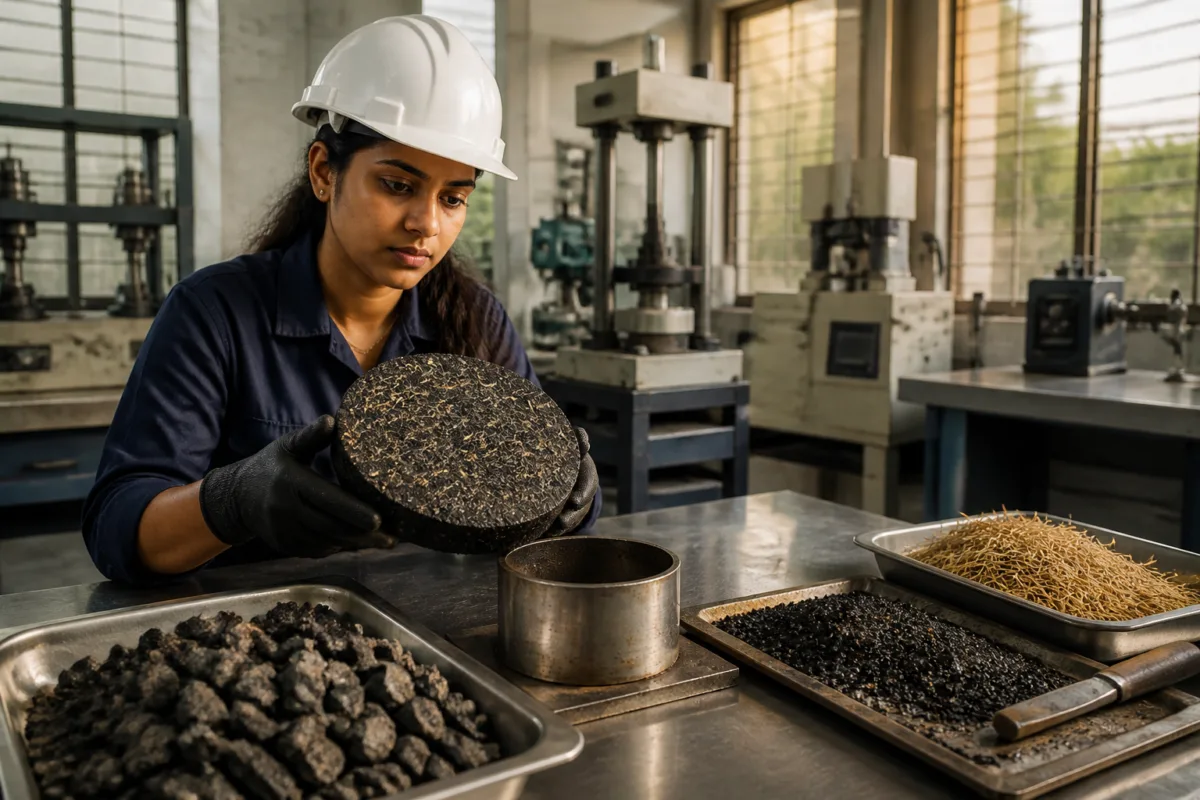
Research presented by Vadodara roads and buildings department engineer Rajeshwari Nair at the Indian Roads Congress’s 85th Annual Technical Session in Hyderabad has examined the use of waste bamboo fibre in bituminous road construction.
The technical session was held at the Mir Ali Nawaz Jung Bahadur Hall in Hyderabad from November 19 to 22, 2026, according to a report by Nav Gujarat Samay. Engineers and experts from across India attended discussions on road structures and sustainable construction.
Nair’s research examined whether waste bamboo fibre could be converted into an input for high-quality dense bituminous macadam, a strong asphalt mixture used in road construction. The report said the study used 0.3% bamboo fibre and recorded improvements in several reported performance indicators: a 36% increase in Marshall stability, a 64% improvement in the rutting tolerance index, a 27% improvement in TSR and a 20% improvement in the healing index.
The reported findings indicate potential benefits in two areas that are increasingly important for road agencies: the use of waste-based materials and the performance of road surfaces under repeated traffic loading. Better resistance to rutting and improved healing characteristics could, if confirmed through further testing and field use, support longer-lasting pavements and reduce the frequency of maintenance interventions.
The report also cited a lifecycle assessment that found the method could reduce carbon emissions by up to 54%. A lifecycle cost analysis was reported to indicate potential savings of up to 26%. These figures describe the results or estimates cited in the research and should not be read as evidence that the material has already been adopted in Vadodara or elsewhere.
No road project, procurement decision or field trial involving the bamboo-fibre mixture was announced in the report. Its immediate significance is therefore as a research finding presented to the road engineering community. Further laboratory validation, performance monitoring under local traffic and weather conditions, and formal approval under applicable road specifications would be needed before any wider implementation.
The report said Nair’s research work has also appeared in the Journal of the Indian Roads Congress and Indian Highways. It added that she had presented papers at CECAR 10 in South Korea and the Institution of Engineers (India) National Convention, and that an abstract had been selected for the PIARC BEAM 2027 conference.

