


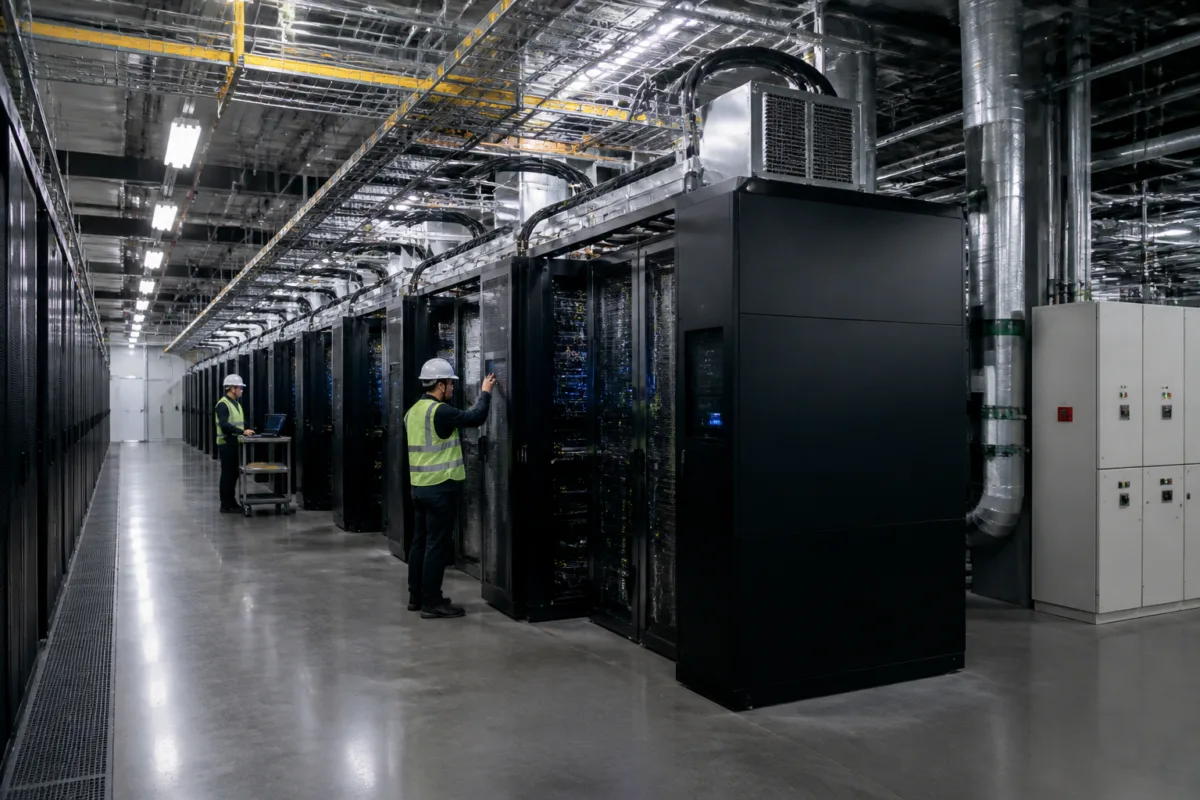
Nvidia Blackwell processors identified in lender and regulatory documents were installed at a Shanghai data centre linked to the Yangtze River Delta Project, according to a Bloomberg investigation published by the Economic Times. The findings have raised questions about how restricted computing equipment entered China, how it was financed and how large-scale data-centre development is being monitored.
The equipment identified includes a GB300 NVL72 rack, one of Nvidia’s most powerful data-centre systems, according to a serial number in documents submitted to Chinese regulators in November. The rack was offered as collateral for a 96 million yuan ($14 million) loan obtained by Shanghai Shuoyao from Shanghai Innovation Bank, Bloomberg reported after reviewing the lender’s filings.
A second company, Shanghai Kezhan, described a GB200 server at the same facility in documents connected to a 90 million yuan loan secured in late 2025 from a finance-leasing company wholly owned by a local Shanghai government agency. The GB200 also uses Nvidia’s Blackwell generation of processors.
The documents do not establish how the equipment reached China or whether the shipments had US approval. Nvidia’s Blackwell products were described in the report as illegal to ship to China without a US licence. The report said the Trump administration had also stated that it did not want such chips sent to China, at least for now.
The site is associated with a project described in local media as being designed to accommodate as many as 800,000 servers. Bloomberg said it was unclear how far the project had progressed, what combination of servers its operators intended to deploy or whether the overall technical and energy parameters outlined in construction plans could be met using Chinese-made processors.
The scale cited for the project places the issue beyond an isolated equipment transaction. A data centre designed for hundreds of thousands of servers would require substantial power, cooling, buildings, network capacity, logistics and financing. The available reporting does not establish that the full project has been built or that it has reached its stated capacity. It does, however, show how individual high-value computing systems can become part of the financial and physical infrastructure of a data-centre development.
Bloomberg traced the GB300 rack’s serial number through a public warranty database to Taiwan-based Gigabyte Technology, which assembles Nvidia chips into servers and racks. The database entry matched the serial number to a GB300 NVL72 rack. Gigabyte declined to say who originally bought the hardware or when, citing company policy. A company spokesperson said its business complied with applicable laws and regulations and that transactions were subject to internal compliance requirements.
The report also identified connections between Shanghai Shuoyao, Shanghai Kezhan and Singapore-based Megaspeed, a company under US scrutiny over alleged diversion of Nvidia chips to China. Shanghai Shuoyao confirmed that it was one of Megaspeed’s service providers but described the relationship as limited to ordinary commercial cooperation. Bloomberg said it had no evidence that Megaspeed itself diverted the hardware found at the Shanghai site, and Megaspeed has denied wrongdoing.
The US administration placed Megaspeed on a trade blacklist this month, citing what it described as a significant risk of involvement in chip diversion. Megaspeed was founded in 2023 by Alice Huang, who has also been linked to companies associated with the Yangtze River Delta Project. The project’s president is identified in the report as Kang Wei. Bloomberg said it was unclear what role, if any, Megaspeed played in moving the equipment to the site.
Other records reviewed by Bloomberg point to additional restricted Nvidia hardware at the facility. Shanghai Longjie, which shares a parent company with Shanghai Shuoyao, disclosed servers containing earlier-generation Hopper chips. Shanghai Kezhan separately disclosed 32 servers with H200 chips, although the relevant documents did not include serial numbers that would allow the equipment to be traced as readily.
Shanghai Kezhan is headquartered about half a kilometre from the project, according to the report. The company and Shanghai Shuoyao also solicited engineers for work involving Nvidia H100 and H200 chips, while both companies added imports and exports to their registered business activities in February 2024. In May 2025, trade records showed Shanghai Kezhan as the consignee for an $11 million shipment flown from Malaysia to Shanghai Pudong International Airport. The shipment was described as storage chassis, but its customs product code denoted computing servers, Bloomberg reported.
The financing records are significant because they show high-value computing equipment being treated as a bankable asset. Shanghai Innovation Bank also provided a 200 million yuan loan to Shanghai Longjie against collateral that included restricted Nvidia chips, according to documents reviewed by Bloomberg. The report said it was unclear whether the hardware involved in those loans had received US approval.
For city and infrastructure planners, the case highlights the difficulty of assessing data-centre expansion through construction activity alone. Equipment procurement, ownership, financing, energy requirements and cross-border compliance can materially shape whether a facility is viable and how it operates. In this case, public records reveal parts of that chain, but they do not provide a complete account of the project’s construction status, server inventory or legal import history.
Neither Nvidia nor the leasing company involved in the Kezhan loan responded to Bloomberg’s questions, while Shanghai Innovation Bank and other companies named in the report could not be reached or did not answer. The available evidence therefore supports a documented account of restricted hardware identified at a Shanghai data-centre project and linked financing arrangements, but not a definitive conclusion about who diverted the equipment or whether the entire development breached export controls.

