


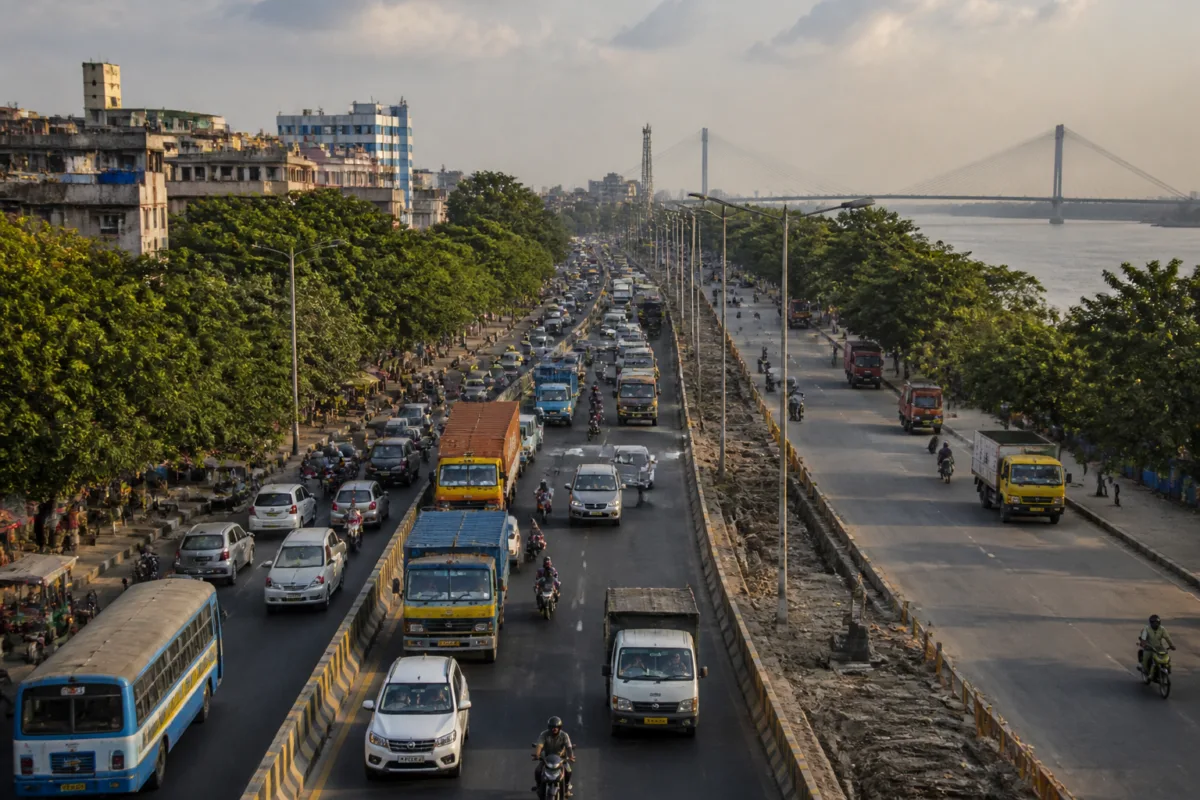
The proposed Kolkata Outer Ring Road is emerging as a key infrastructure opportunity in West Bengal, with Adani Group managing director Karan Adani saying the group is looking to bid for the project along with upcoming thermal power and ropeway developments in the state.
The West Bengal government revived plans for the outer ring road earlier this year. The project is envisaged as a four-to-six-lane peripheral highway across four districts, with the objective of easing urban congestion and improving freight movement around Kolkata. Economic Times reported that the alignment could extend between 130 km and 200 km, integrate existing expressways and potentially include a new bridge across the Hooghly.
The report does not indicate that the Adani Group has been awarded the project. Adani said the group was considering bidding for it as part of a broader expansion in West Bengal. Group chairman Gautam Adani had announced investments exceeding ₹1 lakh crore in the state by 2035, according to the report.
Karan Adani identified greenfield expressways, ports and power generation—including thermal and renewable capacity—as priority areas. The group’s first business initiative since the September investment announcement is a renewable power supply contract, under which Adani Energy Solutions subsidiary Powerpulse Trading Solutions will supply 1,750 MW of round-the-clock renewable power to the state electricity distribution company for 25 years from July 2028.
For Kolkata, the outer ring road proposal is significant because it could provide an alternative route for traffic that currently enters or crosses the metropolitan area. Its potential to streamline freight movement would depend on how effectively it connects with existing expressways, industrial areas, ports and rail-linked logistics facilities. The reported possibility of a new Hooghly bridge also indicates the scale of land, right-of-way and river-crossing decisions that would shape the project.
Adani also argued that supporting infrastructure should be planned before major port capacity is added. He said governments should consider road and rail connectivity, power and water infrastructure over a 30-to-50-year horizon, even when capacity is added gradually. He cited connectivity constraints at Paradip port, including a lack of land for additional rail lines, as an example of how inadequate early planning can limit later expansion.
The argument is relevant to West Bengal’s proposed infrastructure push because road development, port expansion and industrial investment would need to be coordinated rather than delivered as separate projects. The outer ring road’s eventual public value will therefore depend on details not established in the report, including its final alignment, land requirements, approvals, funding structure, construction schedule and integration with public transport and freight networks.
Adani described West Bengal as a potential base for manufacturing and logistics investment, citing its industrial history, workforce and geographical position. The group is also seeking to develop an integrated network of ports on India’s eastern seaboard, which it says could offer industrial customers alternative routes during supply-chain disruptions.
At this stage, the Kolkata Outer Ring Road remains a revived government plan and a potential bidding opportunity for the Adani Group, rather than a confirmed company-led project. The next significant indicators will be the state’s formal project documents, procurement process, alignment decisions and clearances.

