


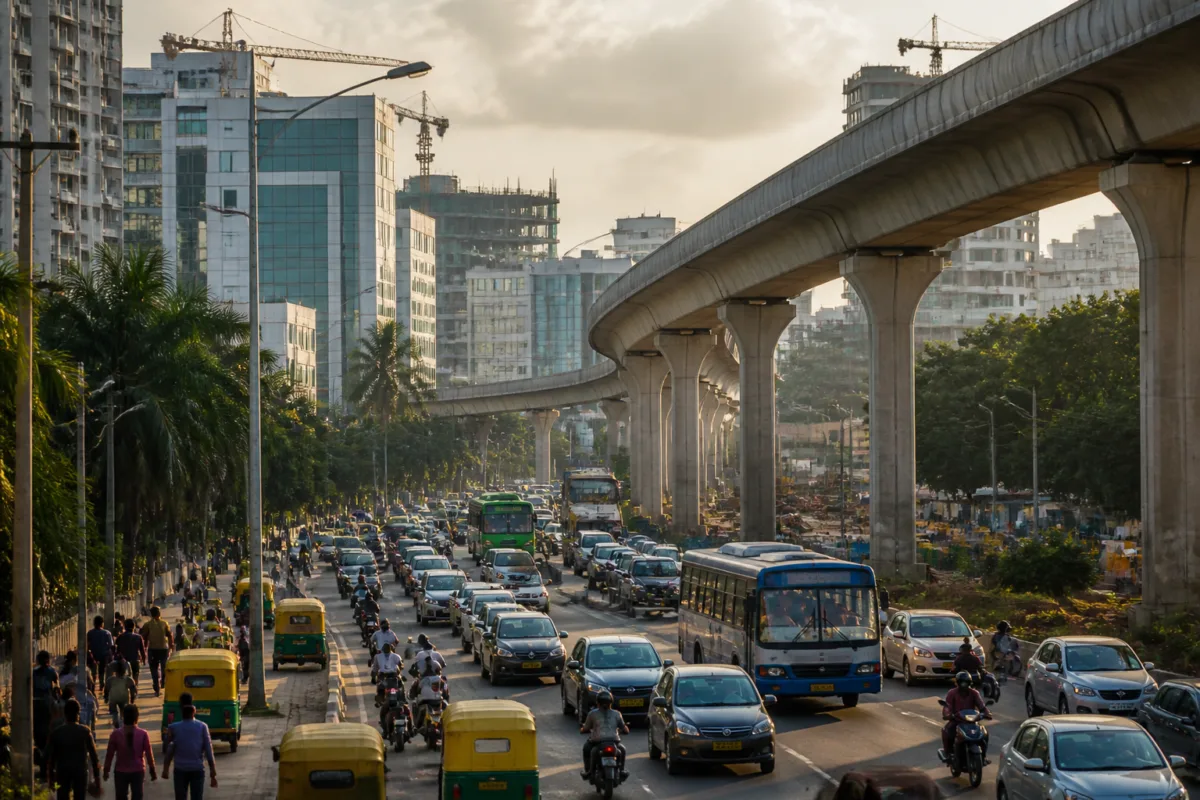
Bengaluru’s proposed Sarjapur–Hebbal Metro corridor may not become operational until April 2033, later than its earlier 2031 target, as the project continues to await approval from the Union government. The 37.8-km line is planned under Namma Metro Phase 3A and is intended to connect major residential, commercial and employment areas across the city.
The corridor would run from Sarjapur in southeast Bengaluru through Bellandur, Koramangala and the central business district to Hebbal in the north. According to the report, the revised plan comprises 20.52 km of elevated track, 14.28 km underground and an additional elevated section of about 3 km near Hebbal via Ganganagar.
The proposed alignment includes stations at Carmelaram, Bellandur, Iblur, Agara and Koramangala on the elevated section. The underground section is planned to include Dairy Circle, NIMHANS, Shanthinagar, Town Hall, KR Circle, Bengaluru Golf Course, Palace Guttahalli and Mekhri Circle. Ganganagar and Hebbal are among the stations identified in the northern section.
The line is also expected to provide interchanges with existing and planned Metro corridors, allowing passengers to transfer across the network rather than depend entirely on road transport. Its proposed alignment would link areas associated with Bengaluru’s information technology and commercial activity to established central and northern neighbourhoods.
The project’s approval and cost have been the main sources of delay. The Karnataka Cabinet approved Phase 3A at an estimated cost of Rs 28,405 crore. The Union Ministry of Housing and Urban Affairs (MoHUA) subsequently raised concerns about the cost and recommended that the proposal be reconsidered.
Bengaluru Metro Rail Corporation Limited (BMRCL) revised the detailed project report in January 2026. The revised estimate is Rs 25,999 crore, while the underground portion was reduced and one proposed station was removed, according to the report. MoHUA informed the Rajya Sabha in August 2026 that the revised DPR was under appraisal, but did not provide a definite approval date.
The report said the project had been awaiting central approval for nearly 22 months. It attributed the disagreement partly to the high estimated cost of underground construction, which is around Rs 695 crore per kilometre. The Karnataka government has argued that underground Metro construction costs more because of construction conditions, land-related requirements and the nature of work involved.
For commuters, the delay means that the proposed alternative to roads on the Sarjapur–Hebbal axis remains several years away. The corridor is intended to improve connections between Sarjapur, Bellandur, Koramangala, central Bengaluru and Hebbal, where daily travel currently depends heavily on roads and private or hired vehicles. The report said the line could eventually support public transport use and reduce pressure on routes such as Sarjapur Road and the Outer Ring Road, although the extent of any impact would depend on completion and network integration.
The corridor also covers localities where transport access is closely linked to housing and commercial demand. Sarjapur and Carmelaram are important residential and employment areas, while Bellandur and Iblur are near Bengaluru’s technology and Outer Ring Road corridor. Koramangala combines residential and commercial activity, and Hebbal and Ganganagar connect northern neighbourhoods with other parts of the city.
Improved Metro access could influence housing choices and rental demand in these areas, but the report cautioned that any real estate effect will depend on final station locations, construction progress and last-mile connectivity. Earlier market expectations of rental growth should not be treated as a guaranteed increase in property values, particularly while the corridor remains subject to approval and its completion date has moved to 2033.
The immediate issue is therefore not only the revised completion schedule but whether the project can secure approval on its revised terms. Until that process is completed, the Sarjapur–Hebbal line remains a proposed transport connection rather than an active construction project, leaving its cost, timeline and eventual benefits dependent on decisions still pending.

