


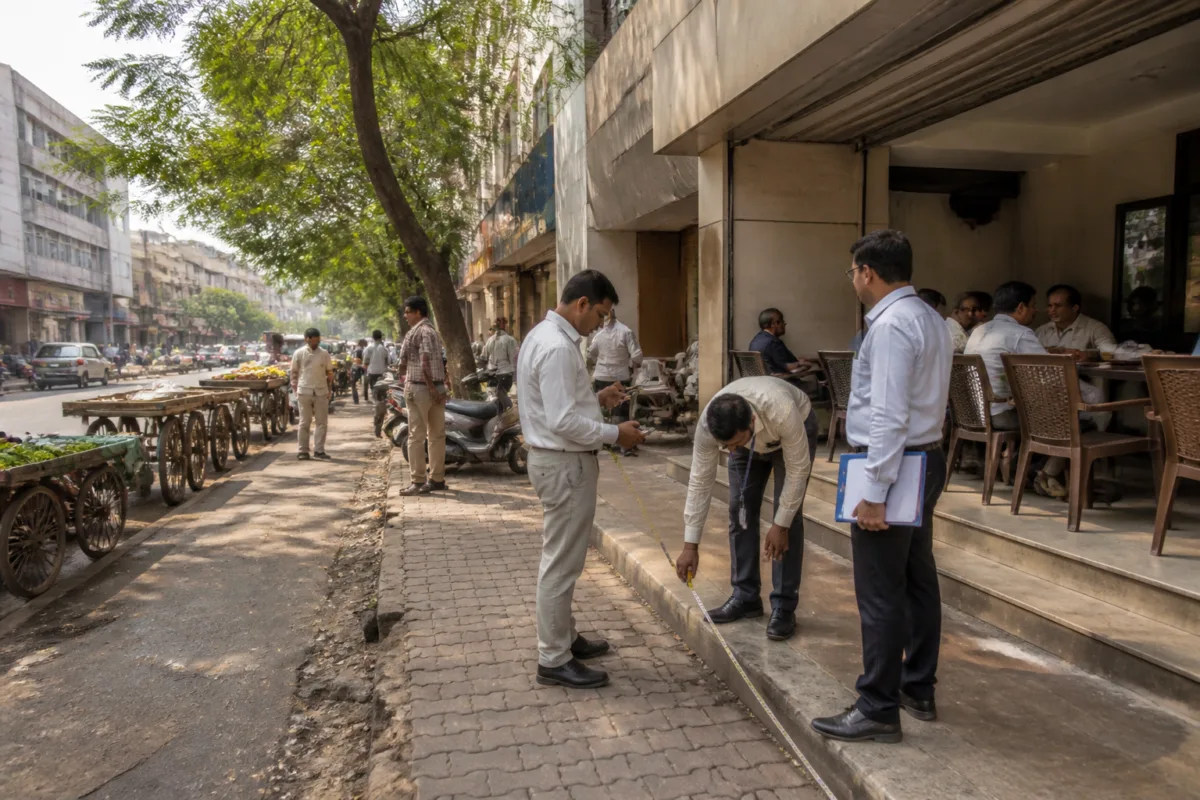
The Pune Municipal Corporation’s recent anti-encroachment drive in the Dhole Patil ward has raised questions about whether enforcement is being applied consistently to small street vendors and larger commercial establishments occupying public space.
According to a report by Pune Times Mirror, civic officials removed handcarts and street vendors from roads during the drive, while restaurants operating from the ground floor and front-margin area of the Dhole Patil ward office building remained untouched. The building is the Late Damodar Narayan Dhole Patil Memorial Building on Chhatrapati Shahu Maharaj Path.
The ground-floor space was originally reserved for a vegetable market, the report said. Restaurants including Madhuban and Nandu’s have allegedly operated from the building’s shops for around 15 to 20 years. Sheds and umbrellas have also reportedly been installed in the front margin to provide seating.
Residents and vendors cited in the report questioned why handcarts belonging to small operators were removed while larger establishments continued to use front and side margins. The report also referred to alleged encroachments near Kapila-Kathi Kebab, bhel and panipuri stalls, the Bank of Maharashtra compound wall and the area near Shankar-Parvati Chambers.
The allegations extend beyond restaurants. Pune has designated hawkers’ zones along Dhole Patil Road and Mata Ramabai Ambedkar Road for handcart-based businesses. The report said some permanent iron kiosks had allegedly been installed in these zones in the names of relatives or other individuals, while action against them had not been reported.
The municipal administration has said that enforcement should not make exceptions. Municipal Commissioner Naval Kishore Ram warned that the names of political leaders who attempted to stop encroachment action would be made public, according to the report, and directed that the drive be conducted uniformly.
Dhole Patil ward office Assistant Commissioner Bhaskar Mahadik told Pune Times Mirror that the management of Madhuban had claimed it possessed permission to convert a vegetable-market shop into a restaurant and to use the front margin. Mahadik said the operators had promised to submit supporting documents for verification.
He said action concerning Kapila and Madhuban would be considered after the documents were received and examined. By late evening, however, the operators had reportedly not submitted the documents. Mahadik also said that action would be taken in accordance with the rules against unauthorised encroachments on roads, footpaths and front and side margins.
The issue now places the ward office itself under scrutiny. If the municipal corporation is seeking to clear public pathways and margins, the same standards would need to be applied to commercial activity on or adjoining civic premises, subject to the permissions and records held by the establishments. The report did not establish whether the restaurants possess valid approvals, making documentary verification central to the dispute.
The episode highlights a recurring governance challenge in Indian cities: enforcement against informal operators is often more visible and immediate than action involving established commercial users or properties linked to public institutions. In this case, the available account records competing claims but does not provide the permissions, leases, building-use approvals or encroachment inspection records needed to determine whether the restaurants’ occupation is authorised.
For residents, the consequences concern more than the livelihoods of vendors. Commercial use of front margins and road-facing areas can affect pedestrian movement, access, traffic safety and the intended use of land reserved for civic or market purposes. Any further action by the PMC will therefore need to clarify the legal status of the ward-office premises and neighbouring establishments, while applying the same rules to street vendors and larger businesses.
The immediate test for the Dhole Patil ward office is whether the documents promised by the establishments are obtained and independently checked, and whether the outcome is communicated publicly. Until that process is completed, the allegations of selective enforcement remain unresolved.

