


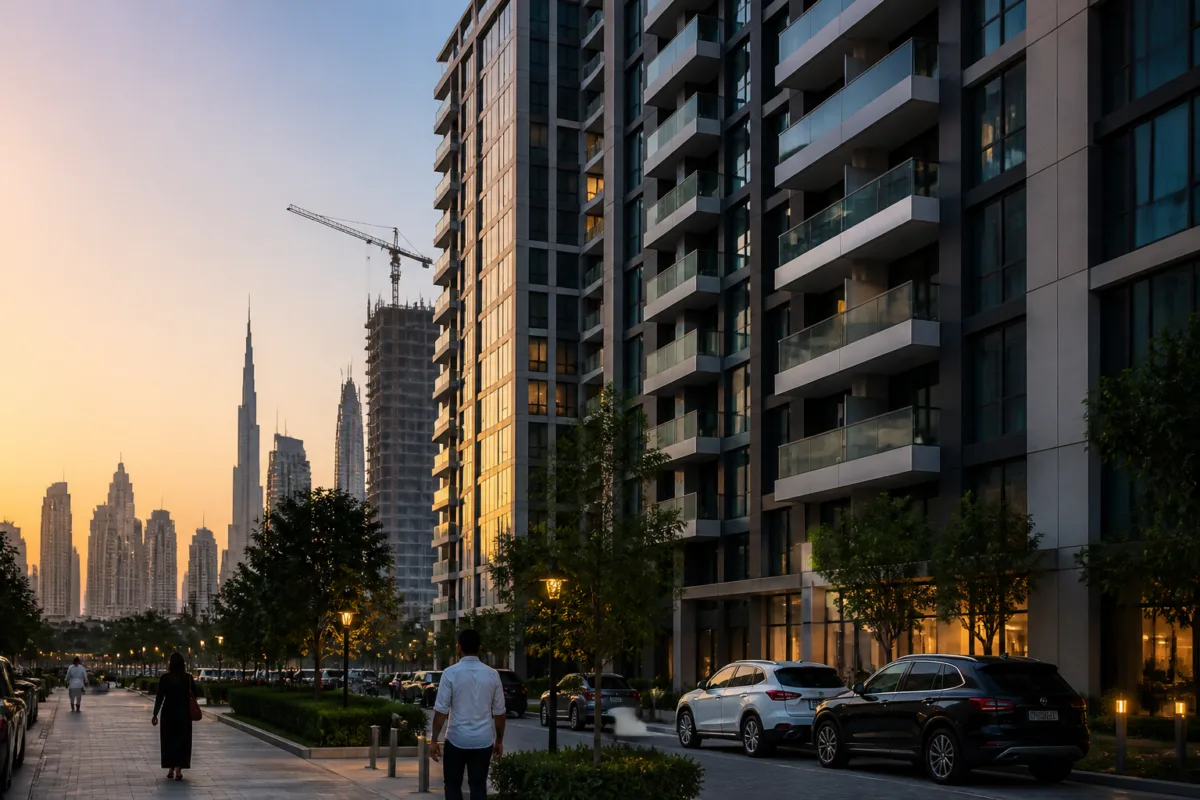
Dubai’s property market is seeing buyers favour completed homes over under-construction projects as concerns about delivery timelines, construction costs and market uncertainty weigh on off-plan transactions, according to data and expert views reported by the Economic Times.
Overall property transactions in Dubai fell 41% year-on-year to 19,501 in the ongoing quarter, based on Dubai Land Department data cited in the report. Deals involving properties still under construction declined 45%.
The share of under-construction transactions fell to 63% between October 1 and November 20, from 68% during the same period a year earlier. The shift indicates stronger demand for completed homes, which can provide immediate occupation or rental income, although the report noted that changes in the mix of properties sold may also have influenced the figures.
The difference is also visible in median transaction values. The median value of under-construction properties declined 11.18% year-on-year to AED 1.35 million, or about $368,000, while the median value of ready properties rose 13.7% to AED 1.64 million. The figures do not establish that buyers are paying more solely because homes are completed, but industry executives cited the reduced construction and handover risk as a possible factor.
Several handovers could be delayed by six to 12 months because of higher input costs, according to industry executives quoted in the report. Amit Kumar Jhunjhunwala, chief investment officer at Nisus Finance, said construction costs had increased by 35-40% on average, with some materials becoming substantially more expensive. He said MDF prices had risen to nearly 2.5 times their earlier levels and that suppliers were increasingly asking for advance payments to secure orders.
Jhunjhunwala said off-plan sales had been affected by uncertainty over delivery timelines, rising construction costs, shipping delays and supply-chain constraints. He also said investors account for more than 70% of the under-construction market, with the remainder comprising end-users, making investor confidence an important influence on transaction activity.
Indian buyers remain a significant group in Dubai’s property market. Data from real estate advisory Anarock, cited in the report, put their share of buyer activity at around 20.6%, ahead of British buyers at 13.3%.
Aayush Puri, chief executive officer for residential, Middle East, and CEO of Anarock Channel Partner, attributed part of the slowdown to the high base created by record sales in 2025, regional conflict and uncertainty in the second quarter, fewer new launches and more cautious buyers. He said the change did not necessarily mean buyers had lost interest in Dubai, but that they were taking longer to assess pricing, geopolitical risks and the timing of investments.
The reported shift places greater emphasis on established locations, credible developers and realistic rental-return assumptions. For buyers, completed homes reduce exposure to construction and handover uncertainty but may require a higher upfront purchase price, as suggested by the gap between the reported median values. For developers, the slowdown in under-construction transactions highlights the importance of controlling costs and maintaining confidence in delivery schedules.
The available figures show a change in transaction patterns rather than a complete withdrawal from Dubai’s property market. They also do not quantify the number of delayed projects or establish how many buyers have moved from off-plan purchases to ready homes. Those questions will determine whether the current preference is a short-term response to uncertainty or a broader change in Dubai’s investor-led housing market.

