


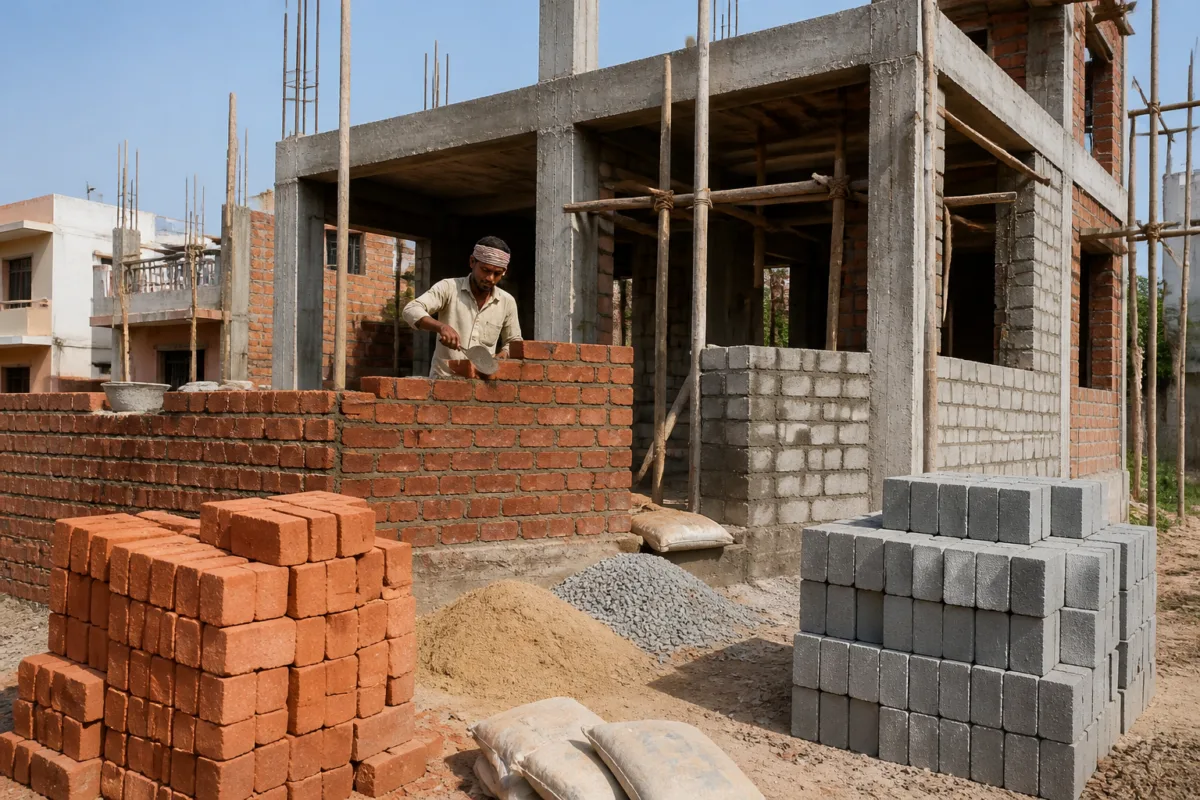
Choosing between red brick and cement block can affect material use, construction time and labour costs when building a house. A MagicBricks report, citing an unidentified contractor, compares the two options for a 1,000 sq ft home and says the overall wall-construction cost may be broadly similar despite differences in material and labour expenses.
The report says red bricks are traditionally made from clay and fired in kilns. They are widely available and familiar to most masons, particularly in smaller towns and rural areas. Their smaller size, however, means that more units may be required to build a wall. The report says this can increase the number of mortar joints and raise cement, sand and plaster consumption.
For a 1,000 sq ft house, the report estimates that around 45,000 to 50,000 red bricks could be required. It places the material cost at approximately ₹3 lakh to ₹3.5 lakh, with cement and sand adding ₹1.2 lakh to ₹1.5 lakh. Labour is estimated at ₹2 lakh to ₹2.5 lakh, taking the total reported cost to about ₹6.5 lakh to ₹7.5 lakh.
Cement blocks, also referred to in the report as concrete blocks, are made using materials such as cement and sand, often with machines. Their larger size means fewer units may be needed for a wall. The report says this can reduce mortar consumption and allow masonry work to progress faster, potentially lowering labour costs.
The estimated requirement for the same 1,000 sq ft house is 12,000 to 15,000 cement blocks. The report places the cost of these materials at ₹4 lakh to ₹5 lakh. Cement and sand are estimated at ₹80,000 to ₹1 lakh, while labour is put at ₹1.5 lakh to ₹2 lakh. The resulting total is estimated at ₹6.3 lakh to ₹7 lakh.
These figures suggest that a higher per-unit price for cement blocks may be partly offset by lower mortar and labour requirements. The report says that red bricks can be more economical in locations where they are readily available and relatively inexpensive, while cement blocks may offer time or labour savings in areas with reliable supplies and suitable workmanship.
The report also says that red bricks are considered strong and durable, and attributes a potential service life of more than 100 years to well-fired bricks. It adds that actual durability depends on brick quality and construction methods. For cement blocks, the report says performance depends on manufacturing quality, warning that poorly made blocks may be more vulnerable to cracking.
The comparison should not be treated as a universal construction budget. Actual quantities and costs can change according to the building plan, wall height and thickness, the number of doors and windows, structural design, local material prices and prevailing labour rates. The source does not provide a project location, detailed specifications, a bill of quantities or the identity and qualifications of the contractor whose estimates are cited.
Homeowners comparing the two materials should therefore obtain current local quotations and check product quality before making a decision. The choice should account not only for the price of an individual brick or block, but also for mortar, plaster, transport, wastage, workmanship and the construction system specified for the building.

