


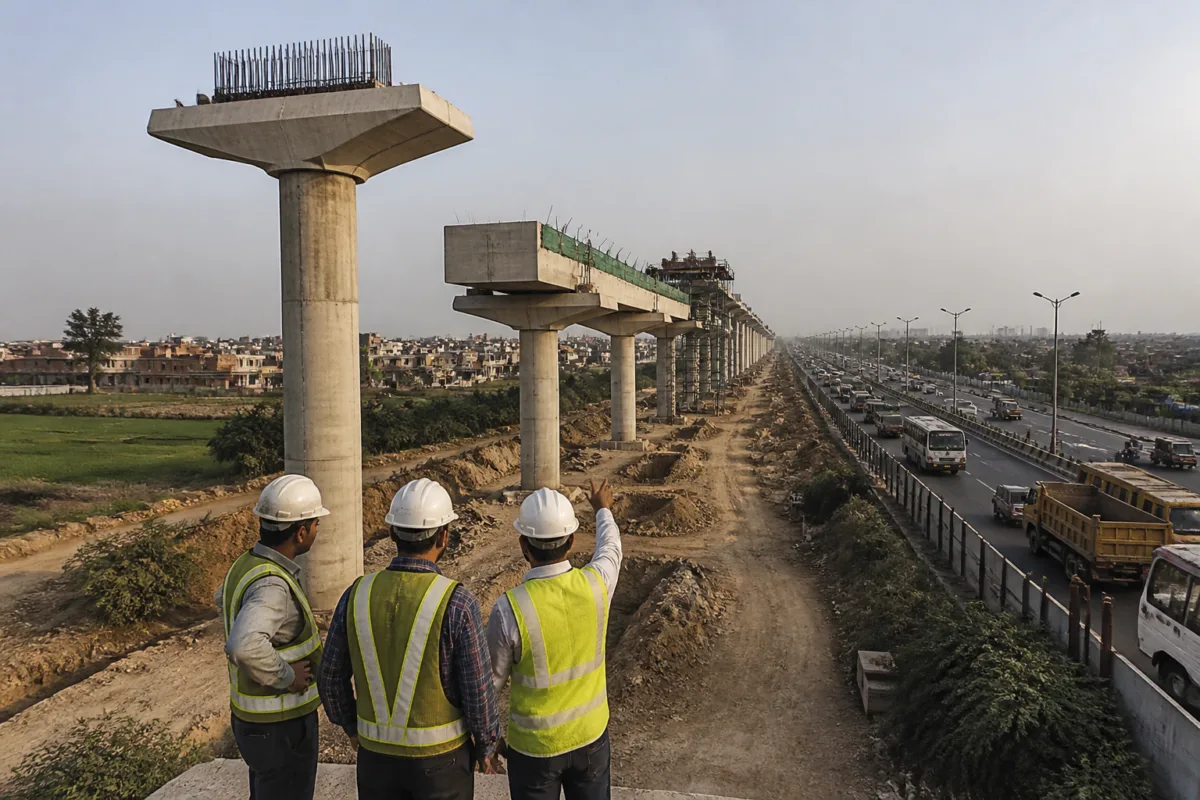
The Delhi–Panipat–Karnal Namo Bharat corridor has received approval from the National Highways Authority of India (NHAI), following clearances from the Centre and the Haryana government, according to The Realty Today. The 136.3-km regional rapid transit corridor is being developed by the National Capital Region Transport Corporation (NCRTC) at an estimated cost of about ₹33,051 crore, with completion targeted for 2030.
The corridor will run parallel to the Delhi–Ambala highway, or NH-44, linking Delhi with Sonipat, Panipat and Karnal. The report said NHAI has granted land-use permission for pier construction, station development and the shifting of high-tension power lines along the route. Preliminary work has begun on an approximately 22-km stretch between Narela and Murthal.
The proposed line will have 22 stations, most of them elevated. Kashmere Gate in Delhi and the stations in Panipat are the stated exceptions. The project’s planned maximum design speed is 180 kmph, while operating speed is expected to reach 160 kmph. Trains are planned at intervals of five to 10 minutes.
Six stations are proposed in Delhi: Sarai Kale Khan, Kashmere Gate, Jharoda Majra, Burari Crossing, Bhalswa and Mukarba Chowk. Sarai Kale Khan is planned as a major interchange, with connections to the Delhi–Meerut corridor, Hazrat Nizamuddin railway station, the Inter-State Bus Terminal and the Metro’s Pink and Blue lines. Kashmere Gate is expected to connect with the Red, Yellow and Violet lines, while other Delhi stations are planned to connect with the Pink and Magenta lines.
In Haryana, the corridor will pass through stations at Kundli, the KMP Expressway interchange, Bahalgarh Chowk, Rajiv Gandhi Education City, Murthal, Bari Industrial and Ganaur in Sonipat district. The proposed connections include the Rithala–Kundli Metro line, the Orbital Rail network and the international fruit and vegetable market.
Panipat is planned to have four stations: Samalkha, Panipat ISBT at Siwah bus stand, Panipat City at Gohana Crossing and Sector-18. Five stations are proposed in Karnal: Ganjbar-Badauli-Kohand, Gharaunda, Karnal Bypass at Madhuban, Sector-7 and the New Bus Stand, or ISBT.
The report said the corridor could reduce the Delhi–Panipat journey from two to two and a half hours by road or conventional rail to about one hour. The journey to Karnal, currently described as taking three and a half to four hours, could fall to about 90 minutes once the corridor is operational.
The Haryana government has included the corridor in its Transit-Oriented Development policy, according to the report. That policy context is expected to support higher-density residential, office, retail and mixed-use development around stations. However, the projected expansion of real estate activity remains an expectation rather than a completed outcome.
Abhay Kumar Mishra, president and CEO of Jindal Realty, said the corridor could improve links between the National Capital Region and Haryana and support residential, commercial and mixed-use development. Vinod Kumar, director and founder of Sky Byte Developers, said faster links to Delhi could increase interest in locations including Sonipat and Panipat.
The project is expected to connect Haryana to the wider Namo Bharat network and, through the Delhi–Meerut corridor, to Uttar Pradesh. Its eventual impact on travel and station-area growth will depend on construction progress, the delivery of planned interchanges and the integration of surrounding urban development.

