


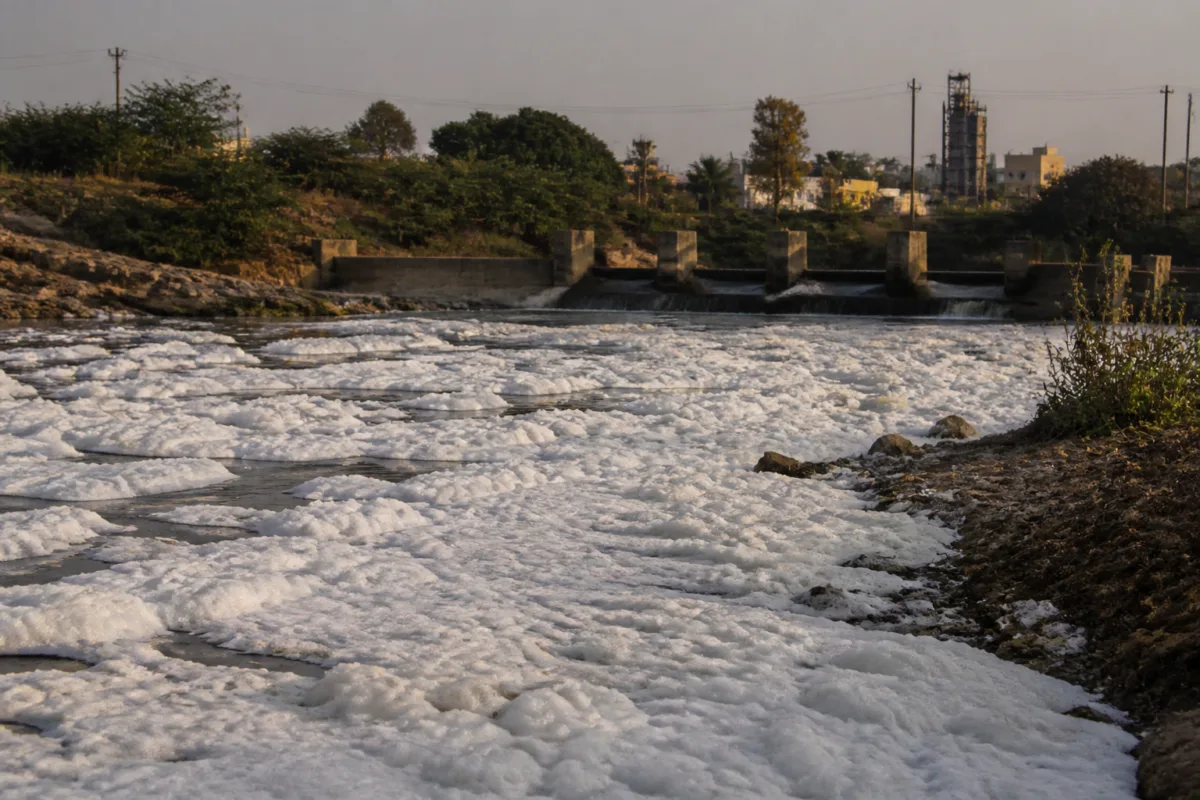
Thick white foam has covered the Manjeera river in Sangareddy district after pollution carried by the Nakkavagu tributary, according to a report by Telangana Today. The incident has renewed concerns over industrial effluent, untreated residential wastewater and the protection of water drawn for public supply.
Nakkavagu originates in the Patancheru area and passes through an industrial belt before merging with the Manjeera a few kilometres downstream of the check dam at Sarafpally in Chowtakur mandal. Telangana Today reported that the tributary carries industrial effluents as well as wastewater from residential areas.
The Manjeera then flows towards the Ghanpur Anicut, a Nizam Sagar project from which the Mission Bhagiratha department draws water for supply to Medak and Kamareddy districts. The report also said that people in Sangareddy, Medak and Kamareddy, along with nearly 33 per cent of Hyderabad’s population, consume water from the same system. The population figure and the reported pollution sources have not been accompanied in the report by laboratory results or an official water-quality assessment.
Sangareddy MLA Chintha Prabhakar called for tests on both the Nakkavagu and the Manjeera to identify the causes of the pollution. He also sought treatment plants along Nakkavagu and at other points where polluted water enters the Manjeera.
Prabhakar asked the pollution control board to take strict action against industries accused of releasing harmful effluents into Nakkavagu. Telangana Today also reported that industries in Sangareddy and beer companies operating along the riverbanks were releasing industrial effluents into the Manjeera. The report did not identify the companies or cite enforcement orders against them.
CPI(M) leader Athimela Manik separately called for residential communities to establish treatment plants for drain water before it is discharged into streams. That demand places the issue beyond industrial compliance alone: the condition of the river is also linked to the collection and treatment of wastewater from settlements along the drainage network.
The reported foam is a visible sign of pollution, but its exact chemical composition and health implications require testing. The immediate governance questions are therefore whether pollution-control authorities have sampled the water, whether treatment facilities exist at the relevant discharge points, and whether industries and residential communities are meeting applicable discharge requirements. Those actions were sought by the political representatives quoted in the report, but no response from the State government or pollution control board was included.
For communities dependent on the Manjeera system, the issue is not limited to the appearance of foam at one location. It concerns the ability of urban and industrial areas upstream to prevent untreated discharges from entering a river that supports regional water supply. Confirmed sampling, publicly available results and enforcement updates would establish the scale of the problem and the effectiveness of any corrective measures.

