


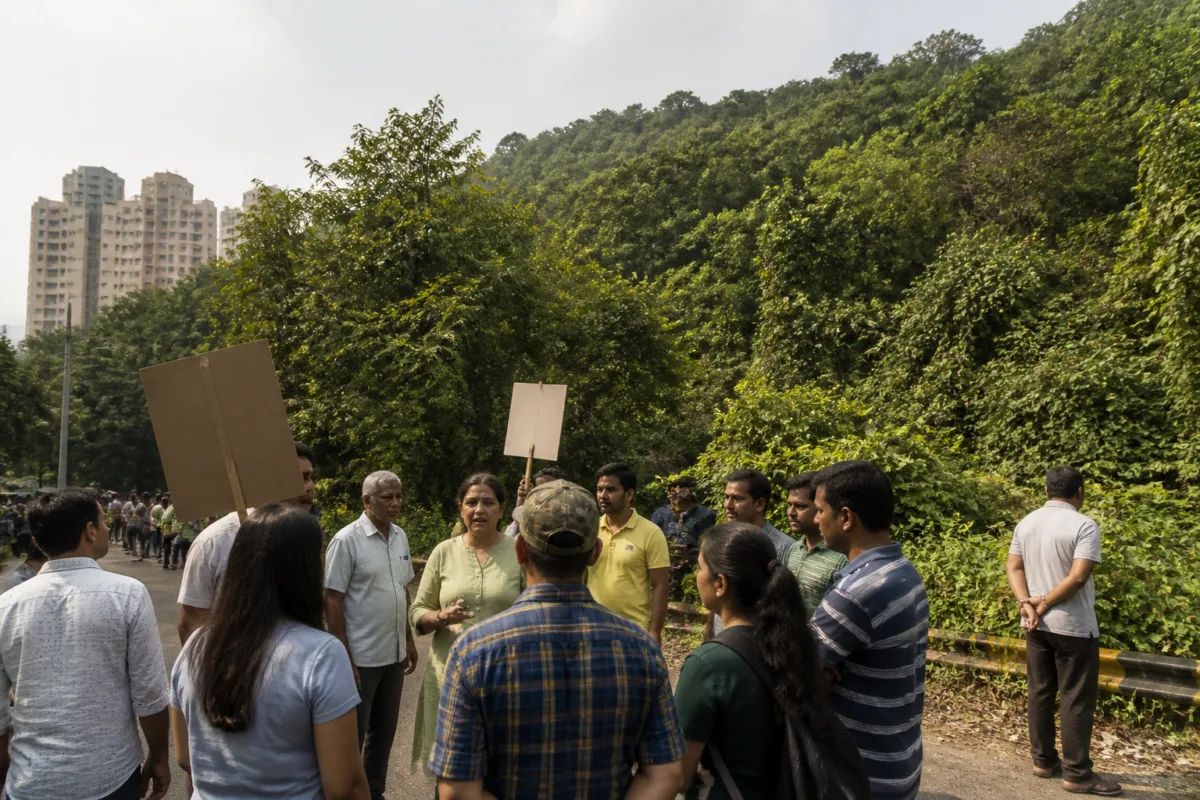
Residents and nature advocates gathered in Mulund on Sunday to oppose a proposed ropeway connecting the foothills on the Mulund side of Sanjay Gandhi National Park (SGNP) to the Taramati Mata Temple inside the protected area. They said the project could increase construction, visitor pressure and ecological disturbance in the forest.
The protest comes as the Maharashtra Public Works Department (PWD) seeks a consultant to prepare a comprehensive architectural design for the ropeway. The tender scope includes identifying possible alignments and station locations, assessing land requirements, studying international ropeway systems and carrying out topographical, geotechnical, geodetic, hydrographic and reconnaissance surveys.
The appointed consultant is also expected to prepare the detailed alignment and system design, identify the origin and destination stations, estimate the project cost and assess its social, environmental, forest and wildlife impacts. The reported scope indicates that the project remains at the design and investigation stage rather than being an approved construction scheme.
The proposed connection follows an earlier demand by Mulund BJP MLA Mihir Kotecha to link the foothills with the temple to promote tourism. Kotecha has clarified that the ropeway would not extend to Borivli and would proceed only after the detailed design is finalised and the necessary clearances are obtained from the Centre’s forest and environment departments.
That requirement places the project’s environmental assessment at the centre of the debate. SGNP covers approximately 103 sq km, and protesters questioned whether a ropeway serving a religious site inside the park is necessary. They also raised concerns that the project could legitimise what they described as an unauthorised religious site and enable further construction within the protected green area.
Nishant Bangera, who participated in the protest, said the temple is in the forest core and is visited by relatively few people. He said a ropeway could involve tree cutting, construction activity, operating staff, offices and higher tourist numbers, with associated waste and pressure on wildlife. These are the concerns raised by the protesters; the PWD-commissioned assessment is intended to examine such impacts formally.
Nature lover Hemant Shringi said the area already faces water shortages and traffic congestion because of dense population and inadequate infrastructure. He argued that adding a ropeway could increase pressure on the surrounding system without contributing to forest restoration.
The project therefore raises two linked planning questions: how access to a religious and tourism destination should be managed inside a protected landscape, and whether transport infrastructure can be provided without expanding the built footprint or visitor burden in the forest. The answers will depend on the alignment, station locations, land requirements and findings of the environmental, forest and wildlife assessments.
No final alignment, project cost or construction timeline is provided in the report. The next substantive step is the preparation of the detailed design and impact assessments, followed by consideration of the clearances that the project proponents have said would be required before work can proceed.

